
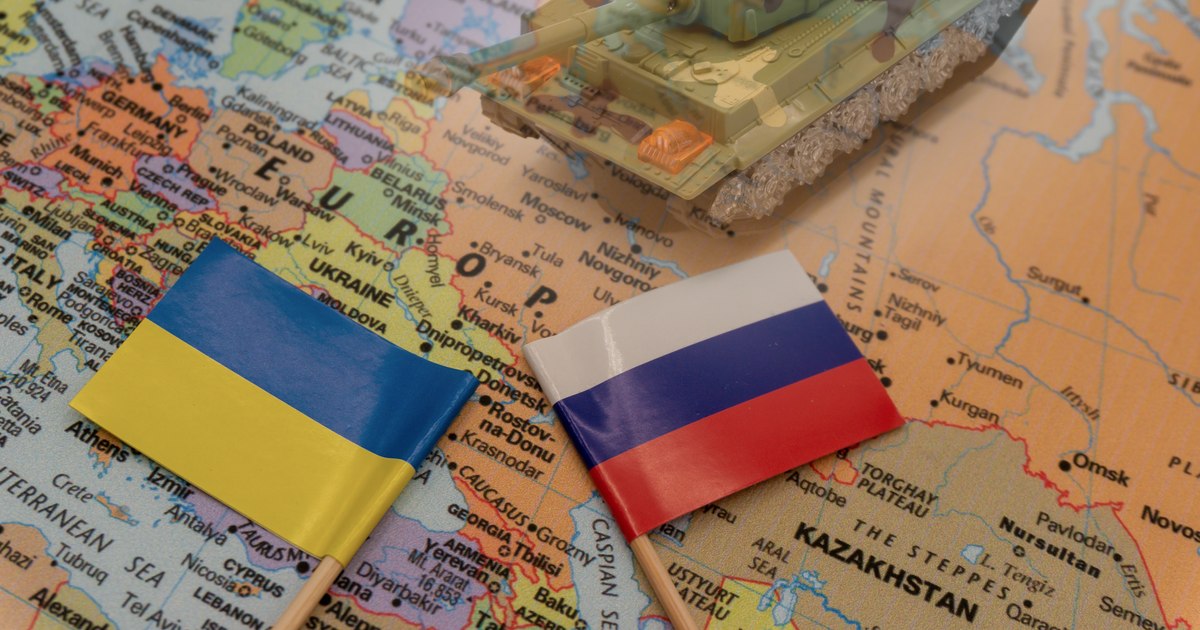
There is talk in the EU of sending troops to Ukraine, although the ammunition promised last year has not been delivered. Security expert Iulia Joja explains why the war industry of one of the world's most powerful economic areas is failing to live up to expectations.
Europe's arms industry has suffered a setback in Ukraine. PHOTO: Shutterstock
Iulia Joja, who teaches European Security at two universities in Washington and at the US Diplomatic Institute, claims that we are in a paradoxical situation, where sending troops to Ukraine is being discussed, but the EU has failed to deliver what it promised in March 2023: one million artillery shells.
A year after the start of the plan, a little more than half of the set amount of ammunition was sent. Ukraine now has big problems with ammunition, as the Ukrainian military is in danger of running out of things to fight with.
Two years into the war, Europe's defense industry is failing to produce enough munitions to help Ukraine cope compared to Russian production and the help Putin is getting from Iran, North Korea and other countries.
“Adevărul” asked Iulia Joja about this failure: is the armaments industry in Europe, which has one of the strongest and most advanced economies in the world, exceeded by the promised ammunition requirement or are we talking about other factors?
“The problem with the defense industry is that adapting or increasing production is strictly a national decision, so it's up to each state to produce more. But the companies, whether they are from Germany, whether they are in the United States, whether they are in Romania, say: “We have no problem increasing production, but we need contracts from our own governments or other entities.” the expert specified.
“We do not have a single defense industry in Europe”
These contracts apparently did not appear. “And so the problem comes back to the national level and we go around in this vicious circle where Germany fails and then we all fail, in order, after Germany, because we don't have, unlike the United States, a single European Union industry.”
Why Germany? Joja claims that Germany is the state with the economy and industry developed enough to be able to increase the production of armaments in such a way as to substantially help Ukraine.
“And yet we don't see any moves in this direction, and not even the intention to make them. I have never seen either the chancellor or others say that they want to increase the production of ammunition, of projectiles for Ukraine, in the conditions in which Russia has switched to a war economy”Joja explains.
She believes that Germany could, with an increase in ammunition production, substantially help Ukraine.
“I don't see things moving in this direction. It seems that Germany's strategic vision stops somewhere at its own borders”she concludes.
The German experts and decision-makers Iulia Joja spoke with told her that, from their perspective, the war is somewhere in eastern Ukraine, thousands of kilometers away from them.
To overcome this situation, in which there is no coordination between EU countries regarding the defense industry, the European Commission has proposed the allocation of 1.5 billion euros from the current EU budget (2020-2027) to finance some companies that manufacture weapons and ammunition.
Moreover, the project provides for the stimulation of European arms production, by setting a target of 40% of arms purchases to be made, by 2030, from EU countries, given that now 78% of purchases are made from outside the EU, especially from the USA.
German and Dutch opposition
The main countries that criticized this proposal were Germany and the Netherlands. As soon as the European Commission came out with this proposal, the representatives of the two countries raised objections, according to the expert: “How do we borrow for defense and how do we give the European Commission power, even limited power, to control our war industry?”.
Joja says that it is not a question of control, but of coordination to ensure increased production, so that Europe has an industry that provides at least part of the necessary armaments.
“It is absolutely natural and if the European Commission does not come to coordinate this production, then no one else will”concluded the expert.
Another reason invoked by the two countries is the refusal to contract a possible credit at the European level for the development of the war industry.
“We have to invest in our own security, given that, once again, we lack a strategic vision regarding Ukraine, which is an urgent one, but also in the medium term we have to consider the perhaps gradual, perhaps radical withdrawal of the US from the European security architecture”says the expert.
“We have to wake up to reality”
The Americans have been saying since the time of Barack Obama that they will focus on Asia and withdraw from Europe.
“It hasn't happened, but we know it's pretty inevitable by 2030 that it will happen”, says Joja. In these conditions, we have two options. “Either Biden wins, who says he wants to help Ukraine, but shows he can't help Ukraine. For months he has been unable to convince his own Congress to continue military aid to Ukraine, which is not substantial aid compared to the US's $860 billion budget. The 60 billion for Ukraine is not an extraordinary effort“, says Joja.
Then there is the Donald Trump variant.
“We know it's the worst case, we don't know how radical the measures will be, but I'm not convinced that if Russia attacks a Baltic country, Trump will jump to the rescue. He does not love Ukrainians, we know that very well, and he does not love Europeans. We know this very well from the first term“, explained the expert.
Joja believes that the Biden option would be the best for Europe, but nevertheless “for the first time we really have to wake up to the reality that we can't rely 100% on the United States of America and that we have to build up our defenses. It would be ideal if it were coordinated by the European Commission, in the absence of someone else and in the worst case scenario, everyone on their own”.
