
Scientists have discovered an ancestor of a species of amphibian, which they have named Kermitops gratus, due to its resemblance to Kermit the frog from The Muppet Show, according to The Guardian.
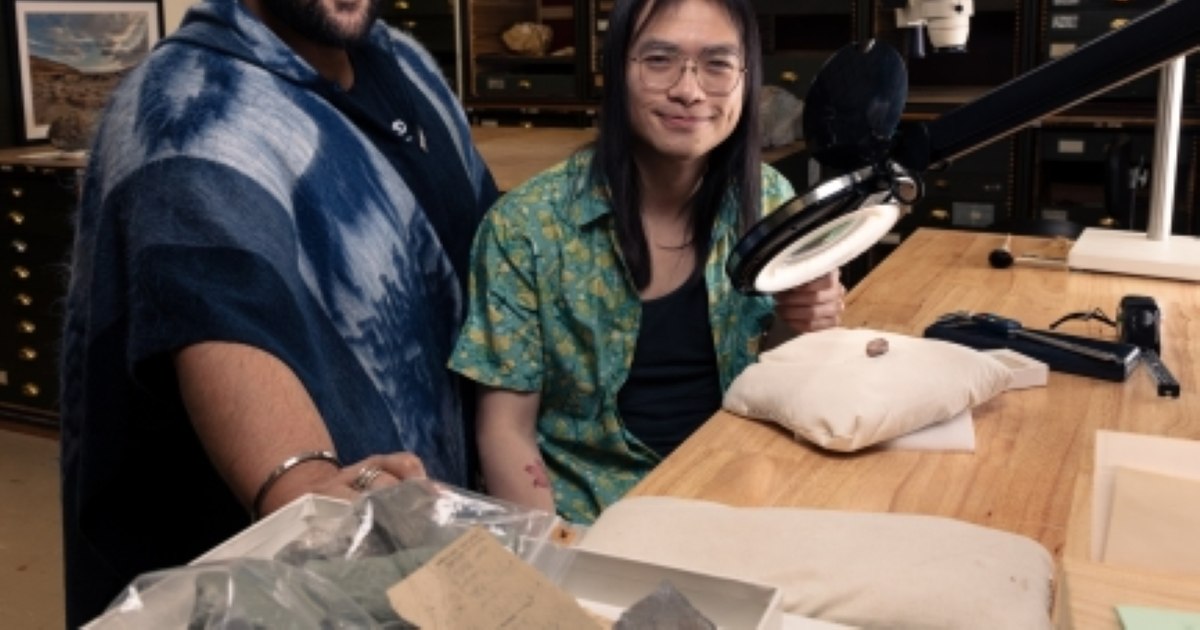
Calvin So and Dr. Arjan Mann, photo Smithsonian Museum
Experts say these prehistoric creatures are among the first true amphibians and represent a key evolutionary step in life's transition from water to land.
Calvin So, a doctoral student at George Washington University in the US capital, told where the name of this amphibian ancestor that lived 360 million years ago comes from.
“Using the name Kermit is significant for how we can bridge the gap between the science presented by paleontologists in museums and the general public. (…) Since this animal is a distant relative of today's amphibians, and Kermit is an icon of modern-day amphibians, this was the perfect name for him“, he explained.
The specimen was discovered four decades ago in an area of Texas, USA, known as the Red Beds, but remained unexamined in the fossil collection of the Smithsonian National Museum of Natural History.
The fossil was finally analyzed in 2021 by Dr. Arjan Mann, a paleontologist at the museum, who described it as “a very well preserved skull”.
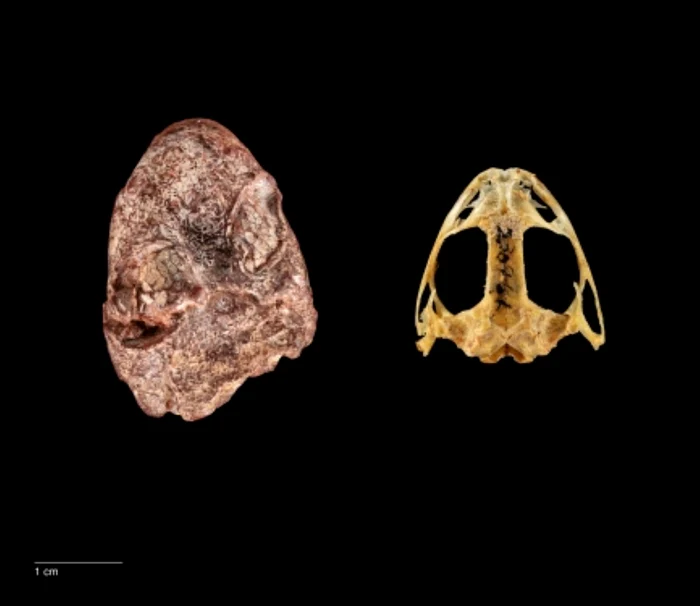
Amphibian fossil, photo Smithsonian Museum
After studying the fossilized skull remains several centimeters long, which show large, oval-shaped eye sockets, paleontologist Dr. Arjan Mann and his assistant, Calvin So, identified the remains as a temnospondyl, a diverse group of ancient amphibian relatives, who lived 360 million years ago.
Analysis of the skull revealed what the researchers described as a “mixture of features,” different from features seen in the skulls of older tetrapods, the four ancestors of amphibians and other living vertebrates.
They said that the region of Kermitops' skull behind its eyes was much shorter than its elongated, curved snout, making it look more like a salamander.They concluded that these skull proportions would have helped Kermitops catch insects tiny, larva-like.
Early fossil preservation of amphibians and their ancestors is rare, making it difficult to understand the origin and evolution of frogs, salamanders, and their relatives.
Dr. Arjan Mann wanted to emphasize that paleontology is not limited to dinosaurs and this field can offer many answers regarding the evolution of life on earth.
“This is an active area of research that many more paleontologists need to dive into again. Paleontology is always about more than dinosaurs, and there are plenty of interesting evolutionary stories and mysteries still waiting to be answered.” stated Dr. Arjan Mann.
