
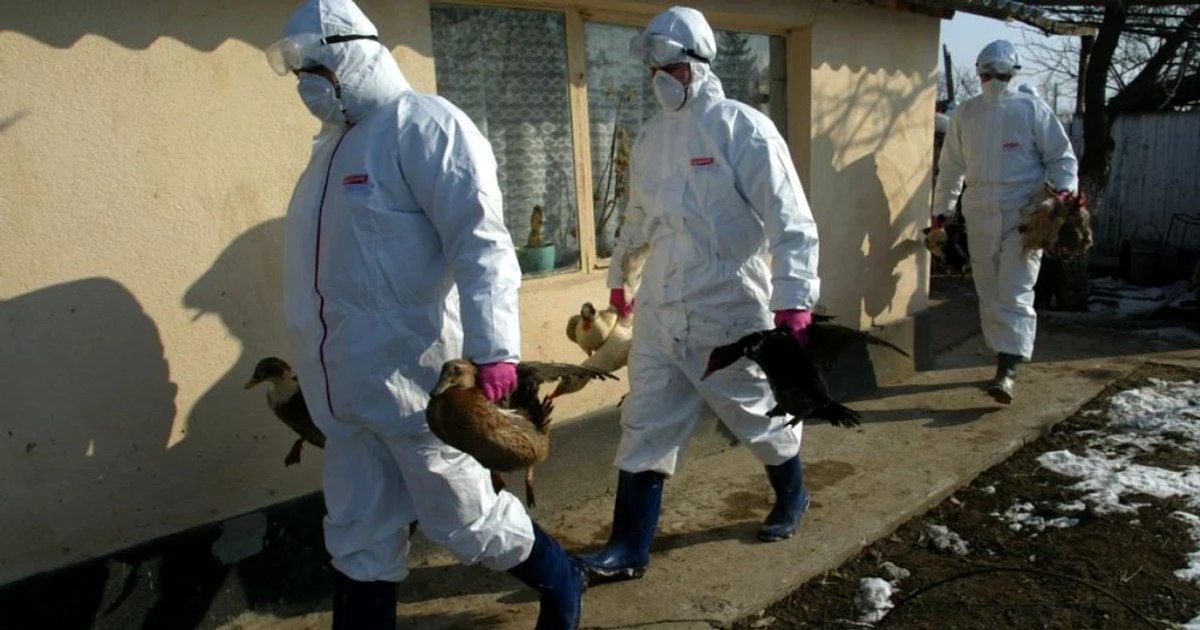
After an American citizen got sick from avian flu that he got from a cow, the European authorities in the field draw attention to the fact that the mutations this virus goes through could make it dangerous for humans. The US Centers for Disease Control and Prevention said genetic analysis showed the virus develops in the mammary glands of dairy cows. As a result, milk should only be consumed if it has previously been pasteurized or boiled. Doctors say that the H5N1 strain is highly pathogenic and the mortality rate is very high. That is, the effects could be ten times worse than those of COVID.
PHOTO Archive
The European Food Safety Agency (EFSA) has warned of a bird flu pandemic if the virus becomes transmissible between humans, as they have no immunity against the virus.
The warning came shortly after Texas reported that the H5N1 strain of the bird flu virus had been detected in a person who raised cattle, Reuters reports. The man is the second case in the United States of being sickened by the highly virulent virus that has spread to dairy cows in five states, federal officials said. Of about 15 people with flu-like symptoms and possible exposure tested, only this worker tested positive. He was told to isolate himself and is being treated with an antiviral. “The patient worked directly with sick cows at a dairy, so the virus was most likely transmitted through that close contact,” said Chris Van Deusen, spokesman for the Texas State Department of Health.
Experts are worried about the growing number of animals infected with this virus.
The second case in two years
So far, only one human infected with bird flu has been identified in the United States, in Colorado in 2022. That person was involved in the slaughter of poultry suspected to have been infected with H5N1 bird flu.
Bird flu is a concern for governments and the poultry industry both because of the risks of disease in birds and because of the possibility of its transmission to humans. The number of bird flu outbreaks has been smaller so far, but the disease has spread geographically, including Antarctica, to an increasing number of mammals, increasing the risk of it becoming a threat to humans.
To date, no human-to-human transmission of the disease has been observed, and transmission of avian influenza from infected animals to humans is quite rare. “If H5N1 avian influenza viruses acquire the ability to spread among humans, widespread transmission could occur due to lack of immunity,” the EFSA showed. 887 cases of human infection with the H5N1 virus were reported worldwide between January 2003 and February 26 this year, the World Health Organization said in its latest report. Of these, 462 were fatal, representing a rate of 52%. Most of the cases were detected in people who were exposed without protection to sick or dead poultry, to live bird markets or to a contaminated environment, the cited source reveals.
50% mortality
Researcher Octavian Jurma explained to “Adevărul” why such a virus would cause big problems for health systems.
“First of all, the H5N1 strain is that it is highly pathogenic and the mortality rate is very high. If in birds we have 90%, in mammals it drops to 50% and it's the same in humans. That is, the effects are about 10 times worse than those of COVID, for example. Let's not forget, though, that throughout history, in various forms, the flu virus has been the biggest killer. Second, we see that the strain has a tendency to adapt to mammals. If last year it decimated the population of marine mammals in South America, now we see that it has adapted and outbreaks have been found among dairy cows in the United States. The problem is that genetically they are much closer to humans than a dolphin, for example. This is where the danger comes from, and it is precisely for this reason that the World Health Organization has sounded the alarm about this virus and demands careful monitoring of the situation. The big problem will really be when the virus adapts long enough to spread from person to person. Then we are talking about a catastrophic situation, most likely a new pandemic. However, in the case of the H5N1 bird flu virus, I repeat, the mortality is higher, and at least in our country, but not only, the medical system will be brought to the ground. As a result, the World Health Organization has asked national institutions with public health responsibilities to monitor the epidemiological situation very carefully. Of course, the first cases of human-to-human H5N1 infection must be detected quickly. Practically, we are talking about a coordinated effort at the international level”, stated Octavian Jurma.
How do we avoid infection?
The researcher also explained what we need to do to protect ourselves from the H5N1 bird flu virus. “First of all, we are talking about common sense measures. That means washing our hands, using disinfectant and wearing a mask when we go to a hospital, for example. I know we don't like it, that we are traumatized, but the rules from the time of the COVID pandemic are holy and applicable here as well. Then the US Centers for Disease Control and Prevention announced that genetic analysis showed that the virus develops in the mammary glands of dairy cows. As a result, milk must be consumed only if it has been previously pasteurized or boiled. The same must happen if we want to eat eggs, they must be cooked. Anyway, it must be said that for now we have a fairly low risk of an H5N1 pandemic, but there remain great reasons for concern because, I repeat, it would be much more severe compared to COVID, with a much higher mortality.” emphasized Octavian Jurma.
Professor Paul Digard, from the Department of Virology at the University of Edinburgh, also explained that it is not excluded that the bird flu virus may change in the future. “Just like with COVID, H5N1 is constantly changing, it never stays put. You can't say it's never going to adapt, it's never going to change in a way that causes the next pandemic, but I think it's a very low risk right now,” Digard said.
Monitoring of the epidemiological situation, mandatory
For his part, Professor Emanoil Ceauşu declared for “Adevărul” that regarding H5N1, at this moment, we should not panic, but it is mandatory to supervise the situation from an epidemiological point of view. “The bird flu virus has long passed to mammals and not much has happened to humans. Of course there are cases, but some isolated ones, for now, fortunately. It is my opinion that human infections with this virus are rarer because we do not have the necessary receptors for this strain. Of course, the European authorities in the field feel obliged to give warnings, but my opinion is that this virus has been among us for decades and has undergone mutations that have not significantly influenced us. That doesn't mean something can't happen in the future with this virus. It is precisely for this reason that we must be careful, the situation must be monitored. However, we live in an ocean of viruses, attention must be increased. In the end, we have to learn how to live with these germs with the help of preventive measures when necessary.” stressed Professor Emanoil Ceaușu.
We remind you that, in October 2005, the H5N1 variant of the virus arrived in Romania, being identified in birds from Ceamurlia de Jos, Tulcea county. Romania was, moreover, the first European country where the presence of this virus was officially confirmed.
