
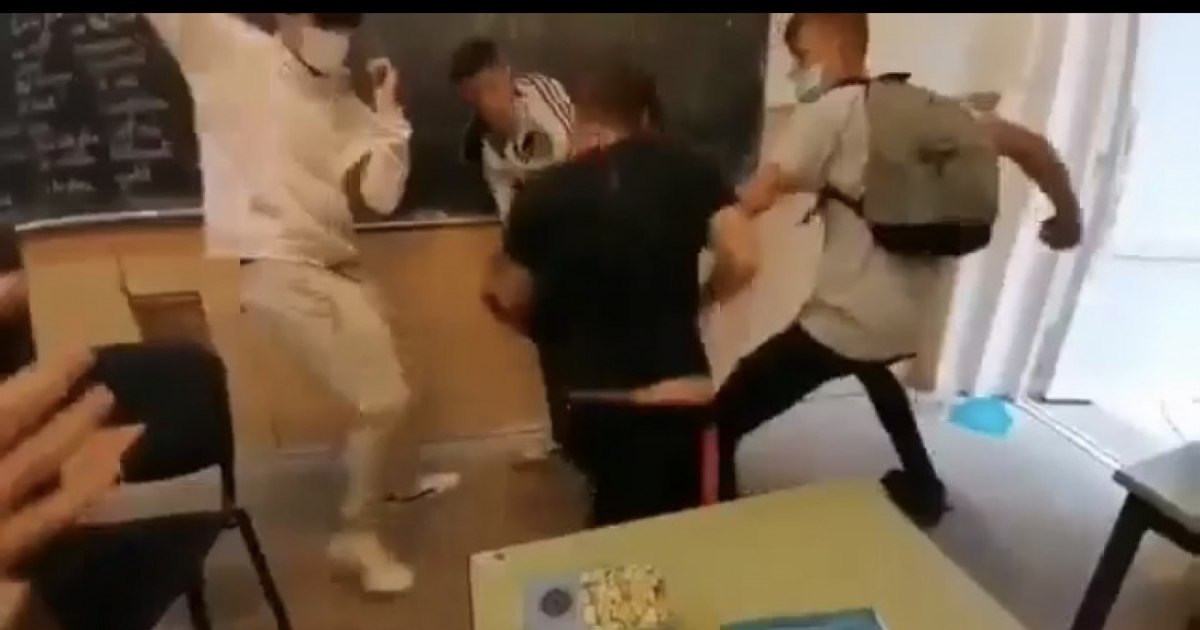
The National Plan to Combat School Violence was put up for public debate the other day, and the document provides for a series of measures aimed at stopping the phenomenon that has almost become a national sport. Among the most important decisions are equipping educational units with video and audio surveillance systems, increasing the number of school counselors, but also online guides addressed to parents and students.
Last December, a student from the “Nicolae Titulescu” School in Capital was raped in the school toilet by an older colleague. In February this year, several students from the “Dimitrie Leonida” High School, also from the Capital, arrived at the hospital intoxicated with paralyzing gas sprayed at them by a student victim of bullying. And the other day another was stabbed with a machete in the courtyard of the “Iuliu Maniu” Technological High School. However, there are many more cases of aggression. This is the context in which the authorities decided to take measures: the Ministry of Education put the National Plan to Combat School Violence into public debate.
Among the proposed measures are equipping schools with audio-video systems, purchased from non-refundable funds, the establishment of online or offline libraries containing guides for parents, students and teachers, extracurricular activities for the emotional development of children, coordinated by teachers, school counselors or volunteers, but also an annual contest “Take a stand, say STOP violence!”. The plan also regulates the notion of violence by a teacher against a child and explicitly defines the forms of abuse that take place in schools.
The video surveillance system, a decision at the limit of the law
One of the measures proposed by the ministry refers to the placement of surveillance cameras outside schools, in corridors and including in classrooms, laboratories, banquet halls, dining rooms, etc. It is an extremely controversial proposal that has given rise to heated debates among teachers, parents, but also specialists in privacy and personal data protection. Cosmin Andreica, head of the Europol union, believes that the surveillance system will prevent many acts of aggression and violence.
“From a policeman's perspective, I can tell you that these cameras are very effective. First, it discourages the behavior of certain students. Some will not care about them, but others will. There are many acts that some students commit knowing that no one sees them. The fact that you slap a colleague, the fact that you spit on a colleague, took his sandwich, threw it on the floor, then put it in another slice of bread, then in your bag and then… what – we will laugh at him for eating from the floor… There are many situations like this”exemplified the policeman.
Therefore, the cameras would be useful, he says, but the policeman wonders, however, what guarantee the legislator and the educational institution can offer that these images will not end up in the wrong hands.
“From the desire to prevent certain facts, we could reach other situations where, for example, the child Cornel of the politician Georgel forgets what he allows himself to do or forgets what he did. He allows himself to sit with his feet on the table. For example, if the same procedure as we have with the police body-cam were used, those cameras record audio-video and can only be accessed in case of a criminal complaint. And only for a certain event and only by certain designated persons. The circuit is closed. There is no possibility to steal some images and have them published later“, stated Cosmin Andreica.
However, there is opposition from teachers, on the one hand, but also from some parents and students. “However, there were many students who said they wanted those rooms, because they would feel protected. As for the teachers, they fear that they will be evaluated, that what they do in class will be seen, that they will be late for classes, etc.“, considers the policeman.
However, we are also dealing with the other side of the coin. While many teachers oppose the installation of surveillance cameras, others take the decision far too seriously. This is the case of the management of Secondary School No. 30 in Timișoara, which decided to place the system including in the toilets. More precisely, the rooms are located in the area where students wash their hands, not in the rooms where the toilet bowls are. The decision, although most likely well-intentioned, sparked a local scandal. “I wanted to see what was going on. We were thinking that we would be congratulated”the school principal testified.
“We created discontent. In the idea that your offspring can be found doing everything the regulation does not allow. During every break, the toilet has become a place where girls put on make-up, a place where they smoke, a place where they dance and the girls who are there have a very inappropriate vocabulary. The same thing happens in the boys' toilet.” the director explained her decision. The devices have not yet been put into operation, but the outraged parents have asked the County School Inspectorate for an explanation.
Students with problems at home are aggressive at school
The National Plan to Combat School Violence provides another important measure, namely the increase in the number of school counselors until reaching a norm of a maximum of 500 students, a maximum of 500 students and preschoolers or a maximum of 300 preschoolers, annually.
“These children, almost half of them, need counselors,” the headmistress of a technological high school in the capital told us. “If a child has problems, they should be sent for counseling, because maybe the parents don't have the opportunity and maybe some things are going wrong. We, the teachers, especially the directors, know the problems that the children have and we can direct them to counselling. Unfortunately, we have a lot of traumatized children, with big family problems, who try to resist school through aggression. That's why I'm telling you that yes, more counselors are needed”the teacher also specified.
The director Dana Bobocea, from the “Grigore Moisil” National College, shares the same opinion, who told us that in the school there is only one counselor for every 1,000 students. “Don't face it. We should have more. Just as a teacher has an average of 300 students because he has 12, 14 classes each with 25, 30 students, so an average of 300 students, I think a counselor can manage the problems of 300 students. Or manage problems at a certain school level: preschool, primary, secondary, high school. It is not okay for a school counselor to handle from class zero to class 12th. Because children's problems are different from teenagers' problems”the teacher declared.
How effective will these proposals be? “It depends from school to school. In my high school, I'm convinced that the plan will work”, Prof. Dana Bobocea, director of the “Grigore Moisil” National College in the capital, told “Adevărul”. She added that the well-being of the student is essential in this process of combating violence.
“We are actually co-opted into an international team that will participate in the Paris Summit in the context of Romania's accession to the OECD. One of the topics of discussion is the very state of well-being within the school. We have podcasts that we do with educational actors, with people from the Ministry of Education, from school inspectorates or from the local community through which we try to identify solutions regarding the promotion of well-being at school”.
The teacher also explained to us what, exactly, this concept of well-being means, which, at first glance, seems quite abstract. “Wellness, in my view, is doing your duty as a teacher, providing your child with information that is scientifically correct, age-appropriate, and discipline-appropriate. Well-being means constantly communicating to him where his purchase level stands. It means not to humiliate him, not to discriminate against him. But don't humiliate him by telling him he didn't study today. You have a grade of 4 because… and you list the reasons why it was graded that way”the teacher explained.
According to the data presented by the Ministry of Education, in the last school year approximately 5,400 cases of violence were registered, 73% of which were personal attacks.
According to the most recent statistics, in Romania, half of the students suffer from threats, humiliation or physical violence, and 81% witness bullying situations.
