
Harvard astrophysicist Avi Loeb believes it's time for scientists to overcome the prejudices that accompany alien theories.
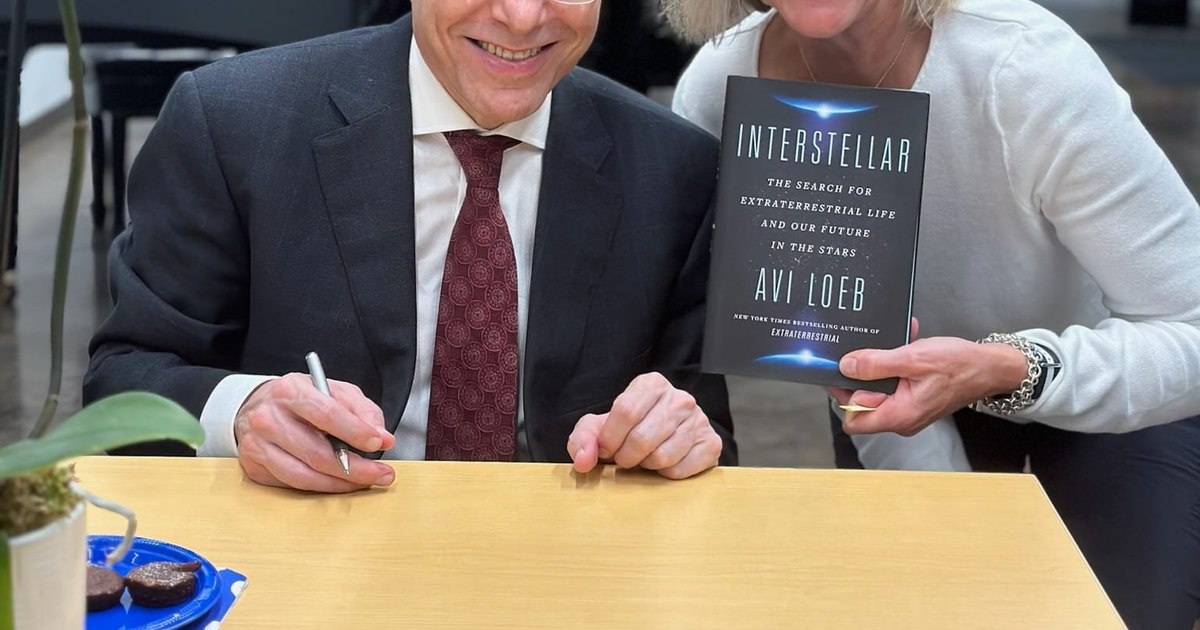
Avi Loeb, at the launch of his book, with an admirer, facebook photo
In recent years, the professor has scandalized the world of astrophysics, arguing that the idea that an extraterrestrial intelligence is behind two recent discoveries is reasonable. Several of astrophysicist Avi Loeb's colleagues are outraged. “Loeb is on a mission to find aliens. He thinks he sees something in the data that hundreds of experts don't, and he wants you to believe it too.” Steven Desch, an astrophysicist at Arizona State University, told Business Insider.
Avi Loeb claims that while no evidence of aliens has yet been found, this may be precisely because scientists have been so reluctant to look for them.
“Obviously, they will never have extraordinary evidence if they don't look for it. The question of whether we are alone and whether we actually have a partner out there, a neighbor, is perhaps the most important in science“, he said.
While the scientist's claims have upset many of his academic colleagues, they have earned him a growing following among ordinary people, and his theories are the subject of an upcoming Netflix documentary.
Among the biggest admirers of his work are several tech tycoons, who have begun funding Avi Loeb's most ambitious work to date, Project Galileo. This is a research program dedicated to the search for evidence that we are not alone in the universe.
“I think sometimes it goes a little too far,” said Charles Hoskinson, a cryptocurrency mogul and mathematician. But this boundary-pushing is exactly why he supported Loeb's research. “That's what happens when you take a very passionate, very aggressive type A personality who is constantly working and thinking and who wants to be right. You have to accept that from time to time he will make bold statements” – said Charles Hoskinson.
Oumuamua changed his view of the role of science
For decades of his 40-year career in astrophysics, Avi Loeb showed no interest in extraterrestrial life. He published theoretical papers on black holes, exoplanets and other cosmic events, which won him the acclaim of distinguished astrophysicists and earned him prestigious appointments, including a chair at Harvard and an advisory role at Breakthrough Initiatives, a space research body who has ties to Mark Zuckerberg and the late Stephen Hawking.
Then, in 2017, a strange object was discovered floating in our solar system. “The 400-meter-long object traveling through the Milky Way” was discovered by scientists at the University of Hawaii, who named it 'Oumuamua.
It was the first time scientists recognized an object from interstellar space visiting the solar system. The discovery was revolutionary, but also baffling. 'Oumuamua had a very unusual shape and did not have the dust, ice or tail characteristic of a comet. But it accelerated as it left the solar system, which is typical for a comet. Physicists were perplexed.
Several explanations have emerged. Steven Desch Desch and his colleagues at Arizona State University suggested that 'Oumuamua was a piece of a Pluto-like planet. Another team said the object was a new type of comet, with an invisible tail made of vaporized hydrogen.
Avi Loeb disagrees with this interpretation and has laid out his arguments in numerous articles published over time. His hypothesis is that 'Oumuamua was, in fact, the first example of extraterrestrial technology spotted in our solar system and that it could be “a piece of solar cloth from an alien spacecraft”.
Avi Loeb's theory was picked up by the international press and quickly drew criticism from his peers.
“It is not a conclusion. It's more like: let's imagine what's possible and enable it! Let's not dismiss it prematurely“, defended the astrophysicist.
Academic convention requires scientists to support their theories with a solid evidence base. Many believe that before sharing ideas widely, it is right to validate such ideas with colleagues. Because he made his ideas known without taking into account the validation of the scientific environment, Avi Loeb passed from “one of the most respected, quoted and loved astrophysicists” to one who “does harm to astronomy”, Hoskinson said. This, however, did not discourage him, but, on the contrary, motivated him to continue his research
“I have written more than 1,000 papers in theoretical astrophysics. As I got older, I realized that it is more important to pay attention to evidence than to theoretical opinions and ideas.” he said.
In 2021, it announced that it had secured $1.75 million in funding to launch the Galileo Project, whose goal is to search for signs of extraterrestrial technology on and near our planet.
Evidence of extraterrestrial existence on Earth
Bioastronomers use observatories like NASA's James Webb Telescope to look for “chemical signatures” of life on exoplanets, planets outside our solar system. NASA is also sending probes to see if there are signs of life inside the solar system. Other scientists are looking for “technical signatures” such as radio signals that could lead to other civilizations.
What sets Loeb apart is that he looks for evidence that he thinks might actually exist “in our yard”, on Earth, or around the planet.
“If any space junk was sent by other civilizations that preceded by, say, a billion years, that's enough time to cross the Milky Way with the kind of spaceships that we've launched back and forth . (…) Maybe that stuff has reached us by now and is moving too slowly to escape the Milky Way. So they will remain bound and continue to accumulate over time, just like plastics in the ocean.”
he added.
Most people believe that evidence exists, but it is kept secret
A 2021 poll by the Pew Research Center found that about half of Americans believe the US military has spotted evidence of alien technology.
The US government's All Areas Anomaly Resolution Office (AARO) said last year it was looking into more than 801 UAP events, meaning an object, airborne or otherwise, that was not easily identifiable or acted in a way that did not can be readily explained within the current understanding of technology. Because UAP data is collected as part of military operations, these reports are often kept secret, which only fuels conspiracy theories, Avi Loeb said.
He believes that to best serve the public interest, research should be done by scientists. They should collect independent, high-quality data that can be shared openly without concern for military defense. And now they have the technology to do it: high-quality telescopes and artificial intelligence that can sort through hours of video footage.
$5 million for the Galileo Project
Avi Loeb doubts that he will be able to get the support of conventional funding agencies for his research. He has, however, so far managed to raise about $5 million for the Galileo Project, most of which has come from private donations from multimillionaires, which he says were unsolicited.
With the publication of his book “Extraterrestrial: First Sign of Intelligent Life Beyond Earth”,
in 2021, he attracted the sympathy of many fans. One of them was Eugene Jhong, a philanthropist and former technology executive. In an email, he told BI that he likes to fund controversial researchers.
Avi Loeb said $250,000 from Jhong appeared in his research account months after his book was published, with no explanation and no expectations. This became the first seed money of the Galileo Project.
“I had never heard of him, and he gave the money simply because he was inspired. He heard me talking on a podcast. After we met on Zoom, he gave another million dollars,” he said.
Another tycoon attracted to extraterrestrials is Frank Laukien, the CEO of the American manufacturer of scientific instruments Bruker Corporation, who became a co-founder of the Galileo Project.
The Galileo project also attracted prestigious experts. Its advisory board includes scientists such as Charles Alcock, former director of the Harvard and Smithsonian Center for Astrophysics and Seth Shostak, senior astronomer at the SETI Institute, Rizwan Virk, founder of MIT's Play Labs technology accelerator, and Stephen Wolfram, founder and CEO of the multinational technology computing company Wolfram Research.
In search of a meteorite that fell in 2014
Avi Loeb established an observatory on Harvard University property that tracks hundreds of thousands of aerial objects using visible light, infrared, sound and radio. The data, which has been collected since November, is fed into machine learning software that figures out how to differentiate unusual objects from birds, balloons, drones, planes or satellites. A second observatory for this activity is being assembled in Colorado. Each costs about $500,000, Loeb said.
One of Project Galileo's biggest efforts might also be its most controversial: a boat trip near Papua New Guinea in search of a meteorite that crashed to Earth in 2014.
The expedition, which cost $1.5 million, took place in 2023. Dredging the ocean floor with a magnetic sled, the team recovered what they believe is material left behind by the interstellar object, small metallic balls that they called spheres “BeLaU”.
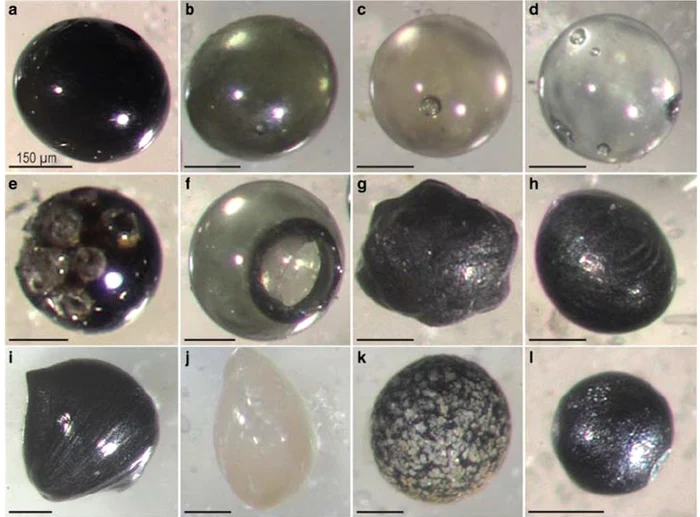
Microspheres discovered within the Galileo Project, Facebook photo
Loeb and his colleagues' analysis, conducted with Stein Jacobsen of Harvard, a professor of geochemistry, suggests that they were indeed made of strange materials. These were particularly rich in beryllium, lanthanum and uranium as well as heavy metals and contained some special isotopes.
“They had a composition of elements from the periodic table that looked very different from materials on Earth and Mars, the Moon or asteroidsLoeb said.
The paper on the BeLaU spheres was published in August 2023 on the online forum arXiv, where scientific articles are shared before undergoing a rigorous peer review process.
As with 'Oumuamua, this work attracted media attention and provoked negative reactions from his peers.
