
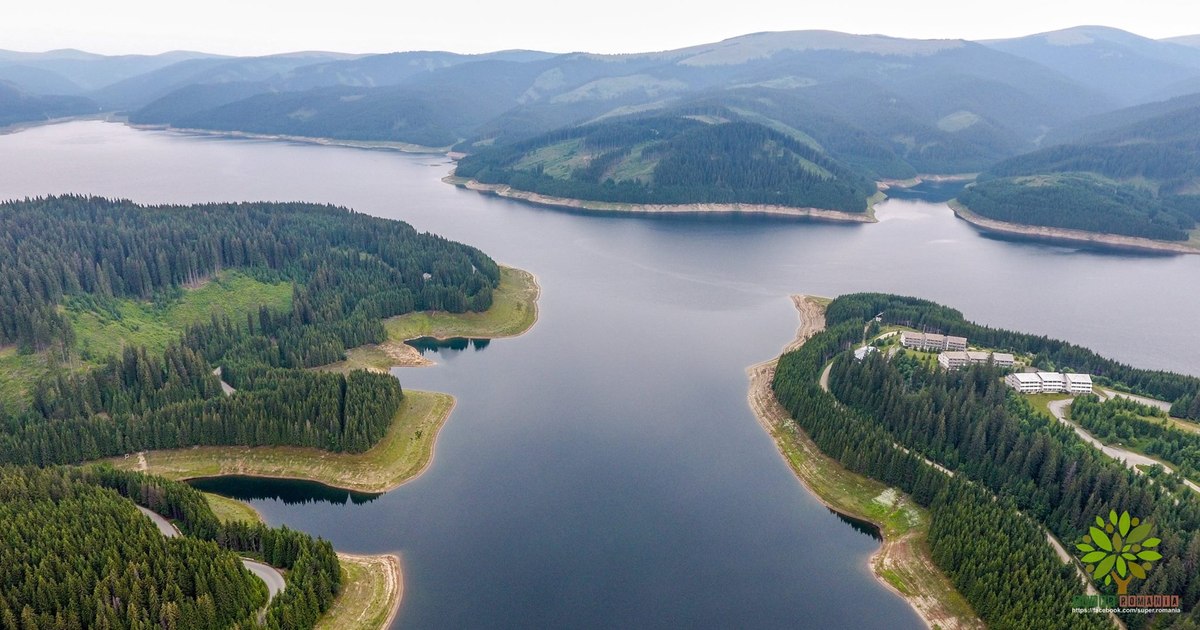
Voineasa (Vâlcea) is the oldest settlement on the Lotru Valley. Most Romanians remember the mountain resort from the years of communism, when it was the favorite place for spending free time, for rest, but also for treating some ailments.
Vidra Voineasa resort in Vâlcea county aerial view Photo Water and its friends
Voineasa (Vâlcea) has more than half a millennium of documentary attestation, since the time of Neagoe Basarab, through a charter that established the border between Wallachia and Transylvania on the summit of the Lotrului Mountains.
The resorts in the Lotrului Mountains, Voineasa and Vidra, which have the same territorial administration, began to emerge after, in the 60s, the first workers sent to the picturesque pastoral settlement appeared “to turn the stormy waters of Lotr into light”. This is how the writings of the time recorded, referring to the most important energy development on an internal river of Romania.
Ciunget has remained to this day the country's largest underground hydroelectric plant. Without the hydropower development of Lotru, the tourist activity would not have started in the infrastructure that served as the organization of the hydrotechnical construction sites.
In this area of Vâlcea County, the mountains were literally moved, hundreds of kilometers of underground tunnels were built, roads were laid out among rocks, lakes and reservoirs, nature being shaped by man in an amazing way (SEE PHOTO GALLERY).
And while other rural areas were depopulating massively during that period, Voineasa (Vâlcea) was becoming a command center for the construction of some of the most spectacular buildings, even for today.
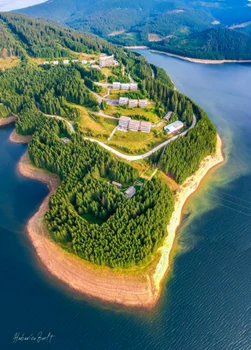
Image 1/38:
Vidra ghost resort – Voineasa on the shore of Vidra Lake in Vâlcea county Photo Szolt Habarics
The hydrotechnical construction sites that gave birth to resorts
The locals, people who until then had only dealt with raising animals – cattle and sheep – or carts “they had worked with the goat through the forests of Lotru”, they slowly became certified builders. The settlement was quickly populated, with people coming from all over the country.
Then the first blocks were built, as well as hundreds of houses, giving meaning to a saying from the elders: “Whoever comes and drinks water from Lotru, stays on Lotru”.
In a delightful semi-alpine landscape, the development of some colonies began, gradually transformed into resorts, the blocks and villas becoming accommodation units. For a while, tourists and builders coexisted together.
Contrary to expectations, the first tourism facilities appeared first at Vidra (elevation 1,300 meters) and then at Voineasa (elevation 600-800 meters). And if in 1981 there were only 100 places to stay in the tourist circuit, seven years later there was talk of a capacity of 1,800 places: a six-story hotel, three mini-hotels and five villas at Vidra (680 places), as well as six large hotels and 14 single-family villas (over 1,000 places, to which another 500 were added in the agro-tourism guesthouses).
This demonstrates the incredible development that tourism has experienced in this area, in a relatively short time. In Voineasa, before 1989, international scientific, cultural and sports meetings were organized.
Paradise lost and thousands of accommodation places “erased from the pen”
Today, however, none of the incredible tourist base received as a gift, after the Revolution, by the trade unions is working anymore. At the end of last year, 2023, the lock was placed on the last and largest accommodation unit that used to belong to the state – Hotel Lotru in Voineasa. In recent years, moreover, it has operated only seasonally, in a closed regime, through the Pension House.
The same happened at Vidra-Voineasa, which many tourists categorize as a “ghost resort”, being often compared to Chernobyl.
On Lacul Vidra, in the glory years, the National Olympic Kayak-Canoe Team trained and camped summer after summer, led by the great rower Ivan Patzaichin, multiple gold laureate at the Olympic Games.
On the shore of this lake, Ceaușescu wanted to develop a resort that would host the Winter Olympics. Unfortunately, everything that started remained frozen after 1989.
Plans and places frozen in time
If the plans had continued, Vidra would have had every chance to become the most beautiful resort in Romania. The area itself has a huge potential, from many points of view, even more than that of Valea Prahova – here, for example, the snow persists for the longest time, even half a year. This year, for example, the slopes closed at the beginning of April, while the ski season opened at the end of November.
It was desired to build in these places ski areas like in the West, with tens of kilometers of slopes, which would be connected with those in Parâng and Șureanu mountains. The idea was also taken up after 1989, when the development of ski areas in the areas of Vidra, Obârsia Lotrului and Voineasa was discussed again.
Through a project, the beneficiary of which was the Institute of Business and Marketing for Tourism Bucharest, it was proposed to place 13 cable cars mounted on the surrounding mountains: Fratoșteanu, Petrimanu, Puru, Mioarele, Mereuțu, Ștefanu, Cărbunele.
The total capacity of the potential of these domains was 14.1 kilometers of slopes that could serve 10,475 skiers/day at Obârsia Lotrului and 12.5 kilometers for 5,645 skiers/day at Vidra. It was believed that the mountain resort can be sized to accommodate, in perspective, 7,500 places at Obârsia Lotrului and 4,500 places at Vidra, so a total of 12,000 places only in the Vidra-Obârsia Lotrului area.
Only 1,200 accommodation places out of a potential ten
Finally, in 2012, the Ministry of Tourism inaugurated only the Transalpina Ski Area, between Vidra and Obârsia Lotrulu, designed after those in Tyrol.
It has seven slopes with a total length of 9 kilometers, of which the longest is over 2 kilometers, equipped with snow cannons and cable transport facilities – gondolas, chair lifts and ski lifts.
The altitude at the base of the slopes is 1,350 meters. From here you go up the mountain, with the gondola, up to 1,800 meters, from where you continue with the ski lift up to 2,000 meters altitude, on Bora Peak. The resort offers landscapes like no other in the country, thanks to Lake Vidra at its base.
Thanks only to the private sector, from Voineșita (the first locality of the Voineasa-Vidra resort) to Obârsia Lotrului (that is, from one end of the settlement to the other), approximately 1,200 accommodation places are available today, i.e. less than a tenth of the huge potential of the area, in 47 guesthouses/cottages/villas/hotels certified by the Ministry of Tourism, or in the homes of the locals.
“He was joking…”
“Everything closed. Even the villas in Voineasa or Vidra, which were still functional, are no longer open. From around 2010 onwards the banter started. They had managed to modernize 24 of the rooms in Lotru, to bring them to a three-star standard, and they dismantled those”admitted the mayor of Voineasa, Gabriel Năstăsescu, for “The truth”.
Even the ski slope and the chair lift in the area of the Vidra villas were left in disrepair. “We, as an administration, have no power, because it is about union heritage and legislation that no one wants to change. I brought all the televisions, nothing connects… I notified the county authorities – the Prefecture and the County Council – about their closure (no – of accommodation units with 1800 places)… The only lever we have at hand is just let's charge them 500% in tax, because they leave them in ruins… They agreed to pay”the mayor of the resort also specified.
“Hunters” from all over the world, fascinated by the area
However, beyond the desalination that has engulfed many resorts in Romania, no one, absolutely no one has been able to take advantage of the beauty of these places, not even the wood thieves who have left entire mountains bare in the area.
No wonder, even in the current conditions, that interest in this area remains extremely high. Chinese, Turkish, Italians, including the parents of the well-known artist Laura Pausini, but also representatives of other nations, have shown interest in investing in the area over the last decades.
Moreover, all those who arrive in these places liken the landscapes to those of Switzerland, Austria, and the Alps in general. And it does not necessarily refer to the areas inhabited by the natives, where there is also the administrative headquarters (heart) of the locality.
A large locality in the state – 5th place nationally in area
Voineasa (Vâlcea), on the Lotrului Valley, is one of the largest settlements in Romania in terms of extent – the fifth place nationally, with approximately 461 km², most of which is occupied by the mountain massifs. Vidra and Obârsia Lotrulu also belong to Voineasa.
The Lotru highway has two national roads DN7A and DN67C Transalpina, two county roads DJ701D on Valea Latoriței and DJ105G on Valea Voineșita, a strategic road (or the Royal Road). These roads that meet at Obârsia Lotrului will be connected to the IV PanEuropean Corridor which will become the most important access road that will connect the west of the country with Bucharest and Constanța.
Five star nature
Due to its geographical location, the Voineasa mountain resort benefits from all the advantages of a complete tourist area: mountainous relief with high peaks that reach up to 2,300 meters altitude, deep valleys, abundant natural resources, lakes and rivers with crystal waters, extensive forests, a diverse and rich flora and fauna and a mild climate throughout the year.
Among the special attractions of the area, we would also like to mention the trout fishing – indigenous, rainbow and fountain – in the Lotru, Latorita, Voineșita rivers, or in the Brădișor, Petrimanu, Galbenul and Vidra lakes (to mention the most popular ones), as well as hunting in the surrounding forests for wild boar, deer, deer, bear, hen or mountain grouse. The settlement is also a destination for hiking, recovery, rest, adventure or sports.
The resort of national interest, located approximately 80 kilometers from Râmnicu Vâlcea, in the northern area of Vâlcea, borders four counties: Gorj, Hunedoara, Alba and Sibiu.
Here is a spectacular skiing area in Romania – Transalpina Ski, one of the most beautiful and largest reservoirs and dams in Romania – Vidra (1,240 hectares), as well as part of the famous Transalpina mountain road – the most tall building of this kind in the country.
Once upon a time, the area also had a Mocăniță, whose route was built after the First World War and which went from Voineasa to Gura Lotrului-Brezoi, but was abolished after the Second World War.
There are many stories circulating in the area related to this and the gold that used to be extracted from the mountains here, or about outlaws and other mysteries.
