
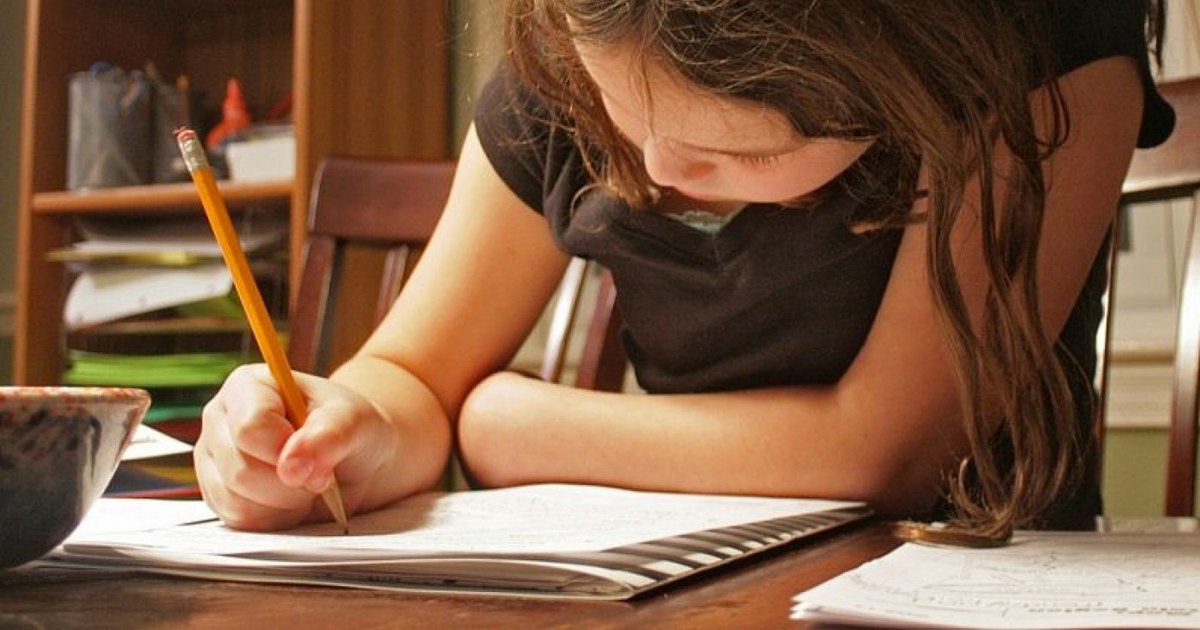
Students in Poland will no longer receive compulsory homework. Extra lessons have been eliminated in the junior grades, and middle school children will only work in free time if they want to. It is just one of the measures by which the authorities are trying to reform the education system after parents denounced chronic fatigue among schoolchildren. Could this be a model that could also be implemented in our country? Yes, say the parents.
Romanian students, burdened with homework, have no free time at all. Photo source: archive
The government of Poland issued a decree by which compulsory homework was abolished in the lower grades, and in the case of the higher grades it became optional. Specifically, teachers can no longer give compulsory homework to students in grades I-III. As for grades IV-VIII, assignments become optional and are not graded in the catalog. The decision comes in the context of the attempt to modernize the education system in this country which, at present, puts quite a lot of emphasis on rote learning and less on practice, applied exercises, critical thinking and creativity.
“I'm satisfied, because I didn't like the homework too much“, declares Ola, an 11-year-old student. “It didn't really make sense, because most of the students in my class copied them in the morning from someone who made them. Or they used Internet pages. So it didn't make sense“, she emphasizes. However, the body of teachers is not convinced by these new rules and regrets that they were not consulted more. “The teachers think that this happened too quickly, too hastily”, complains a union leader of the teachers, Slawomir Broniarz. “We talked too little about this and were not consulted enough. Yes, we had to do it, but the teachers should have been talked to first“, he declares.
We are talking about a situation that is strikingly similar to what is happening today in Romania: an education system that is based on “dumb”, extremely bushy subjects, on a lot of information-ballast, useless, sometimes truncated and, not in last line, on a very large volume of homework. But while Poland is taking a stand trying to solve the problem, we are still sleeping peacefully. And time passes, governments change, the ministers are there today, not tomorrow. The education system becomes year by year even more difficult to decipher, even more difficult to reform, a vicious circle that cannot be broken, a cancer with metastases impossible to treat. All this time, while the authorities struggle in their own impotence and spin for almost 30 years around the queue, our children carry an increasingly heavy burden on their shoulders: they have become the illiterates of Europe.
What would be done? Obviously, the fundamental reformation of a rotten, outdated system. Let's burn it – metaphorically – to the ground and rebuild it from scratch. First step? There is no first step, there are several steps at once, because the effort must come from several actors and at the same time: authorities, teachers, students, parents, society.
Suffocated with homework and no free time
Cătălin Viorel Nan, vice-president of the National Federation of Parents' Associations, told “Adevărul” that “any reform can be good. But with one essential condition, namely: that it be thought out correctly and applied correctly. Because there are a lot of good things that have been done for education, but that are not applied, so somehow they are kind of useless, and a lot of less good things that still work“. Children should learn at school, Cătălin Nan believes. “Just like we go to work to do our work and stay there for 8 hours, that's how teachers should do their work. Our children should be educated at school, and who wants to work at home in addition, very good! Do it! But if, after six hours of education at school, you send them home for another three, four hours of homework, automatically at least two things happen. One: you force the parents to work side by side with the children, and many are overwhelmed, and two: you force them to send the children to meditation. Because there are many situations in which students meditate, including to cope with the requirements of the class. There are children who have been meditating since the 5th, 6th grade. They are already exaggerating“, commented Cătălin Nan on the situation.
Learning by repetition and practice has its role and it works. We don't say it, it's a proven thing. But, says the parent, the school should primarily deal with this aspect. “I, when I give my child to a system, I trust that system. But that system sends it back to me. He says: well no, stay like that, because we only do our work three quarters of the time. The system must self-regulate from within. The burden is heavy, I admit, but it is the duty of the system to solve this problem. Not the parents. Solutions cannot come from outside the system. Too often the ball is thrown in the parents' court and we are asked to come up with solutions or, worse, we are told that we are to blame.”
Romanian students are not only burdened with homework, but also with a very large volume of homework. “They have homework for almost every subject. In addition to the basic subjects, students receive assignments in geography, history… the total volume is very large. How many extra hours should the child stay at home to deepen the knowledge from school? Therefore, do your job at school, and teacher, and child, because they still need to play, they still need to rest, relax, run a bike or hit the ball in front of the block. They have other needs besides school and homework.”
If we fill the children's day only with school, says Cătălin Nan, in the little free time they have left, they escape where it is most convenient for them: on phones, laptops, tablets, on the Internet and on social networks. They no longer have time to socialize face to face. When will they do it? In the evening? At night, when they get up from their desks after doing their homework? “Socialize remotely, online. They don't have time for meetings anymore. They get their dopamine from other places. From the Internet. It's simple, fast, handy, and they have access to such an escape at any time.”
Need a school for the future
The vice-president of the National Federation of Parents' Associations also stated for “Adevărul” that the school should prepare children for the future and for the jobs of the future. We live in a modern world, in a world of innovation, when technique and technology become more and more efficient, and everything happens at a dizzying pace. Therefore, let's leave the past where it belongs, in the past, and prepare our future generations for what they are really going to face in life. “It is only a matter of time before artificial intelligence replaces perhaps even jobs. The school should prepare children for the future, for jobs that we don't know much about today. But they should know,” he also stated.
The children we raise today are the ones who will make the decisions of tomorrow. Decisions that could affect us all. And if we cultivate a generation of illiterates, what can we expect? So let's give them the chance to make the best decisions. That means evolution. At least in Poland. “Sthe solution is complex and lies in the hands of the authorities who should take the bull by the horns. To recognize the problem, to think of a reform, to apply it correctly. Let someone come and say: we have a problem, let's all sit around the table and solve it. Then a solution could be found, and not only in terms of homework and their large volume, but in general, a solution that would save the Romanian education system“, believes Cătălin Nan.
We remind you that, last month, Poland announced that it will begin an extensive process of curricular restructuring, which will span a duration of 4 years and which consists in reducing the content of the subjects while keeping the same number of hours. This is so that teachers have more time available to review certain information already taught, and students to deepen their knowledge and apply it in practical activities.
