
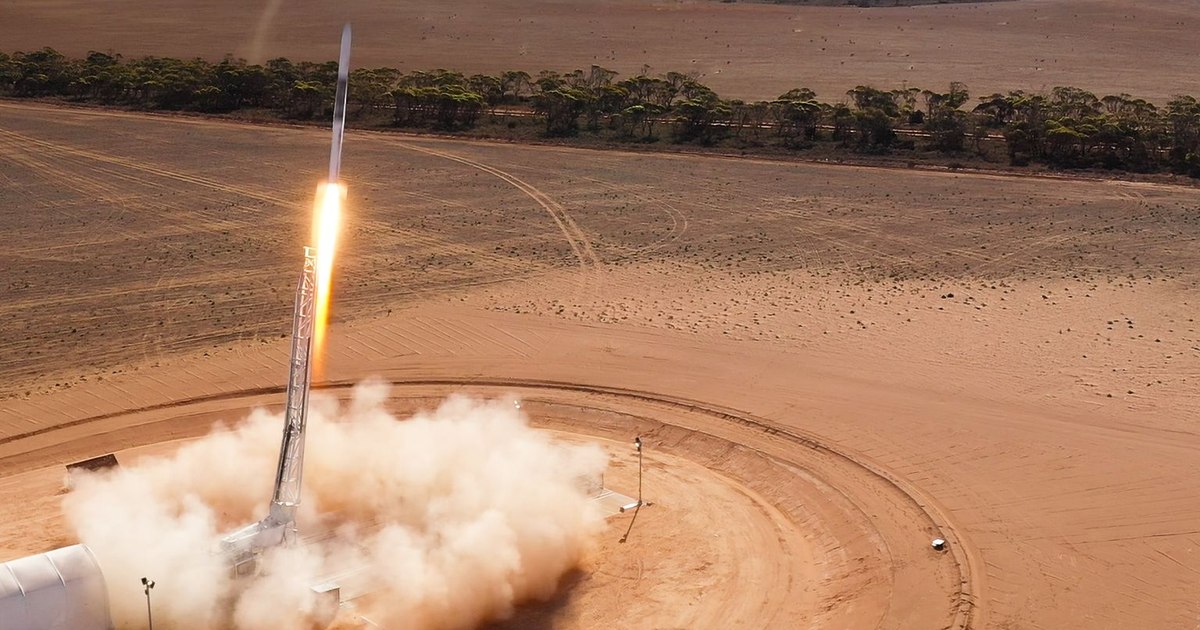
Hyimpulse, a German start-up in the space sector, announced on Friday that it had successfully launched the first rocket that uses paraffin as a fuel, i.e. candle wax, with the aim of testing this technology before a first flight orbital at the end of 2025.
Hyimpulse PHOTO: X
The small SR75 rocket, equipped with a single stage and having a length of 12 meters, was launched from southern Australia at 05:10 GMT, the company Hyimpulse, based in Heilbronn, western Germany, announced in a statement, writes Agerpres .
The suborbital launcher, which is therefore not powerful enough to place in an orbit around the Earth, was designed to reach an altitude of 250 kilometers and to carry a payload of 250 kilograms. Through this launch it is desired to obtain data about the operation of the propulsion system and the control systems.
With Friday's launch, Hyimpulse, a company founded in 2018 and which has 65 employees, sends “a signal about Germany's capabilities as a space power and widens Europe's access to space”said its co-founder Mario Kobald, quoted in the same press release.
Competition is fierce in Europe for space minilauncher projects. In Germany, Hyimpulse competes with rockets developed by Isar Aerospace and RFA, in France with rockets produced by Maiaspace and Latitude, and in Spain with devices invented by PLD Space. This Spanish company made its first suborbital demonstration flight in October 2023.
In order to differentiate itself in this niche, Hyimpulse relies on an innovative propulsion that combines liquid oxygen and paraffin, “which does not present a risk of explosion”. Paraffin is less expensive and less complex technology is used, according to Hyimpulse, which talks about “a launch vehicle construction that is about 40 percent cheaper than if it had conventional propulsion systems.”
According to the data that will be collected, this start-up will perfect the development of its SL1 rocket, with a length of 32 meters and whose maiden flight is scheduled for the end of 2025. This rocket will be able to carry up to 600 kilograms of payload up to an altitude of 500 kilometers, enough to reach low Earth orbit.
