
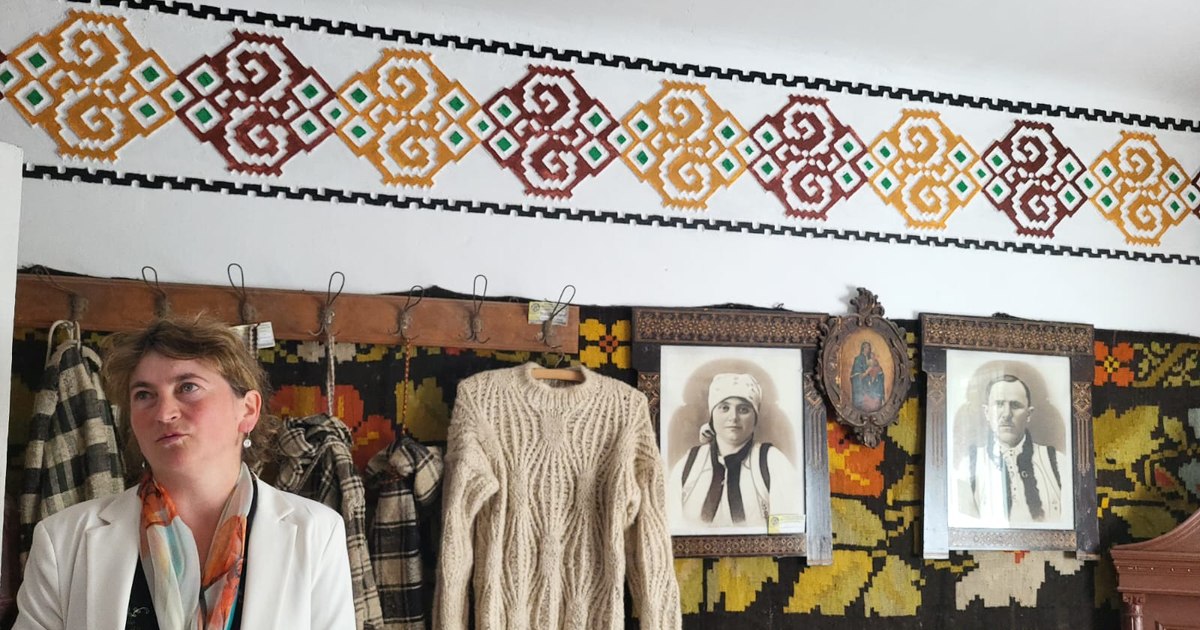
In the Fairytale Land of Dornelor hides a unique village in Romania, Ciocănești, where every house is painted with designs inspired by popular costumes or painted eggs.
Ciocanesti – museum village PHOTO Mariana Iancu
A walk through Ciocănești, in the heart of Bucovina, located approximately 20 kilometers from Vatra Dornei, is an adventure into the world of the old village. Every house has a facade painted with geometric or floral motifs, including the offices of the school, the kindergarten, and the Police.
The storied place has a storied history. The legend says that the name of the village comes from “ciocănari”, i.e. the weapon makers from the time of the great voivodes, and that the great voivode Stefan the Great himself defeated the Turks with a weapon made in the Land of Dornel, namely the mace with fangs. Another legend says that Stephen the Great established the altar site of the Putna Monastery by releasing an arrow made by the hammermen of these lands into the air.
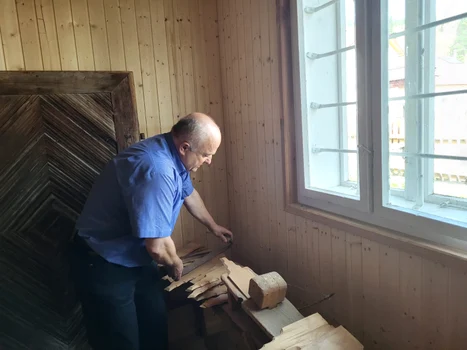
Image 1/11:
Radu Ciocan mayor jpg
A legacy design
It all started in 1948, shortly after the end of the Second World War. Leontina Țăran, a local, removed a model from the folk costume and, with the help of a mason, transferred it to the house. Soon, the idea was copied by other neighbors and so most of the houses were painted with various patterns, the village becoming an open-air museum.
Marilena Niculita, the director of the Ethnographic Museum in Ciocănești, told “Weekend Adevărul” how the village in Dornelor County became one of the stories: “Leontina Țăran's house has become a museum. When he renovated his house he wanted to embellish it with folk motifs. A local bricklayer made a model of the folk costume, then made a wooden template, applied a layer of cement and plaster in relief, set the template and chiseled into the cement. Then, he painted the models in sober colors”.
Others also liked the result, and more and more locals called on the mason's services to beautify their homes. This is why in 2003, Ciocănești was declared a commune-museum.
At the same time, a local council decision was issued that required all residents to make their facades. The town hall provides the necessary materials, and the owners only pay for the labor.
Currently, the works are carried out by the descendants of the mason who beautified Leontina's house in 1948.On houses we find the same motifs as on painted eggs or folk costumes. We have star motifs represented by the lost path or path, the endless road representing infinity, the symbol of flowing water, the rhombus or square signifying wisdom, the circle representing the cycle of life or the four seasons, and the ear of wheat, wealth. As a rule, geometric motifs predominate, but there are also some floral motifs”, explains Marilena Niculita.
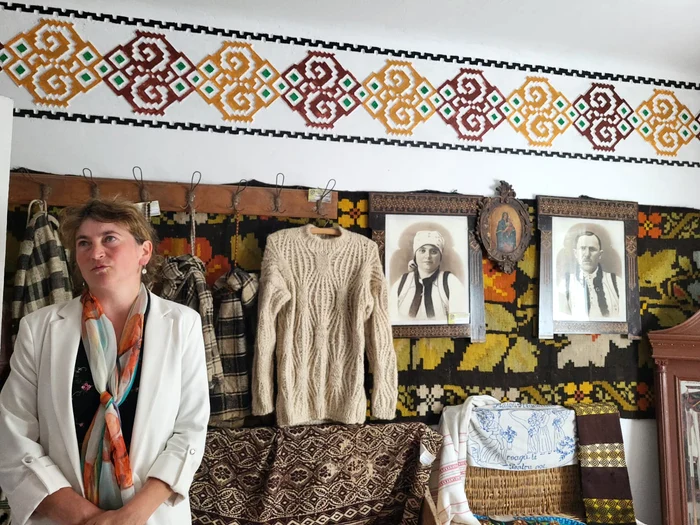
Museographer Marilena Niculita
Bucovina disappeared
Traditions were preserved not only regarding the facades of the houses. The director of the Ethnographic Museum in Ciocănești tells us that in almost every home a room has been preserved as it looked in the time of the grandparents. Such a room is also recreated at the museum in the heart of the village, where you discover a missing Bucovina. Every corner tells a story of the land and the old occupations of the Bukovinans: animal husbandry, mining and rafting. “We have the floating hall, here being the only area where floating is still carried out for tourist purposes in Romania. Plutărit stopped in 1969 with the construction of the Bicaz dam. Before, wood was transported by water even as far as Galati, with 450 cubic meters being loaded in a single transport”, explains Radu Ciocan, the mayor of the commune, who was our guide at the museum.
Now, only tourists go rafting down Bistrita in the summer. As a mining engineer by profession, he was personally involved in the design of the museum and reproduced a life-size manganese mine abattoir with all the wooden reinforcements.
Also in the museum you can admire objects that were used in the processing of iron, in weavers or in stables. The exhibition also includes popular masks for winter customs, dowry boxes, but also many images from the old world of the village.
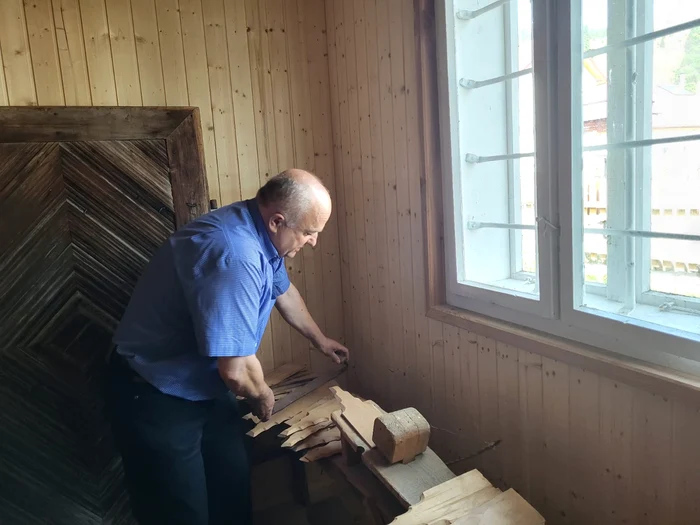
Mayor Radu Ciocan
Egg painted with natural wax
The unique village in Europe does not attract its travelers only by the fairy-tale landscapes that surround the town or by the beauty of the houses. Several festivals take place here annually. Before Easter, the National Festival of Painted Eggs takes place, which this year started on April 21, with the 19th edition. In the middle of summer, in August, the National Trout Festival and Plutăriut Week take place, and in December, tourists are expected at the Festival of Folk Customs and Traditions.
In the middle of the settlement of over 1,500 souls is the National Museum of Painted Eggs, which was opened on November 17, 2007. The first exhibits were painted eggs and other old, precious objects that people had in their households, kept from generation to generation . The museum currently holds an impressive display of sealed eggs, which were collected from all over the Dornelor Basin and which are kept in over 40 boxes – each piece with its own history.
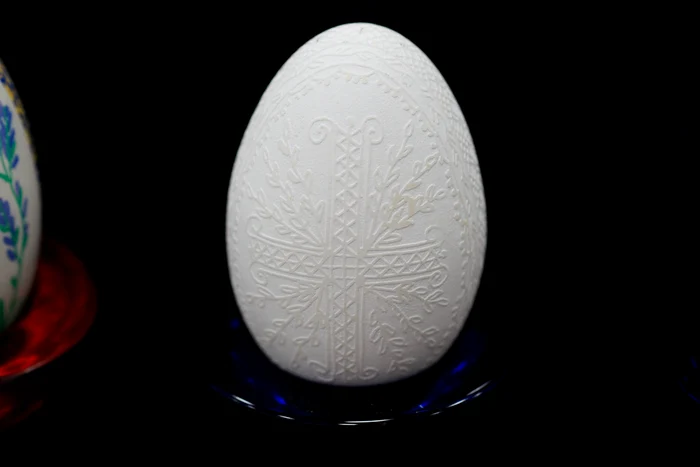
Unique egg from the Ciocănești museum PHOTO Catalin Dumitrescu
In addition to recently painted eggs, there are also very old ones, from the time of the Second World War. The oldest egg in the exhibit is over 100 years old. “It is an egg painted in Ciocăneşti with natural beeswax, immersed in the color bath, and is part of the collection donated by Novac Norbert Ioan. Various symbols can be found on this egg: the vertical line and the horizontal line, which represent life and death respectively, the ear of wheat which signifies wealth, the straight line symbolizes destiny, the sawtooth line represents good and evil, the double line symbolizes eternity, the square represents intelligence, the rhombus – wisdom, the spiral – time, the cross – the four seasons, the symbol of the sun, the eight-pointed star, the shepherd's crutch”, explains Marilena Niculita.
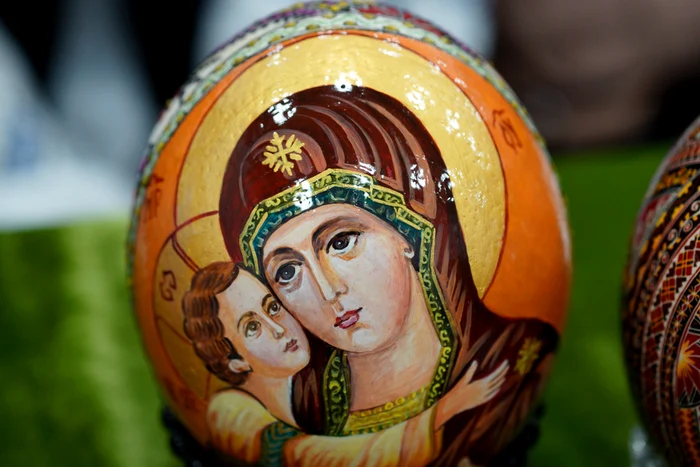
Collection egg from the Ciocănești museum PHOTO Catalin Dumitrescu
