
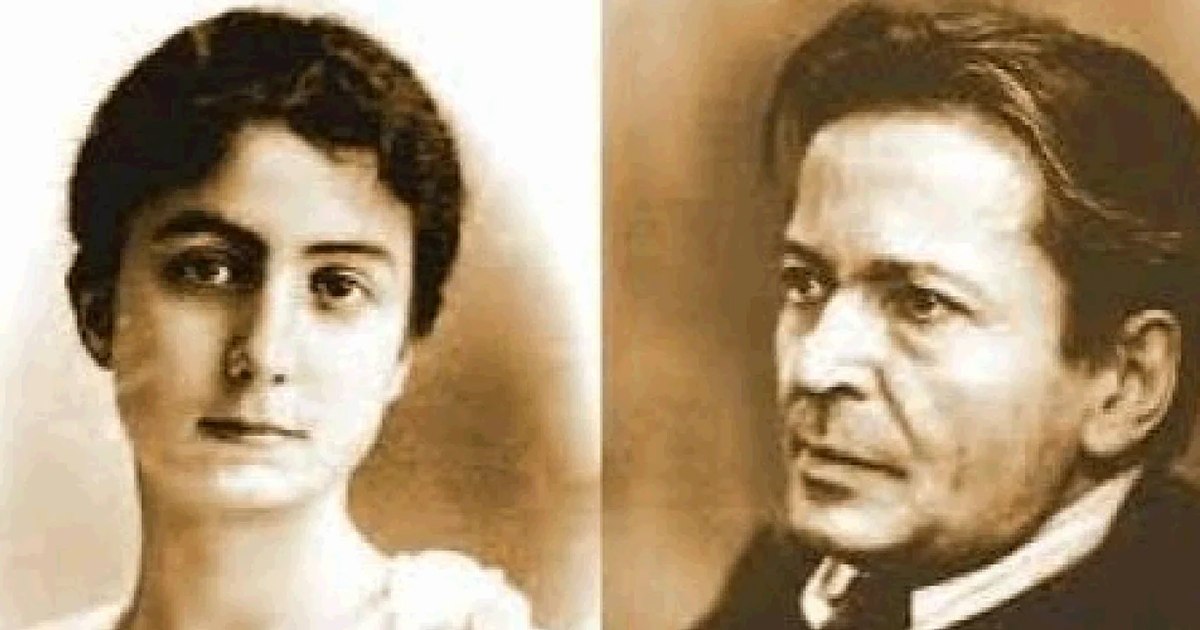
Exactly 69 years have passed since the death of the great violinist, pianist, composer and teacher George Enescu, the turbulent genius whose life story, less known than his work, is a disturbing one.
Princess Maria Cantacuzino and composer George Enescu. PHOTO: Archive
He was born in the north of Moldova, in Dorohoi county, on August 19, 1881, being the eighth child of his parents, who had lost seven others before him.
His sensitive veleities manifested themselves from childhood. Attentive to the mysterious call of nature, George Enescu illustrated it, over the years, in an authentic way, in creations that today enjoy great popularity in all corners of the world.
As for the music, the composer himself claimed that it was part of his earliest memories. He was only five years old when his father took him to Iasi, where he introduced him to professor Eduard Caudella. In 1888, he managed to surprise the teacher, who recommended his parents to send him to continue his studies in Vienna. At the age of 13, Enescu went to complete his studies at the Paris Conservatory, where he was recommended to Jules Massenet, the creator of the operas “Manon”, “Cidul” and “Thais”.
He was only 15 years old when he conceived his first creation, “Romanian Poem”, which established him as a composer.
Moreover, the love for the country, which emerges from this creation, as well as the attachment to Romanian traditions, accompanied George Enescu all his life, despite the exile.
Disturbing love
On a sentimental level, George Enescu's great love was and remained until the last moments of his life, Maria Cantacuzino, whom he married in 1937.
He met Maruca (as she was fondled by her loved ones), heiress of an old aristocratic family from Moldova, in Sinaia, in the Peleș Castle, where the composer was often invited by Queen Elizabeth of Romania.
In the “Revelations about George Enescu”, Ilie Kogălniceanu said that the musician met his future wife, princess Maruca Cantacuzino, around 1907, but their relationship began around 1914. She had been married since 1898 to Mihai Cantacuzino, the son of politician George Grigore Cantacuzino, together with whom he had two children. Enescu often sang in the presence of Maruca's husband at social evenings in her homes.
“Enescu had accepted, he had nowhere else to go, the position of court singer in Maruca's house”, wrote Kogălniceanu.
Capricious by nature, Maria Cantacuzino, who had inherited two monumental properties in Bucharest and in Tescani, fell in love with George Enescu, thus distancing herself from her husband and two children.
Maruca's husband died in 1928, in a car accident, but she kept her husband's name and did not give up the title of princess even after marrying Enescu.
“After their marriage in 1938, Maruca and Enescu lived in the building behind the Cantacuzino Palace, which was left to Maruca after the death of her husband, Mişu Cantacuzino. Enescu preferred the quieter and more modest rooms in the back. He was disturbed by the monumentality of the palace, where his wife held the famous musical evenings. He was a very modest man, a musician who preferred to travel by train second class”the musicologist Viorel Cosma, the author of several books about George Enescu, told in an interview given to Formula As magazine.
During the relationship with Enescu, Maruca also had a relationship with the philosopher Nae Ionescu, which lasted six years. Enescu suffered a lot because of this situation.
The lesser known side of Enescu's life
Although he was very connected to Romania, Enescu left the country in the fall of 1946, after the establishment of the communist regime, because he had begun to anticipate the disaster that was to follow thanks to discussions with friends in the West, who put him on guard.
He arrived in Paris, his city of exile, where he gave violin and composition lessons, held conferences, and gave concerts.
“He adapted to French life, because he was a man of the world, a sociable man, who handled himself with ease in the high circles of Paris, he had manners, he was pleasant to talk to. But I can suspect that, somewhere, the feeling of isolation and longing for the homeland is at work. Friends say that he often had bouts of melancholy. He lived with Maruca in Rue de Clichy, at no. 26. But he had also rented a villa, Les Cytises, in Bellevue, on the outskirts of Paris, where he went in the summer“, the musicologist also said.
The opera that captured the entire creative force of maestro George Enescu for a quarter of a century is “Oedipus”.
From 1906 until the evening of March 10, 1936, when the premiere took place on the stage of the Opera Garnier in Paris, Enescu felt, as he testified in his memoirs, “a poor man prey to the torments formerly endured by martyrs”.
She had a flower child
A less known thing about the life of the great composer is that he had a flower child: in his parents' house in Dorohoi, Enescu had met a young housekeeper, a simple woman, but who loved him very much and with whom he had a little girl (Elena Dinu, who later became a seamstress at the National Opera in Bucharest), Cosma reported.
Maruca Cantacuzino, Enescu's wife, had to accept the existence of the flower child and the fact that the great composer was sending the girl money from Paris, where he moved in 1946.
He sang even when he was sick, for the sake of his wife
The books of Viorel Cosma and Ilie Kogălniceanu – who lived near the composer – show that Enescu died in poverty, that Maruca forced him to sing and give lessons to earn money, even when he was very ill. Viorel Cosma told that for Enescu it was important to always do Maruca's will, “the one who remained for him and for others an authentic princess: “La princesse aimee!”.
George Enescu died on the night of May 3 to 4, 1955, in Paris, being buried in the Pere Lachaise cemetery. Maria Cantacuzino survived him for another thirteen years, dying in Switzerland in 1968.
