
Rareș Beșliu, a photographer in love with nature and animal life, starts the photographic project North of words, a parallel between the Arctic regions and the impact of climate change felt in Romania. He went on a series of expeditions to the coldest areas of the Planet – Svalbard, Greenland, the Canadian Arctic Archipelago – and his stories and photos, collected under the Jurnal de Nord hat, will be constantly published on ertudin.ro and in ” Weekend Truth”.
The polar bear, ready to be released. PHOTO: Rareș Beșliu
Day 5 – Saw 14 polar bears
Today I ate frigănele for breakfast, as my mother Floricel used to make for me when I was little. I missed her and thought what would she say if she knew her beloved grandson was in the polar bear capital? Would she be proud of me or rather angry that I went away from her and home? I would tell her that I love her and that I'm only staying here for two more days, so she shouldn't worry.
If yesterday the bay was frozen only at the shore and had pieces of ice in the sea, today everything is white as far as the eye can see. I can't even tell the shore from the water anymore, it's just a huge expanse of snow dunes. The morning sky was the same color, except where it merged with the ocean and closed suddenly in an anthracite gray. A single ray of sunlight managed to break through the clouds as heavy as all of Canada, and a bear was sleeping far away in the sun, right by that narrow strip of pink sunrise. I jumped out of the car and lay down on my stomach to capture it in the frame over the color. That's how the day started.
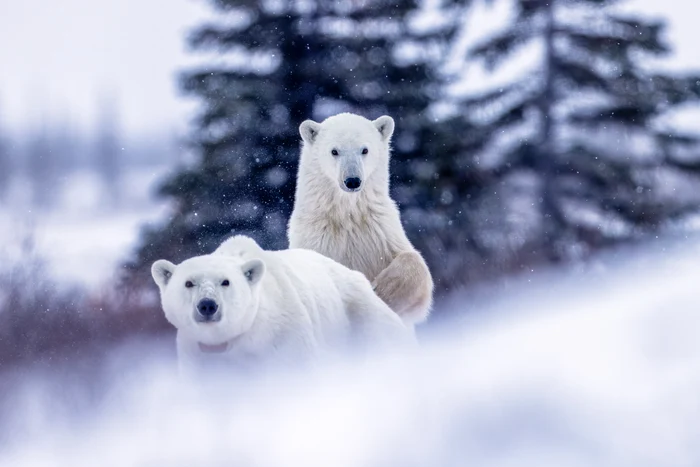
The Playful Bears of Churchill. PHOTO: Rareș Beșliu
Then a female bear with a large cub, almost 2 years old, came our way. My mother had a monitoring device around her neck and I remembered the first polar bear. It was a shock to see then how the large plastic necklace accompanies her everywhere. I don't know how inconvenient it is, but I hope technology shrinks it in the future. All these thoughts disappeared when the cub stood up to see what was new in the tundra. I was quite close to them and I felt his power, the majesty and the strength that he exudes when he shows you who he really is. And a bear with two paws can knock you down with just a look.
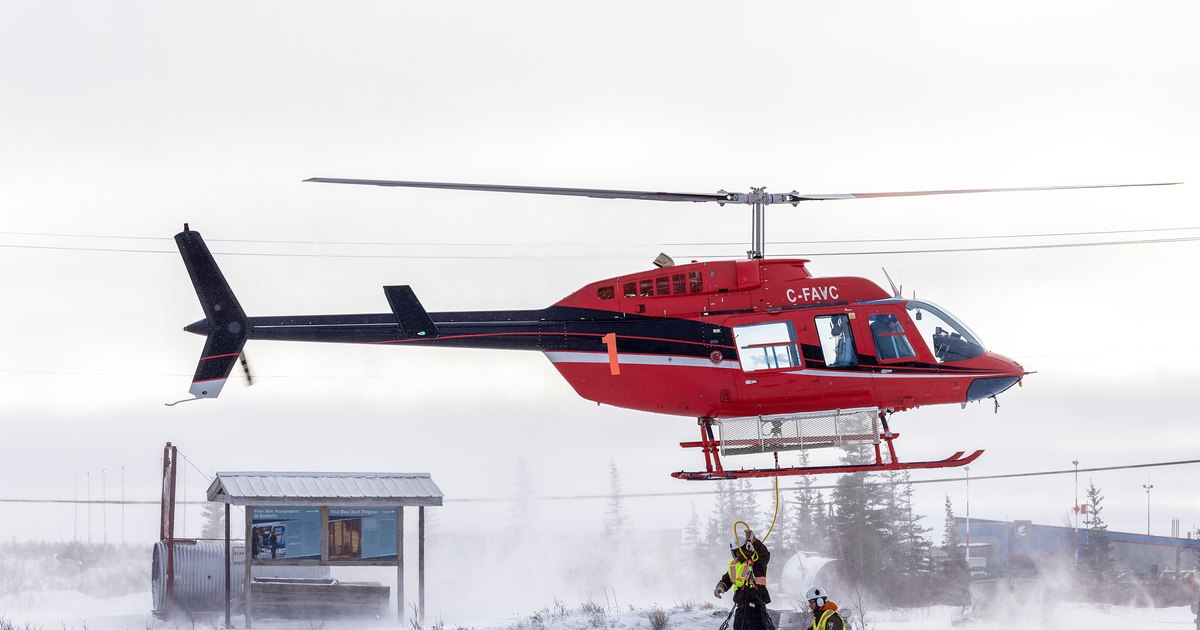
Today, for the first time, I had something set in my schedule. We knew that at 12 we were going to see a “bear lift”, so we got into position about half an hour earlier. For nothing in the world we would have wanted to miss something like this, an incredible moment that only happens a few times a year. I stared long at the huge prison gates, as if waiting for “Surprises, surprises.” At 11:57 the door was opened, and four people came out from behind it “walking” a bear on a stretcher pulled by an ATV, lying on its stomach and blindfolded. He looked exactly like our pig before the slaughter. I was crying with one eye, because it was quite a dramatic image, and the bear was in a vulnerable pose, like I've never seen before. With the other eye I was smiling and glad that he is to be released, right now, when the bay is freshly frozen and he can finally go after food. From prison to feast. I then watched as he was taken off the stretcher and turned on his back with his paws on his chest, like a man being prepared for burial. Then the helicopter began to slowly approach and slowly rise with the bear, who was now sleeping unconscious in a net like net. As the helicopter rose, the bear folded more tightly into the shape of the net until it finally looked like an unborn cub curled up in its mother's womb. How many scenes I saw, so many imaginations and emotions I had. I only came to my senses when I saw the bear fly away and be carried away until it was just a dot in the sky. It's like I just woke up from a dream. Could it be a bird? No, it's the flying bear!
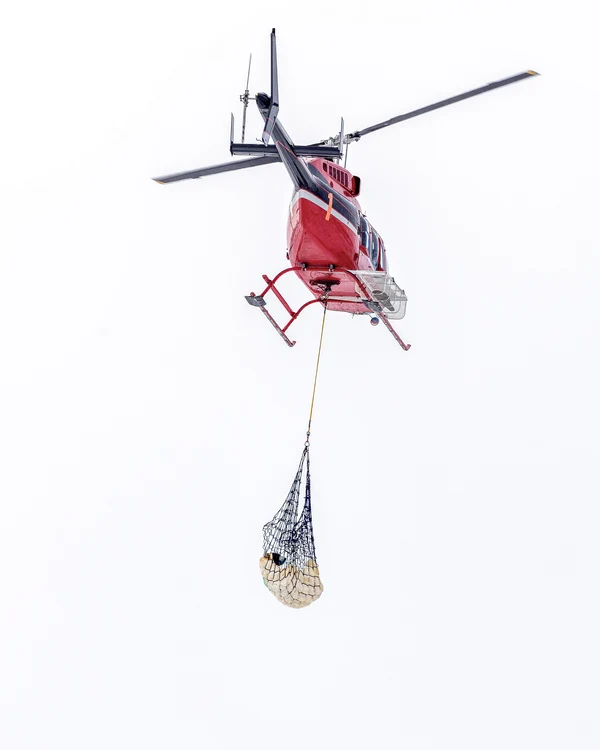
Fram, the flying bear. PHOTO: Rareș Beșliu
Anesthetized after such an intense event, we went exploring through a coniferous forest. I don't know how to tell the difference between the trees, but I understand that spruce (black spruce or white spruce) and larch (tamarack) predominate here. One thing is certain, the forest had fairly uniform trees with branches on all sides, the likes of which you rarely see around here. They are probably protecting each other and the wind no longer has the power to cut them off at will. In the meantime I learned that the ones with branches on one side are also called flag trees – they are the ones that shocked me from my first day at Churchill, and the effect of the wind on them is called “krummholz” or “ice pruning”.
We also found life in the uniform forest: a gorgeous cross fox. Although I was able to photograph it well enough from a distance, I moved closer specifically so that I could study it more closely with my eyes, rather than through the lens of the objective. I know it's a species found only in these corners of the world, so I wanted it to be well imprinted in my memory. We didn't say goodbye to her well, because we saw another fox, this time polar. It was far away, on the rocks, but I was impressed by its speed. She's small and bubbly, like a snowball with fur, pointy ears and marathon runner's legs. It reminded me of a true story, read on the Internet while researching Canada, when I discovered that this year I followed the same route that an arctic fox did in 2018. It left Svalbard, after three weeks it arrived in Greenland, and approximately 3 months later it was spotted on an island in the Canadian Arctic Archipelago. He had traveled 3500 km to get there. The force of nature never ceases to amaze me, and it never ceases to amaze me how small we humans are. I have traveled the same route after countless layovers, missed planes, money spent, energy depleted, stress at peak levels, colds, seasickness, trouble sleeping due to the time zone. The fox just saw his way and conserved his energy as much as he could in search of food and a better place.
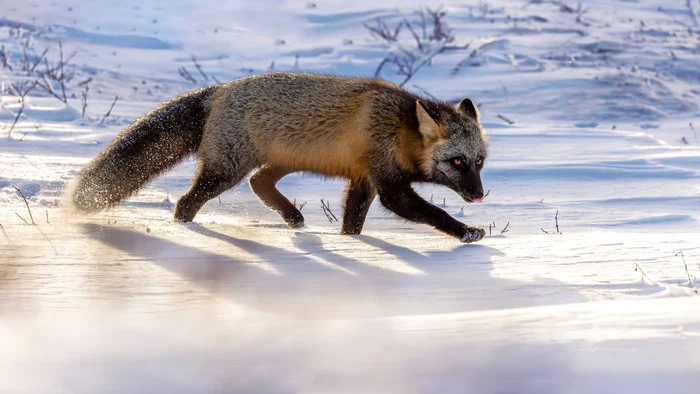
The arctic fox. PHOTO: Rareș Beșliu
While I was making this analogy, two other cross foxes were walking behind me. With the last bits of energy, I turned towards them and tried to find a good frame with at least one. I don't know what came out, I'll see at the moment of truth (read: at the selection of pictures).
After leaving the fox paradise, we arrived at the bear lake. Literally! A bear was sleeping in the bushes at the entrance to the lake area, and two mothers were nursing their cubs on either side of the frozen water. One of the bears had taken a nap under a pile of snow, and the other was sheltering from the wind at the foot of the trees. You can feel their impatience in the air. I remember my start in the world of wildlife photography and how I suddenly became a man who could wait for hours without moving. Nature somehow forced me to do this and it does the same with animals. He puts them to the test every year, tests their limits and patience.
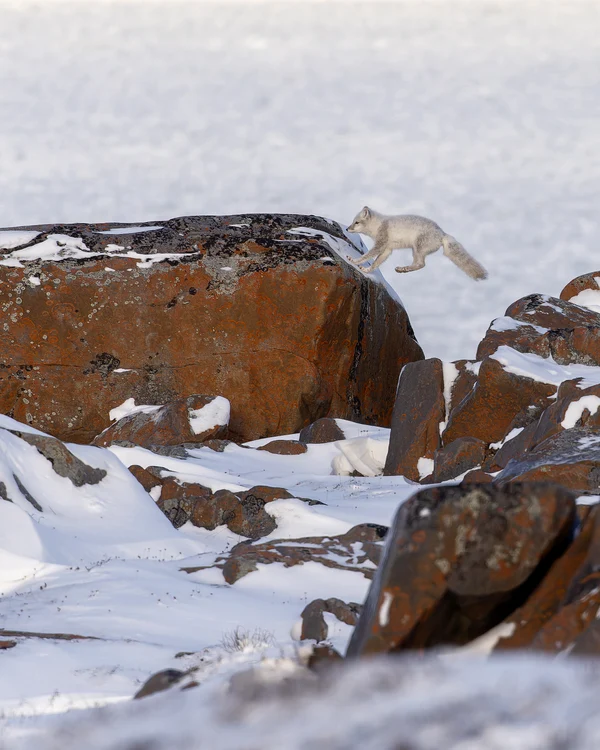
The land of playful foxes. PHOTO: Rareș Beșliu
I leave tomorrow. As always, at the beginning of the trip it seemed to me that I had too little time at my disposal – not even a week in such a complex and fascinating place, which exceeded my expectations from day one. Tomorrow it ends, and I smile to myself. It was an intense expedition, where I saw so much in such a short time, that I am not sad to leave. In return, I promise myself that I will return in another season. I want to see the bears playing in the popcorn, I want to see the few-month-old cubs confusing the mother with their energy, I want to see the Beluga or the Snowy Owl. If I could, I would only come here in the coming years. Now I understand Aimée, who came for the third time (the difference between us is that she is from the same continent).
