
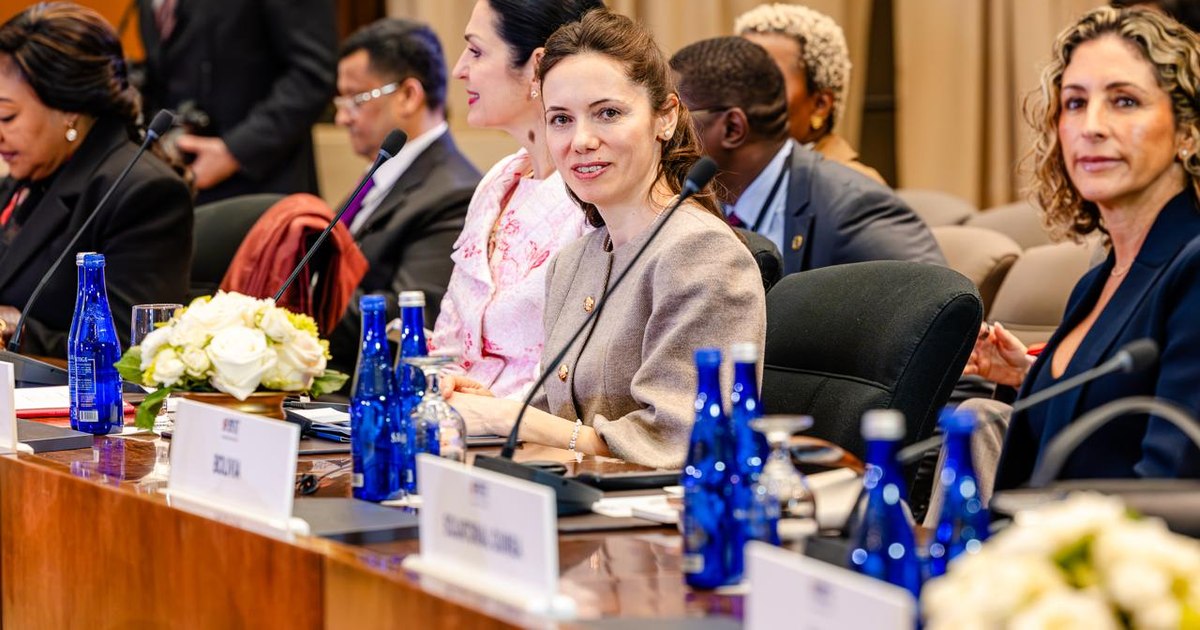
Mirabela Grădinaru’s participation in the international summit at the White House sparked public discussions about the role of the First Lady in Romania. Several voices asked if Romania has a “First Lady” and if her presence in such contexts is justified. In fact, the role is not formalized in almost any country – not even in Western states. In Romania, the wives of former presidents were rather discreet presences, without an active role, with the exception of Elena Ceaușescu, during the communist period. Now, Mirabela Grădinaru has the chance to redefine the role in Romania, say political scientists. “An active First Lady can act as a catalyst and put on the agenda topics ignored by the political class”emphasizes Cristian Pîrvulescu.
Does the institution of the First Lady exist?
The “First Lady” is not an official institution with legislative or executive powers. Political scientist Cristian Pîrvulescu explains:
“It is what in political science we call a <>, in other words a set of practices, expectations and norms that are crystallized by custom, not by law. The partner of a president can become a vector of public diplomacy, can patronize social causes, can humanize the presidential institution and facilitate dialogue with civil society on topics that the actual presidential office cannot directly cover such as health, education or child protection. Practically, the First Lady acts as an extension of the president’s symbolic capital, but with an agenda of her own, usually apolitical”.
Even in the United States, where the role is most visible to the public, it does not exist in the Constitution. But it benefits from some form of regulation.
,,A Washington Court of Appeals decision (from 1993 (in AAPS v. Clinton) held that the First Lady is <
And since 1978 there is the Office of the First Lady (Office of the First Lady). It operates within the Executive Office of the President, with budget, team of advisers and publicly assumed causes: ,“From Nancy Reagan and the anti-drug campaign, to Michelle Obama and healthy eating, to Jill Biden who continued to teach even from the position of First Lady”.
In most states of the world, however, the role remains one built only through long practice.
“In France, Brigitte Macron plays a visible role but without a legal framework — in 2017, under the pressure of public opinion, the idea of an official status was abandoned. In Poland, Marta Nawrocka, the wife of President Nawrocki, has an intense activity, including on social networks, and a biographical page on the website of the Presidential Administration. In Latin America, First Ladies traditionally have a more pronounced role in countries such as Argentina, Colombia, Mexico that all have a strong tradition of public involvement of the presidential partner”explains the political scientist.
The law against convicted sex offenders, promulgated by Nicușor Dan: the places where they are not allowed to work
At the opposite pole are the states from the post-Soviet space, where, says Pîrvulescu, “First Ladies have historically been almost invisible, which is a reflection of the Soviet era, when leaders kept their families out of the public space.”
The stigma imposed by Elena Ceaușescu
Compared to the wives of communist leaders, Elena Ceaușescu was the exception to the rule.
“In fact, Elena Ceaușescu was a special case worldwide because she far exceeded the classic model of the First Lady. She was not only the symbolic partner of the head of state, but also accumulated official positions of power, being from 1980 the first deputy prime minister, a member of the Executive Political Committee of the PCR, a member of the Permanent Bureau, i.e. an integral part of the decision-making core of the state. She was, practically, the second person in the hierarchy of power, not only the wife of the first”says Cristian Pîrvulescu.
Precisely because of this, the model came to be associated in Romania with the abuse of power and the cult of personality, which led after the Revolution to a low visibility of the wives of heads of state.
“The wives of the former presidents had either an extremely discreet profile (the case of Nina Iliescu or Maria Băsescu), or a visibility limited to protocol appearances (Carmen Iohannis)”. exemplifies the political scientist.
In this context, it shows, Mirabela Grădinaru “marks a real first”.
“The causes she addressed – prematurity, neonatal screening, digital education – are not random but themes with social impact. And in a society where social advocacy is still fragile, an active First Lady can function as a catalyst and put on the agenda topics ignored by the political class, can mobilize resources and public attention, can connect Romania to international networks. The visit to Washington, at the invitation of Melania Trump, as part of a summit with delegates from 45 of countries, it is exactly this type of public diplomacy that Romania has not been able to afford until now”.
The chance that Mirabela Grădinaru has
Precisely the lack of tradition in this sense could be an advantage for the floor of the president Nicușor Dan.
“Because there is no rigid model to deviate from, but a free space that can be configured, Mirabela Grădinaru has the chance to transform a non-existent role into a functional one and, possibly, to create a model”, says Cristian Pîrvulescu.
The political scientist also dispels the myth that she cannot be named First Lady because she is not married to the president.
“The fact that she is not married to the president should not be an impediment — we live in an age where the legal forms of partnership are diversifying, and what matters is the de facto legitimacy, not just the formal one. The debate itself is healthy and may lead, at some point, to a regulation of the role, maybe not necessarily through an organic law, but at least through a formalization at the level of the Presidential Administration”.
