
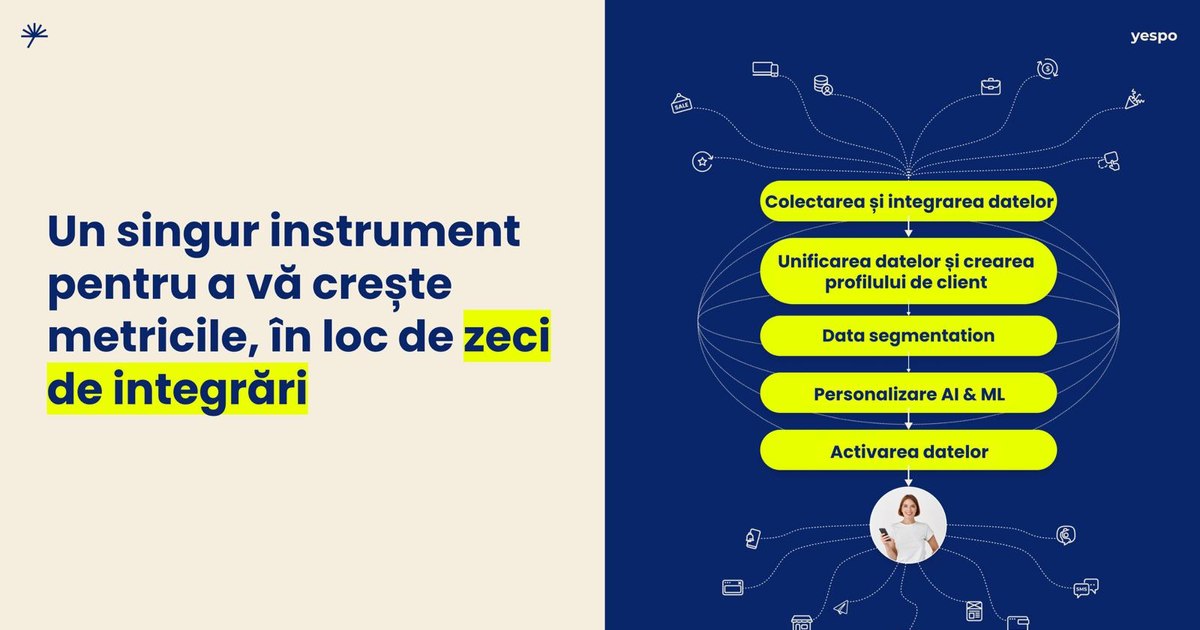
Today, every company wants to be closer to its customers. But between desire and reality, data chaos often occurs. Contacts are stored in different systems, purchase history — in CRM, analytics — in Google, and customer behavior — in advertising platforms.
As a result, teams spend hours on manual work, data isn’t connected, customers get the same messages without their interests in mind, and sales drop.
How can this problem be solved? The business needs not only a database of contacts, but a system that unifies data from all channels, allows its use to personalize interactions and, ultimately, increase profit.
For this purpose there are two main tools — CRM (Customer Relationship Management) and CDP (Customer Data Platform). Although they have a common goal — to help better understand the customer — their operating principles are different.
What is CRM and why is it needed?
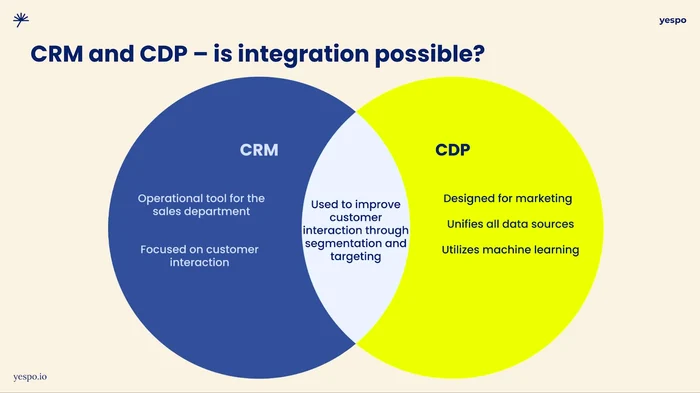
CRM is a system for managing customer relationships. Its main purpose is to help companies organize contacts, control sales, plan the work of managers and increase customer satisfaction.
Simply put, CRM answers the question: “who is our customer and what have they already bought?”
CRM functions:
● storing customer contact data;
● history of interactions and purchases;
● sales funnel management;
● reminders for calls and meetings;
● analytics and sales reports.
But CRM is not just a tool. According to Gartner’s definition, CRM is a strategy that helps increase profit and customer loyalty through effective management of sales, marketing, service and digital commerce.
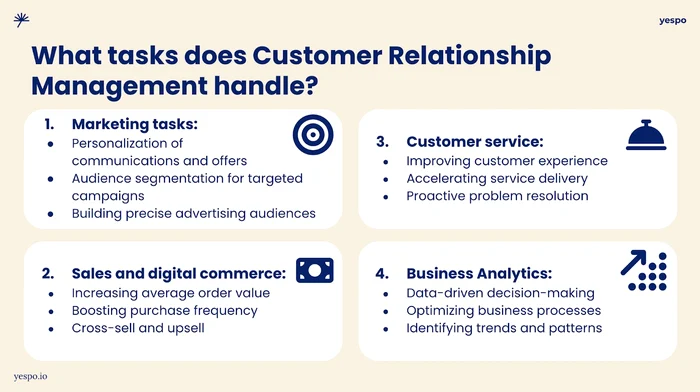
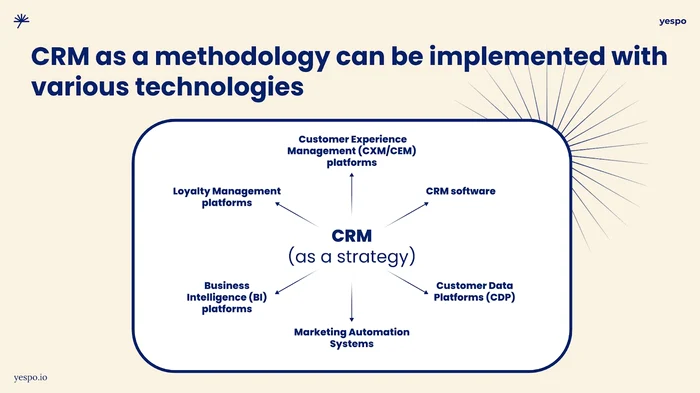
Implementation of the CRM strategy
The CRM strategy can be implemented with the help of different technologies:
- CXM / CEM platforms — analyze the customer experience, collect feedback and help improve the interaction (eg Adobe Experience Cloud).
- Loyalty platforms — create bonus programs and increase customer retention (Talon.One, Open Loyalty).
- Business intelligence platforms — visualize and analyze data for decision-making (Tableau, Power BI).
- CRM for sales — coordinates the teams’ activity and controls the achievement of objectives.
- Marketing automation — configure campaigns, notifications and communication scenarios (ActiveCampaign, Drip).
- CDP (Customer Data Platform) —
which we will talk about in more detail.
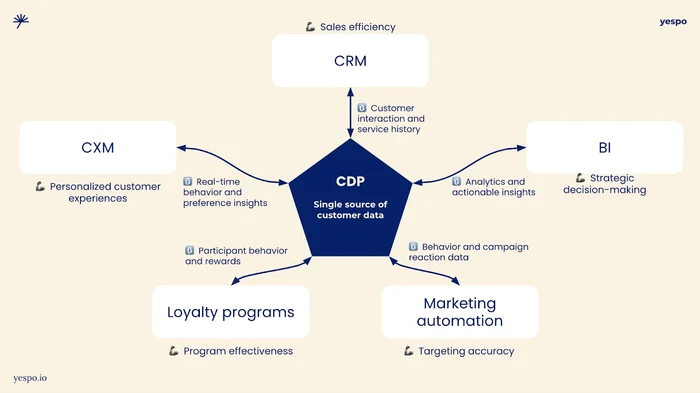
What is CDP and how is it different?
CDP (Customer Data Platform) represents a new stage in the development of a customer-centric business.
If CRM shows what has already happened and only knows the history of identified customers, CDP answers the question: “how does the customer interact with the business and what will be his next action?”
Main functionalities of CDP:
● creating a unique customer profile by collecting and unifying data from multiple channels (website, application, email, push, points of sale);
● automatic updating of profiles in real time;
● customer segmentation according to behavior, interests and life cycle;
● customization of messages, recommendations and triggers;
● analytics and predictions on churn or likelihood of purchase.
If CRM is mainly for sales teams, CDP is a tool for marketers, analysts and digital teams.
This allows the launch of large-scale automated campaigns that “speak” the language of each customer, taking into account their actions, preferences and reactions.
For businesses, CDP becomes essential when the contact base exceeds 10,000 — it automates reactions to customer behavior, reduces churn, and drives repeat purchases through personalized offers and cross-sell.
CDP vs CRM: What’s the difference
Data type:
● CRM — contact data, purchase history, transactions
● CDP — behavioral data, events, anonymous data
Scope:
● CRM — sales and relationship management
● CDP — personalization and analytics
Main users:
● CRM — sales and support teams
● CDP — marketers and analysts
How to use:
● CRM — for existing customers
● CDP — for the entire audience
Result:
● CRM — control of sales processes
● CDP — deep customer understanding
What the combination of CRM + CDP offers
Each tool has its limitations: CRM does not capture the behavioral data of anonymous users and is less flexible in segmentation, while CDP is marketing-oriented and more suitable for medium and large businesses.
Many companies initially try to choose between them. But the best result occurs when they are integrated.
Advantages of integration:
- Unique customer profile
CRM stores purchase history and CDP adds behavioral signals (views, site actions, reactions). Thus, the company sees the complete picture of the customer. - Deeper customization
Data from CDP enriches CRM, and CRM helps CDP create more accurate segments. The result: relevant offers at the right time. - Integration between teams
Sales uses CRM, marketing uses CDP, but the data exchange creates a unified customer experience. - More automation, less routine
CRM fixes the status of transactions, and CDP reacts automatically:
● send confirmation email;
● send messages of thanks;
● launch cross-sell campaigns.
Thus, the company saves time, brings back lost customers and increases repeat sales without additional effort.
Conclusion
In 2026, the choice between CRM and CDP is no longer about “either or” but about how they can work together to create a complete and coherent customer experience.
CRM brings structure, order and control to sales processes and customer relationships. CDP, on the other hand, provides depth — it collects and unifies data from all touchpoints, enables real-time personalization, and turns user behavior into concrete marketing actions.
Together, these systems offer businesses:
● a 360° image of the client;
● relevant and contextual communication;
● scalable automation without additional operational effort.
The result is obvious: increased sales, improved retention and reduced customer churn.
For companies that want to move from fragmented data to a truly data-driven strategy, implementing a CDP becomes an essential step. And choosing the right platform makes the difference between simply collecting data and actually using it for growth.
In this context, solutions like Yespo offer a clear competitive advantage. As a platform omnichannel CDP, Yespo helps ecommerce, retail and online services businesses grow revenue through data-driven personalization and AI. With more than 4,000 brands in 76 countries using it, the platform provides ready-to-use tools — from identifying ready-to-buy customers and product recommendations, to behavioral triggers and direct multi-channel campaigns — all without the need for technical development.
Thus, companies do not just collect data, but transform it into concrete actions that generate real results.
