The digital environment in which companies operate is constantly changing, under the impact of technological progress and, in recent years, the accelerated development of solutions based on artificial intelligence.
. While these developments support business performance and scaling, they also generate major digital risks that are difficult to manage for many organizations, especially SMBs. A key element, often overlooked, but which directly influences the level of protection, is cyber complexity.
Even businesses with seemingly simple IT infrastructures must manage a growing number of technologies, tools, configurations and processes. The lack of security specialists is adding to this pressure, forcing IT teams to operate increasingly sophisticated systems in the face of increasingly advanced threats. At the same time, remote work has extended the perimeter of the organizational network into employees’ homes, where personal devices and unsecured connections can significantly increase the attack surface.
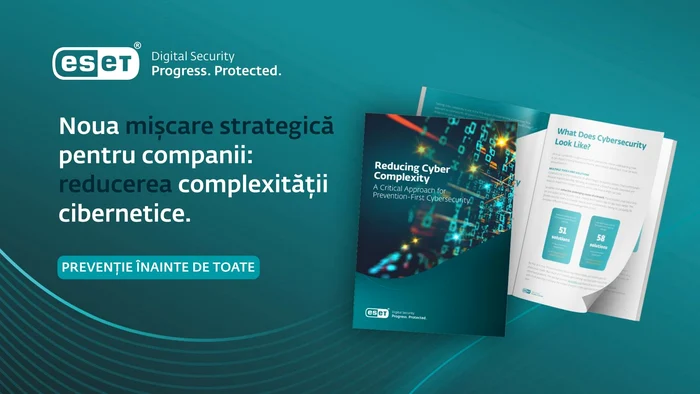
ESET provides for free download a guide dedicated to reducing cyber complexity.
In this context, companies are forced to rethink their approach to cyber security and focus on simplification without compromising the level of protection.
What complexity means in cyber security
Cyber complexity comes in many forms, and identifying its causes is the first step toward control and optimization.
Among the main sources are:
• Simultaneous use of several separate solutions
Over time, organizations accumulate distinct tools for antivirus, firewall, backup, threat detection, or update management. Each works differently, has its own interface and reports, and the lack of a unified view makes administration complicated and inefficient.
• The high level of technical complexity of the solutions
Many security products offer advanced functionality but are difficult to set up and use. The absence of clear interfaces and integrated workflows makes it difficult to adopt and properly exploit them, especially in the absence of the necessary skills.
• The shortage of specialists
Cyber security experts are increasingly difficult to find, and small and medium-sized companies are having difficulty attracting and retaining them. Without dedicated resources, even high-performing solutions run the risk of being used below their potential.
• Accelerated threat dynamics
Malicious actors are constantly diversifying their tactics and techniques, increasing the volume and complexity of attacks. This continued pressure overburdens already resource-constrained IT teams.
Without a coherent approach, all these factors can turn security into a rigid, expensive and vulnerable mechanism. Therefore, reducing complexity becomes an essential condition for sustainable protection.
ESET provides for free download a guide dedicated to reducing cyber complexity.
Simplification through a prevention-focused approach
Managing complexity does not mean expanding your solution arsenal or introducing additional technologies. On the contrary, real effectiveness starts with prevention – reducing risks before attacks materialize.
A prevention-oriented strategy helps organizations to:
- strengthen your cyber hygiene
- stop threats before they escalate
- reduce the volume of alerts that overload the teams
- direct resources to strategic initiatives, not emergency responses
To work effectively, prevention must be supported by reliable solutions, but also easy to implement and administer. Intuitive platforms with built-in automations and minimal maintenance requirements are especially valuable for SMBs.
Practical directions for reducing complexity
Organizations can reduce cyber complexity by following a few clear principles without resorting to excessive investment:
• Consolidate solutions into a unified platform
Adopting an integrated platform that brings together prevention, detection, patch management, reporting and proactive threat analysis reduces redundancies and the risk of error. Solutions like ESET PROTECT are designed to eliminate fragmentation and provide centralized control.
• Automation of security activities
Automating processes such as updates, scans, vulnerability remediation and reporting reduces pressure on IT teams and speeds incident response.
• Outsource complex components when necessary
Managed security services such as ESET MDR can take over advanced monitoring and incident response tasks. Thus, organizations benefit from specialized expertise without investing in building a hard-to-support internal team.
Why IT leaders should prioritize simplification
Growth-oriented companies need solid foundations. In an increasingly sophisticated threat landscape, internal complexity is becoming a major risk factor. Siled tools, cumbersome processes, and a lack of clear network visibility increase operational vulnerabilities.
By integrating essential functions of prevention, detection and response into a single, automated and easy-to-use platform, security can become a coherent and effective system.
Solutions like ESET PROTECT contribute to simplifying the infrastructure, optimizing resources and reducing administrative burdens. Complemented by services such as ESET MDR, they enable significant reduction in operational complexity and free up time for innovation and growth.
Reducing complexity is not just a technical decision, but an essential strategic step in building a digital ecosystem that is resilient, adaptable and ready for the challenges of the future.
ESET security solutions can always be downloaded and tested for free.
About ESET
Founded in 1992 in Slovakia, ESET is a leading private company in the field of cyber security, specializing in the development of advanced technologies for the protection of digital infrastructures. Its solutions, based on artificial intelligence and supported by a global network of research centers, protect millions of users and thousands of organizations internationally. By combining global telemetry with the expertise of its specialized teams, ESET ensures the detection and prevention of known and emerging threats, offering a complete portfolio of solutions for endpoints, servers, cloud and mobile devices.