
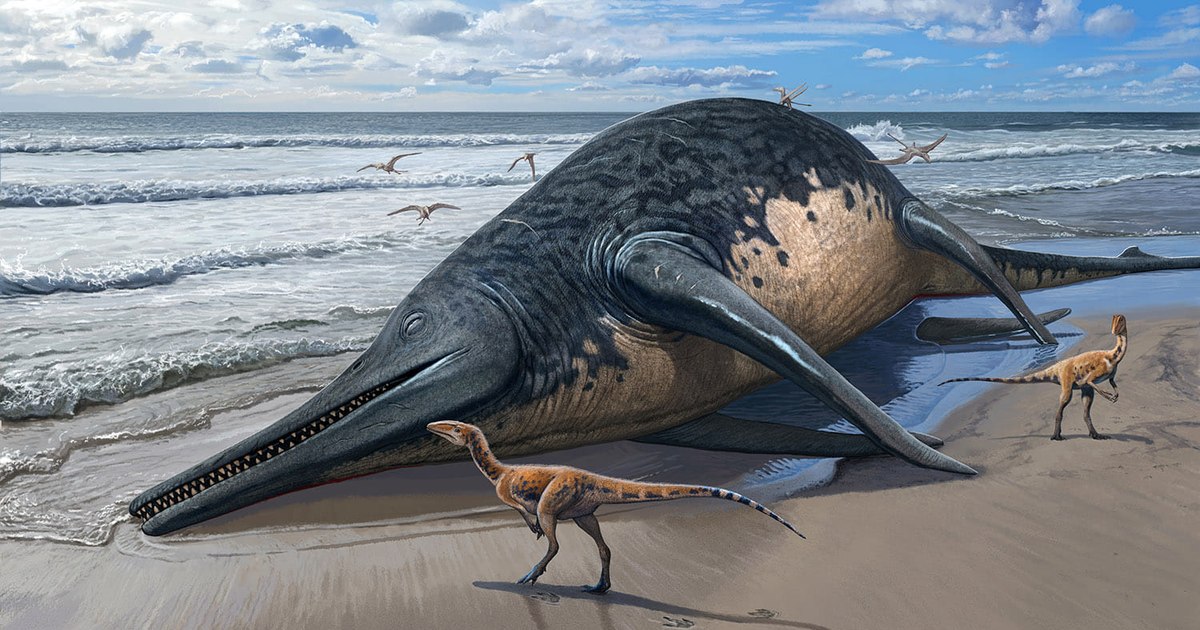
A fossilized jaw discovered by a British girl and her father on a beach in Somerset County, England, belongs to a giant marine reptile that lived 202 million years ago and was apparently one of the largest animals that have ever lived on Earth, informs Reuters, quoted by Agerpres.
The bone, called a surangular, comes from a variety of oceanic reptile known as an ichthyosaur, the researchers say.
By comparing the size of the bone with the same bone from related ichthyosaurs, the researchers estimated that this Triassic creature, which they named Ichthyotitan severnensis, was between 22 and 26 meters long.
It may have been the largest marine reptile known, rivaling the most massive varieties of whales living today, such as the blue whale, considered the largest animal on the planet, which can reach a length of 30 meters.
Marine reptiles dominated the world's oceans during the time when dinosaurs dominated the land. Ichthyosaurs, which evolved from terrestrial ancestors and thrived for about 160 million years before becoming extinct about 90 million years ago, came in various sizes and shapes, feeding on fish, squid-related species, or other marine reptiles, being also viviparous.
“They swam in the oceans when dinosaurs roamed the land”
Ichthyotitan is known only from two jaws, one discovered by Ruby Reynolds and her father, Justin Reynolds, in 2020 in the town of Blue Anchor in Somerset County, and a second, from another specimen of ichthyotitan, discovered in 2016 by along the Somerset coast in Lilstock.
The ichthyotitan was enormous. Graphical Representation. PHOTO Facebook Dr Dean Lomax – Palaeontologist
“It's quite remarkable when we consider that giant ichthyosaurs, the size of a blue whale, were swimming in the oceans at the time when dinosaurs roamed the land of what is now the UK during the Triassic.”', said paleontologist Dean Lomax, associate professor at the University of Manchester and the University of Bristol, lead author of the study published in the journal PLOS ONE.
Ruby Reynolds, who was 11 at the time of the discovery and is now 15, was searching for fossils on the beach with her father when they spotted a fragment of a surangular. Ruby searched the area further and discovered a second fragment – much larger than the first – partially buried in the mud. Later, they contacted Lomax, an expert on ichthyosaurs, and other bone fragments were then unearthed.
For her contribution to this discovery, Ruby Reynolds has been compared to Mary Anning, a 19th-century British geologist and fossil hunter who, among other things, discovered ichthyosaur fossils when she was 12 years old.
“I think Mary Anning was a sensational paleontologist and it's amazing to be compared to herRuby Reynolds said.
“It was an amazing, enlightening and fun experience to work with these experts and we are proud to be part of this team and to be co-authors of a scientific paper that names a new species and a new genusJustin Reynolds added.
Fossil collector Paul de la Salle is the one who discovered in 2016 the remains now attributed to an ichthyotitan.
“They make us feel modest about our place in the Universe”
The dimensions of the ichthyotitan were impressive.
“Such discoveries create incredible moments that make us feel humble about our place in the Universe. To learn that an animal of such proportions once swam in our oceans, felt the heat of the sun as we do and breathed the same air, then disappeared, gives us a chance to see how important each species is in the fragile fabric, but resistant of life“said Jimmy Waldron, a paleontologist from Florida and co-author of the study.
The ichthyotitan lived 13 million years longer than other varieties known up to this date
The ichthyotitan was a member of a giant ichthyosaur family called the Shastasauridae and lived 13 million years longer than any other species known to date, suggesting that these behemoths survived until a global mass extinction event occurred, which led to the extinction of numerous animal species, produced about 201 million years ago, at the end of the Triassic.
Despite the fact that no fossils have been discovered from other regions of the ichthyotitan skeleton, scientists have been able to reconstruct its appearance based on other members of its family, such as Shonisaurus, whose fossils have been found in British Columbia , Canada.
“This animal was enormous, but it also tells us that it had a strong bite”
The surangular is a long, curved bone located in the upper part of the mandible, immediately below the dentition, present in all living or extinct vertebrates, except mammals. The muscles that attach to this bone generate the force of the bite.
“At t rex, the surangular measures over half a meter in length. The surangular that Ruby and her father found is over two meters. This means not only that this animal was enormous, but also indicates that it had a strong bite.”said Waldron, founder of Dinosaurs Will Always Be Awesome, a mobile dinosaur museum.
