

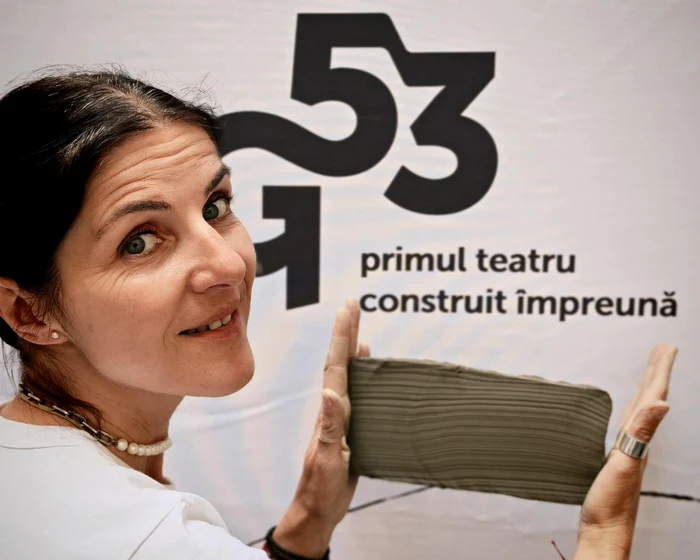
This year, culture in Romania felt the ground running away from under its feet: budget cuts, VAT increase, mergers or dissolution of institutions. In this whole landscape broken as if from medieval tenebrism, the light that balanced everything came from Calea Griviței, number 53, where Chris Simion-Mercurian (48 years old) raised from 0 the first theater built by the community in the history of Romania, the first after 80 years built by private initiative.
Nine years ago, she set out armed with faith, responsibility and courage to fulfill her dream. It was an endeavor that was slowed — not stopped — by extreme obstacles both personal and external: In 2017, Chris Simion was diagnosed with breast cancer, beating the disease after surgery, chemotherapy and radiation therapy. Now, Teatrul Grivița 53 is also proof of survival – with modesty and sincerity, the director says that “This experience did not change me. In my case, it only helped me to become aware of the present”.
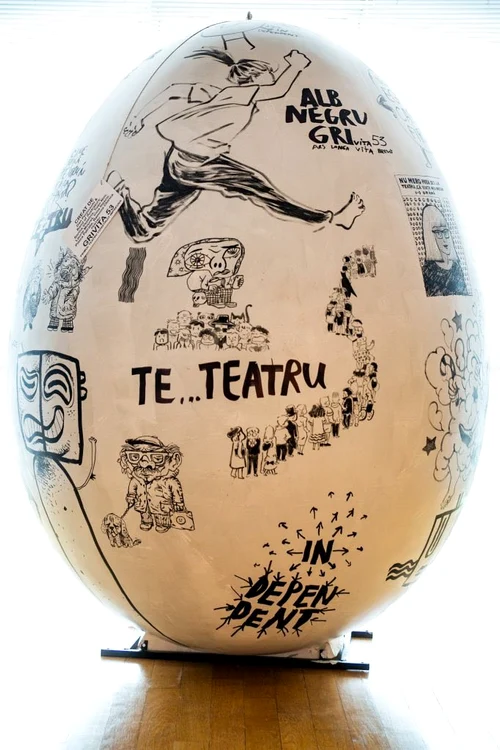
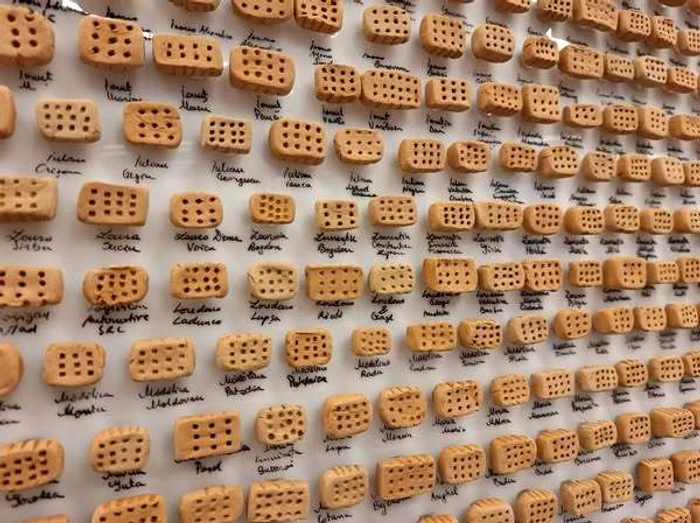
Just before the Winter Holidays, the door of the Grivița 53 Theater was also opened to the public. It is a generous, living space that offers more than performances: 1,400 built-up square meters, a 140-seat auditorium, a 70-seat small auditorium, and several spaces just waiting to receive their regular audience: a café, a small library, and multiple exhibition spaces. All this was possible through a total investment of approximately 4.5 million euros, which involved both the founders’ initial investment of 200,000 euros, 1.7 million euros from EEA grants 2014-2021 through the Ro-Cultura program, but also original campaigns (huge fiberglass eggs painted and auctioned, clay bricks, founder bricks with the name donors) and fundraising from around 14,000 founders, people who donated money or time and made this dream come true. In an interview for “Weekend Adevărul”, Chris Simion-Mercurian spoke about why it takes generosity, courage and passion, but above all responsibility, to build an authentic legacy for future generations. She also talked about the people who were close to her, especially her husband and mother, but also how much everyone’s dream mattered to raise from 0 this miracle called Grivița 53.
“Weekend Adevărul”: How did the idea of being a theater director and creator in post-December Romania come about for you?
Chris Simion-Mercurian: Some people are chosen by their profession and not the other way around. I didn’t feel like I chose my profession, I found myself doing it. I went to the Theater immediately after finishing high school. I entered Theatrology, the first faculty, studying from morning to night for admission, for two months, recovering what others do in years. Then I went to Directing, I knew that a part of me could express itself in this way. I had no doubts. I felt that I was on the right track because I was passionate about what I was doing; for many years I confused my professional life with my personal life.
What lessons did you learn from independent theater before dreaming up a space built from scratch?
I understood that to change what you don’t like you have to act, not complain. I understood to mind my own business. Not to get into gangs. Generosity is a choice that comes from education, but also from personal conviction. It’s clear to me that I don’t take anything with me to the ground and then at least leave everything useful to the generations that come after.
You started out in theater at a time when alternative scenes were rare and viewed with skepticism. What gave you the strength to keep going?
Lack of alternative. I had no choice. The independent theater was a kind of salvation. I could have given up directing because I didn’t opt for compromises, just as I wasn’t validated by the guild until many years later. I suffered a lot because I had high expectations. I learned late to stop putting my soul into what is not worth it and to stop needing everyone’s admiration. And, at the same time, I learned to enjoy the rare sincerity of those who need to live it with me and the friendship of those who do not stop at the ego. And related to the Grivița 53 Theater… Tiberiu, my husband, was the first to join my dream. Then my mother who let me sell my grandmother’s house. Then every founder. This is how power was born: from every man who believed. Solidarity was born from the meeting of my dream with the other’s dream, from trust, from admiration, from need, from faith, from responsibility. Everyone identified with something and put their brick.
When you look back on these almost 30 years of career, what have you learned about home – as a theater, as a city, as a society?
Theatre, city, society… I have the same responsibility towards all of them. I learned that the most important thing is to be, to follow your soul, to follow your dream, not to stop in obstacles, envy, malice, interests, to see your way and, in the end, if God wants, you will reach the end. Just be clear that the divine will is not the same as the human will and let the freedom of the Universe unfold. Don’t always want it to be just how you want it to be. When you own it, you can work through what you don’t like, change, heal. When you idolize yourself, you are blind, you think you are Magister Dixit.
miracle
The Grivița 53 story begins with a very personal gesture: you sold your grandmother’s house to buy the land. When did you first feel that this project could be real and not just a beautiful ideal?
Now when it’s ready. When the first premiere was played. When I saw the first spectators on the seats. So far it’s been a dream. No matter how concretely we advance, there is a risk of not finishing, of losing everything. There were nine years of uncertainty, us (me and Tiberius), with God and those who joined and supported. It was Kafka. It was Ionesco. It was hallucinatory. It was a rollercoaster. Any normal person would have stopped. And from now on there is unpredictability, but if I have come this far, I believe that this endeavor has been permitted by God.
You’ve said several times that you’re not just building a theater, you’re building a spirit. How would you translate this spirit for someone who knows nothing about Grivița 53?
Come see “5+3=9”, the first premiere of the Grivița 53 Theater. Feel its spirit. Through cultural experiences that are different, that are not based on the notoriety of the artists, but on the performance they do on stage, that are not promoted by stars, but by the team, the story, the concept. The spirit is built day by day, it is not a gift, it is not a gift, it does not exist, it is born and every artist who enters Grivița 53 has this responsibility.
On your way, you also went through difficult moments of health and project pause. How have these moments shaped your view of art and resilience in life?
I think you are talking about the cancer I went through. Let’s name it. I lived the disease naturally. It was a complex experience, but it didn’t stop me. I didn’t stop the project, I just stopped appearing publicly so as not to influence people emotionally. Grivița 53 did not need mercy. This experience has not changed me. In my case, it only helped me to become aware of the present. Which is a big deal. It’s not the disease that changes you. But any situation that wakes you up. But you can also wake up without being in a situation that can take your life.
“A genuine cultural heritage”
When you talk about the obstacles of independent theater in Romania, what bothers you more – lack of resources, bureaucracy or indifference?
All three. And they are not separable. First, the legislation should be changed. There should be an interest for this independent movement to receive constant support from the state. As in other European cultural spaces. Or how this support exists in the private medical system. It is also possible in culture, if only one wants to. And someone to fight for it. But is it desired?
There are times when economic pragmatism collides with artistic idealism. How can you still manage it, especially in the current economic context that has hit the cultural sector hard?
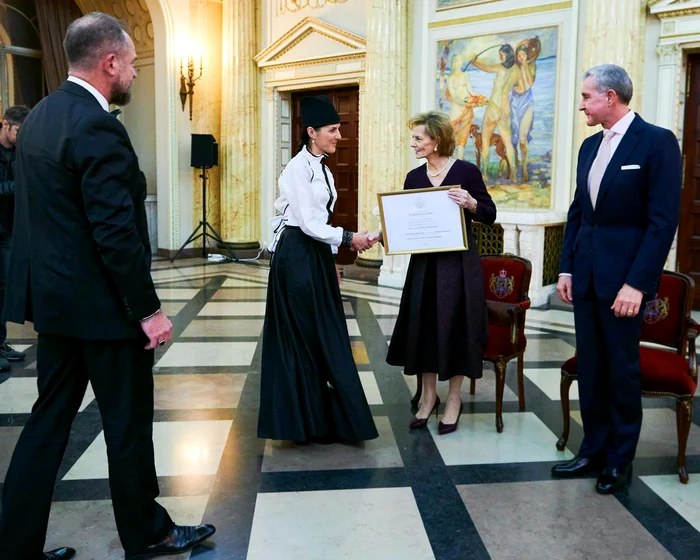
We are privileged because we did not promise a building, but a theater. We have sponsors who are our partners, who identify with our artistic path and we also build the cultural path together. We have the opening of the Sector 1 Town Hall, which supports the cultural approach of the Grivița 53 Theater, as well as the Undercloud Theater Festival, which turns 19 this year. Behind these institutions or companies are people who have the same need that we have: to leave behind us an authentic cultural heritage, to raise the coming generations beautifully.
Brick by brick for a shared dream
Grivița 53 Theater is the first independent theater built from scratch by the community after many decades. What does this fact say about the Romanian public’s desire for culture?
It is the first community building in the history of Romania. The first after 80 years built by private initiative. In our case, however, there were not many people who supported – 14,000 founders out of how many millions of Romanians?
When the public gets to contribute financially and emotionally to a cultural project, a new relationship is created between the artist and the viewer. How does that influence how you will program, produce or perform?
We want to keep the community close. We promised performance, authenticity and the continuation of the cultural journey together. The first year will be a pilot, small steps, patience, openness to learning from experience and not becoming omniscient. None of us have experienced this situation in our lives. So we are learning day by day and we want our viewers to be our friends, come with suggestions, help us grow this healthy space.
The living theater experience
The brick-by-brick community theater is a rare symbol of our cities. What does a cultural community mean to you in today’s Bucharest?
A cultural community identifies with what it consumes. The Grivița 53 community was animated by this dream that belonged to all the founders, not just mine. And it continues to be for all those who want to get out of the artistic routine and live new cultural experiences, performances to take home with you, to haunt you, to remember images, to hear rhythms, lines, vivid experiences, many days after you left the Grivița 53 theater – and at the same time wish to come back soon.
How do you see the role of art and theater in healing or energizing the city after years of pandemic and social polarization?
Come to Teatrul Grivița 53 and get the answer. First of all, to have cultural quality.
What advice would you give to people who want to get involved in the independent cultural field?
To get involved with everything if they have the willingness to put themselves on the back burner, to sacrifice their personal time, family, friends, to make an effort, to function unpredictably, to take risks.
You often work with young independent artists. How do the succeeding generations look? Are they braver or more cautious than you were in the beginning?
They are wonderful. I am different. They are alive, brave, with attitude, with curiosity. However, I would like for them to stop running so much between projects, contracts, to have more peace, to be more faithful to the projects. Give yourself more time. But what I’m proposing doesn’t pay their bills. Run for survival, not for pleasure.
How would you describe the Grivița 53 project in one word?
Miracle.
