

Lung cancer, the main cause of oncological mortality, is influenced to a great extent not only by smoking, but also by environmental factors. This is shown by a recent study carried out by a team coordinated by associate professor Dr. Beatrice Mahler and published in the journal Springer Nature.
PHOTO Pexels
Smoking, recognized as the main etiological factor in lung cancer, is not the only one with a major impact on the occurrence of lung cancer. More and more research highlights the significant impact of environmental pollutants, which explains, at least in part, the high number of lung cancers in non-smokers, says Dr. Beatrice Mahler.
The conclusion also emerges from a recent study carried out by a team of which associate professor Dr. Beatrice Mahler was a part, published in the journal Springer Nature.
“We hope that our research will represent a relevant analytical tool for the scientific community and decision-makers, in order to identify high-risk areas and establish effective prevention and intervention measures”said Dr. Mahler.
“Approximately 24% of deaths can be at least partially explained by air pollution levels”
The study analyzed the data collected in Romania over a period of 23 years.
“The retrospective analysis of the data collected in Romania during the period 1999–2022 shows that men over the age of 50 in the urban environment have a higher risk of lung cancer, 75% of deaths were also recorded among them, highlighting an unequal gender distribution of the impact of the disease, probably partly correlated with the habit of smoking, much more frequent in men than in women”. says doctor Beatrice Mahler.
The incidence of lung cancer increases after the age of 45. What was also highlighted for the studied period is the existence of two waves with an increased number of lung cancers, independent of gender and residence environment.
“The first wave, manifested in the 60–64 and 65–69 age groups, is detectable in 1999, having a downward trend over time. The second wave starts around 2010, affecting the 50–54 and 55–59 age groups. These aspects suggest possible cohort effects, which require further research.” states the pulmonologist.
The study also shows a correlation between lung cancer deaths and increased exposure to PM2.5 (particulate matter, less than 2.5 micrometers in diameter, which is associated with disease and death from heart or lung disease).
“Correlation analysis between lung cancer spatial clusters (new cases and deaths) and PM2.5 particle pollution clusters revealed a different association depending on the analyzed oncological indicator. For lung cancer deaths, the association with increased PM2.5 level is more pronounced (Cramer’s V value = 0.239), indicating that statistically approximately 24% of deaths can be at least partially explained by air pollution levels. These results support the hypothesis that exposure to air pollutants plays a significant role in worsening disease, contributing to increased mortality,” the doctor also mentions.
Increased incidence of lung cancer in areas with high radon concentrations
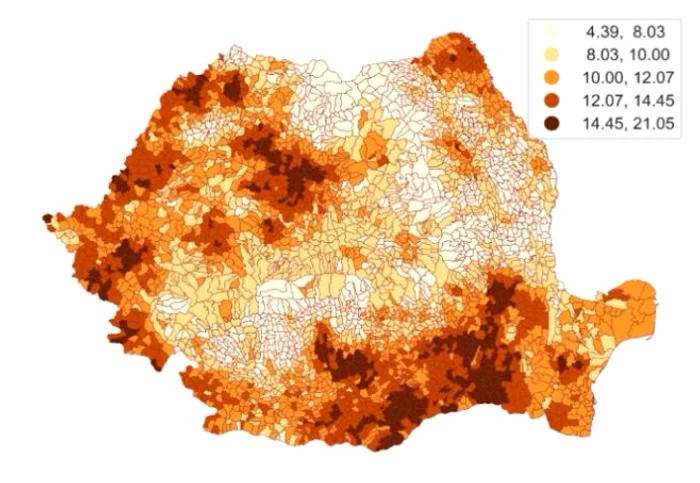
In intensely colored areas, the incidence of lung cancer is high. PHOTO Source: Baetrice Mahler
Radon is recognized in the literature as the second risk factor associated with lung cancer, says Dr. Mahler, and the correlation was also highlighted in the study under discussion. Romania has available data on radon concentrations for approximately half of the country, these data being provided by the Natural Radiation Atlas, made with the support of the European Commission. On their basis, the authors of the study found that high values of radon concentrations are predominantly located in regions that also register increased incidences of lung cancer.
“Chronic exposure to these toxic agents in inhaled air contributes to triggering oncogenic processes, but the effects are not immediate. Studies indicate a latency period of between 10 and 30 years between the time of exposure and the appearance of the disease,” also mentions Dr. Beatrice Mahler.
The authors of the study also created a map on which the incidence of lung cancer can be observed, this being a useful tool for the lung cancer screening program that was started last month, in partnership, by the National Institute of Public Health (INSP), the “Carol Davila” University of Medicine and the “Marius Nasta” Institute (partnership leader).
“There are areas where the incidence is higher and areas where the incidence is lower. Sure, we have cancer everywhere, but there, in the areas where the color of the map is more intense, there are mining areas, there is industry that did not have sufficient protection standards for employees, and in the south, in the Romanian Plain, because we also have to look at the period when the cohort was made, there we have agricultural activities that were done with certain substances. In Romania we have no data, but abroad the link between the carcinogenic risk of pesticides and substances used in agriculture and the increase in cancer incidence has been highlighted”. Dr. Mahler also specified.
