
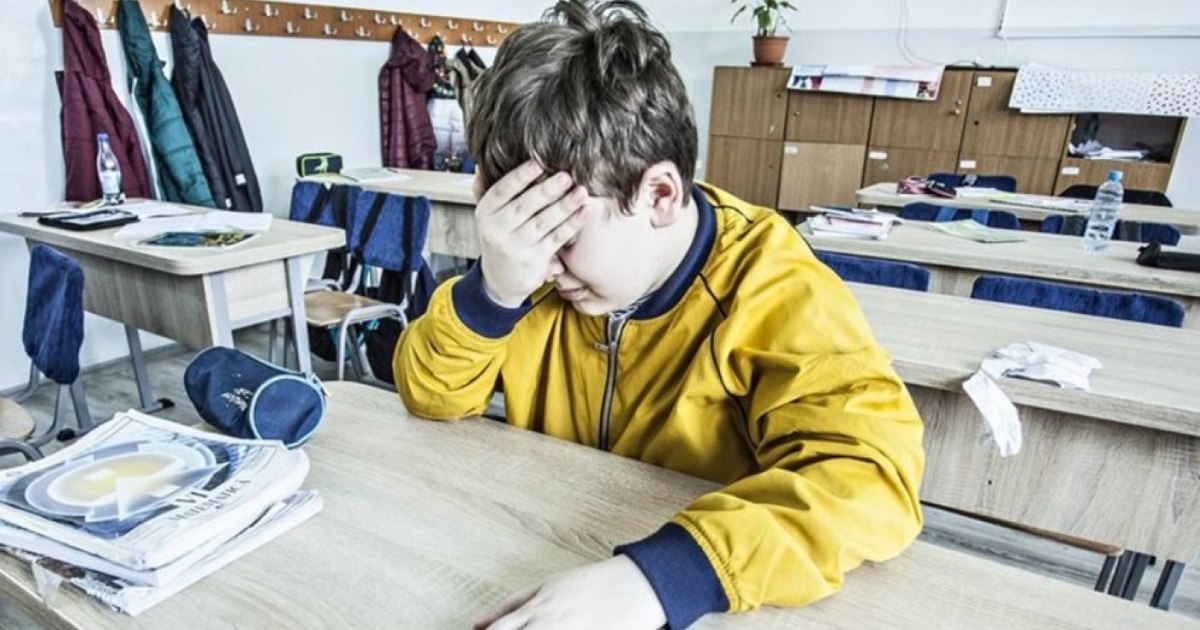
More than 70% of students have been bullied at or near school by peers their age or older. The reason? Most of the time, the aggressors asked them for money or other valuables, but there were also many cases in which they were just scandalized. Even more worrying is the fact that over 90% of bullies were once victims themselves. In this troubling, paradoxical context, many teachers choose to “turn a blind eye”, look away and not get involved.
Bullying has become a national phenomenon in Romanian schools. Source: archive
These are the data of a study carried out by the Ministry of Education in collaboration with the Romanian Police, which once again put the phenomenon of bullying, violence and abuse in schools on the back burner. The questions were answered online by 10,776 students from grades V-XII, 6,657 teachers and 12,209 parents, from 537 schools, between February and March 2024.
In schools in Romania, children fight among themselves under the gaze of their colleagues who make a gallery of them from the sidelines, some of them get excited, others encourage them, film them and then upload the images on social networks. In schools in Romania, bullying has become normal, physical and emotional aggression, but also verbal violence have become an almost common practice. And this phenomenon did not appear yesterday, from today, it was built over time, under the often careless eyes of teachers, parents, and the whole society. Because what do we do for them? Almost nothing. We send them to the banks and let them fend for themselves.
“In the school environment, with this fusion of online and reality, most manipulation and bullying techniques cause victims every day”psychologist Radu Leca explained for “Adevărul”. “Once the techniques learned online are applied in real life, victims need therapy. There are thousands of children who are left without packages, without money for food, without mobile phones, without the financial resources that allow them to play online”.
And everything happens more or less under the eyes of the teachers who instead choose to ignore these facts. “Teachers must understand that the years of the past will never return, the generations have evolved, the children of today have absolutely nothing in common with those of the 2000s. And this aspect must be known and accepted once by the teachers, but also by the parents “. But, the psychologist continues, they are afraid of change. “And they try to cosmeticize this fear by developing a bond of friendship with the children but not by involvement.”
“If they don’t get involved, teachers can be prosecuted!”
School violence produces, after drug use, a structure psychologically called “distancing from reality.” “Practically, all victims end up, at some point, thinking about giving up school, dropping out, to stop being beaten, humiliated, stolen or harassed,” sasks the psychologist. Teachers, on the other hand, choose to turn a blind eye and rarely get involved in such situations, although the law forces everyone to react. “Law 272 establishes that those who work with children, namely teachers, educators, doctors, social workers, etc. have the responsibility to inform the competent institutions when they encounter a form of abuse. If he does not comply with law 272, the teacher also falls under the scope of abuse of office or negligence in office”explained to “Adevărul” police chief commissioner Alexandru Leuţu-Cotroceanu, director of the School Safety Directorate within the General Inspectorate of the Romanian Police (IGPR). “That is, we are also talking about a criminal liability, we are also talking about a disciplinary liability, not to mention the status he has, as a teacher, and the obligations that fall to him from this point of view”. complete this.
Why teachers run away from responsibility: “They don’t want to do anything more”
Teachers who choose not to get involved in cases of violence between students or, worse, who try to cover it up, do so for a variety of reasons: “Out of fear, impotence, ignorance, lack of energy. Because we need to talk about it too. Teachers are very tired, blasé, unmotivated. We are dealing with an extremely fragile class of teachers from a psycho-emotional point of view. Any involvement they might have in all that is the phenomenon of active violence in schools would represent yet another responsibility, which most do not want”.
And then on whose shoulders should the responsibility fall? “The school police exists as a structure, but I, for one, don’t really see it active. And in addition to the school police, we should also have the police of the online space. Without these two police structures our children are in incredible danger from every point of view,” psychologist Radu Leca believes.
Chief Commissioner Alexandru Leuţu-Cotroceanu told us that the police, no matter how much they would like to, cannot supervise the children as the teachers can do, for the simple reason that the police do not patrol the school hallways or the courtyards. “I take the child to school. I expect the child to be safe within the school perimeter. Safety must be primarily the responsibility of the educational institution. After all, there are also some moral obligations that you as a teacher have. To say that you are going to teach your subject and leave does not seem ethical or professional to me”, considers the policeman.
Parents with problem children, in the sights of social assistance departments
When it comes to involving parents in combating and preventing aggression between children at school, we are on a minefield. In general, parents refuse to admit that they have problem children. Therefore, I do absolutely nothing about it. But the problem is much deeper, psychologist Radu Leca believes. “Society itself is devoid of civic spirit. We do not get involved in any kind of incident. We don’t know, we don’t see, we don’t care, it’s not our problem. Why? No Romanian wants to understand that he would have something positive to do for a citizen equal to him in value. People run away from responsibility. Some are afraid, others are very comfortable. Moreover, even when our own children are attacked many of us have no reaction. We are facing a phenomenon of non-involvement”.
On the other hand, violence is a scourge deeply embedded in the mentality of many families in Romania, where education is still done with the whip. If parents resort to aggression against children why would we expect them to intervene when those children are victims of bullying, for example? “Here, other state structures should intervene, such as those from Social Assistance and Child Protection, who can dispose of measures against the parent”, is of the opinion cchief omissar Leuţu-Cotroceanu. “We don’t want to go to the Norway model. But as if not like that, let’s sit and just caress each other, may it be good, may it not be bad. Every institution should do its job to the best of its ability. And here I am also referring to the assistance and social protection institutions that should have certain regarding families, implement the necessary measures and then follow the effects”, is the opinion of the police officer from School Safety.
“Silence is still violence”, a campaign organized in schools
In the context of concerns for the safety of students, the General Inspectorate of the Romanian Police initiated a campaign to raise awareness regarding the need to ensure an optimal safety climate in the school environment – “Silence is still violence. Your voice is the solution”, which will be implemented during the 2024-2025 school year. “The aim of the campaign is to raise awareness among parents, teachers, students, as well as at the level of society, regarding the need to ensure an optimal safety climate in the school environment. We try to prevent the victimization of minors, prevent and combat juvenile delinquency and/or criminality in the school environment and drug trafficking and consumption. We envision three directions of action: increasing students’ awareness of the importance of safety in the school environment, understanding the consequences of negative phenomena on their psychological development and on the educational climate, and informing the population about the identification of risky behaviors and vulnerable situations that students can be exposed to”, Commissioner Leuțu-Cotroceanu also declared.
