
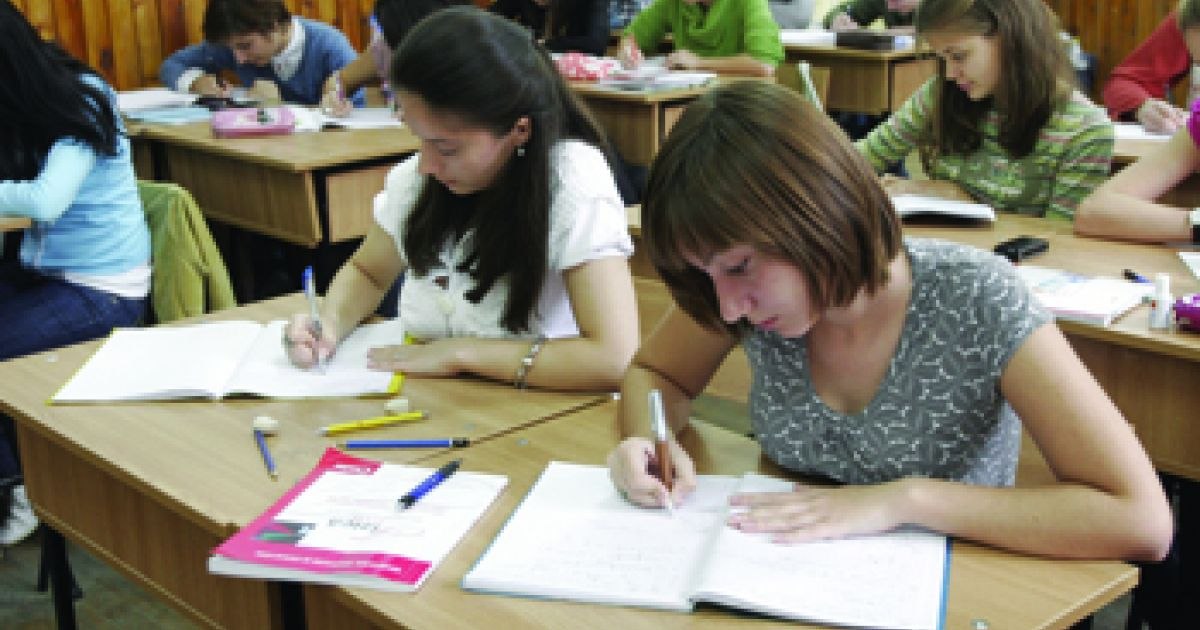
The Romanian language teachers draw a great alarm signal: from the gymnasium, students, many of them, seem to know better English than Romanian. “If in English I speak very well, almost fluently, in Romanian they make disagreements, they find their words, they have a deficient expression and an extremely restricted vocabulary”, He told “Adevărul” Ruxandra Achim, a teacher at the “Ilcagiale” National College in Bucharest.
Romanian students, arguing with grammar. Archive
In addition, more and more young people are expressed in a “hybrid” language, Romengleza becoming a habit in their daily conversations. What to do? “In the context of such a high level of illiteracy among students, they should benefit from several hours of literature and grammar including in high school ”, he considers the teacher.
“Children need, first of all, to know the language of the country in which they were born. And the school should offer them this possibility, not to “cut” them from hours, as they do through the new framework plans “, says the teacher.
From the “bonjurisms” of the 19th century to “Romengleza” today
Romengleza has become part of the daily life, and many do not even realize the moment when they mix the two languages in a conversation. This expression has become so natural that it is often very difficult for them to translate an English word into Romanian.
And this happens not because it would not know the meaning of that word, but because they actually do not know what his correspondent is in our language.
“We must be aware that if we mix in conversations and Romanian and English, in fact, we demonstrate that we do not know Romanian nor English ”, Professor Ruxandra Achim continues, who also explains the reasons for this trend.
“This globalization and infusion, not necessarily English of films, music, vlogs. That is, elements related to contemporary civilization. It’s a fashion, without discussion. It’s a kind of jargon to which young people call. And this is not a new one. It happened at the beginning of the 19th century, only then was French. ”
Professor Ruxandra Achim believes that young people should know very clearly where to stop with the expression in Romanian and where to stop with the expression in English. “We must adapt to the communication situation. We live in Romania, therefore we speak in Romanian. I’m not saying that everyone knows English today. It has become normal, usually. You are no longer “cool” because you know this foreign language. “
Many children find it interesting to express themselves in English in their conversations. It seems to them probably that in this way they draw attention to them, show those around them how “cool” they are. But it is wrong and risks falling into pain. “And, be careful! These young people do not know english language At an advanced level, which would indeed be a performance. Not. They know her at a medium level. And then, what does it boast, more precisely? ”, the teacher asks.
The teacher confessed to us that he often encounters situations in which students express themselves by combining elements from both languages. “I ask Romanian:” What language do you speak? “ The teacher explains that reducing communication to some cliché aspects demonstrates, in fact, to reduce thinking about some clichés.

Ruxandra Achim, a Romanian language and literature teacher. Archive
The antidot of illiteracy among the students
The framework plans that the Ministry of Education has proposed provide in the real profile a number of hours of Romanian language equal to the number of hours of foreign language 1.
“I mean two hours Romanian, two hours of English. To the 11th and 12th grades at Real. Which is very bad ”, Professor Achim continues. This is of the opinion that in high school it would take several hours to include both literature and grammar. “It is absolutely illogical to do, for example, astronomy, but you do not master an essay that you must compose in Romanian ”.
The teacher discusses examples from other European countries, where the national language is treated with priority in schools. “All countries have such hours of national language and literature. And we are not talking about an exaggerated patriotism. After all, you belong to such a community. As such, you must master the mechanisms of expression in that language well ”.
Returning to the framework plans put in public debate, Professor Ruxandra Achim believes that in this context of the “English” Romanian language it is imperative that high school students study in-depth. “It is not possible for Real, from three hours as children currently have, to reach two. The same as they have in English. It is inadmissible. Students should study Romanian at least four hours a week ”.
The reason? Teachers would have time, in this way, to explain certain concepts and subtleties in detail, to present certain aspects with more finesse. And children would have time to assimilate the information.
Obviously, an supplementation of the number of hours allocated to a matter, inevitably, leads to the dislocation of others. Do you have to cut from somewhere else what to do? “The students high school have a maximum of 30 hours a week. Which is why certain subjects could be combined. The history of communism and the Holocaust, for example, could come under the umbrella of Romania’s history ”, It comes with the Achim’s teacher solution.
Literature or grammar?
When we talk about the Romanian language as a discipline of study we refer to both literature and grammar. “Students should study one and the other. You cannot deepen the Romanian language by studying only literature or only grammar. The two go hand in hand. Literature is bearing grammar, it cultivates a literary layer of the tongue, a clean, correct language. Literature cultivates figurative shades of words, meanings that are very useful in an individual communication. Of course, we will not start to talk now in metaphors. But you can understand the figurative meanings of the words by observing the metaphor from a literary text ”, he considers Professor Ruxandra Achim.
It explains that a language, no matter what it is, is not learned by doing only grammar exercises. “In vain do you know the theory of the use of commas if you do not see those commas in a text.” In addition, literature does not play a role only in the sphere of communication. “Literature is an art and gives the child the opportunity to understand and express their emotions.”

Alina Ganj, a foreign tongue teacher. Personal archive
Engelza language, learned with pleasure
Why did the Romanian students, many of them, become better English than Romanian? “First of all, because they came to read less and less. We all know, the vocabulary develops from reading, but this activity is no longer of interest among young people ”, He told “Adevărul” Alina Ganj, a foreign language teacher and the founder of a foreign language center that offers children’s courses.
In a world where they are exposed to small screens, when gadgets have become their modern toys, in a society that offers the information ready, the child no longer struggles to “fight” for her. Reading a book is hard today: you have to make time breaking from somewhere else, you have to focus, put your mind in motion, judge, think critically. And who has time for that? Who still has this availability when we can find summary on the Internet or in movies on Netflix?
On the other hand, the English language that young people speak between them, to the detriment of the Romanian language, which they have forgotten, is the direct consequence of the entourage in which they revolve. Professor Alina Ganj explains that young people tend to attach themselves to colleagues and friends, finally, to influence each other. While at home, in the family, they speak only Romanian, because parents, grandparents, etc. are reported, in the community they proceed in the same way: they relate to those around them.
“The whole Romanian society has English over time, and English is no longer a differentiatory factor. English has become a basic composition in almost any field. That is why there is talk about the importance of learning another foreign language ”, explains the teacher.
She confessed that the exposure of children from an early age to English is also among the reasons why many of them have come to know better than Romanian. “It has been shown that the child’s exposure to a foreign language develops some neuronal connections in terms of the correct pronunciation. We are talking about the so -called opportunity window – a period when the brain is extremely receptive to learning sounds in a foreign language. After this period, it is much harder to depend on the correct pronunciation ”.
Solutions
The two teachers believe that the Romanian language should regain their status and reconsider their chipped image right in school. “It is necessary that the students are studying their deeper throughout the school years, just as reading is very important, opening the appetite for children to read. The English language has become easier and easier to accept and that it is associated with pleasant things, which the student gladly embraces: music, movies, online applications, social networks, etc. In a word, pleasure, relaxation, socialization ”, Prof. Alina Ganju continues. What is not bad at all, but, on the other hand, there must be a balance, to encourage young people to express themselves correctly in their native language. “Readings should be intended for children according to their age. To pull them, to make them resonate with the subject and the characters, to find themselves in those books. If in you, on the other hand, you give them to read a Rebreanu, they will do it, but not with pleasure. For they are hit by an outdated, outdated language, with which they do not identify ”explained the teacher.
It is good that Romanian students have a special inclination towards foreign languages, it is even praised and encouraged. However, when the child has note 10 on the line in English and only 5 or 6 in Romanian, when in English he speaks perfectly, and in Romanian he makes serious disagreements, then clearly a break has occurred.
From September 2026, students in the 9th grade will study for the first time in the last 20 years, the grammar of the Romanian language. This will appear in the form of chapters in the continuation of the gymnasium matter. Teachers and students say that it is one of the best changes in public debate by the Ministry of Education.
