
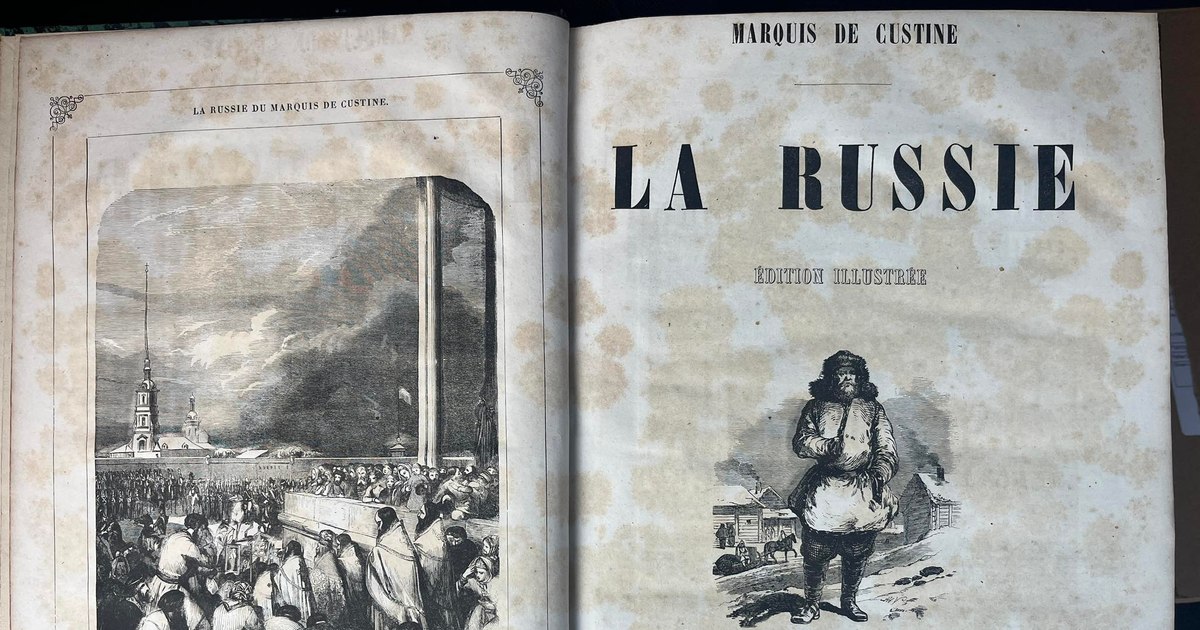
A French writer’s warning about Russia’s danger to Europe, from a book published in the 19th century, has returned to the present day. The philologist Adrian Papahagi claims that many of the defects that the Marquis de Custine observed in Russia since then can be found in Romania today.
The philologist and essayist Adrian Papahagi talks about the only duty of intellectuals in society: “Sbe smart. I mean awake (awake is also moral, not just intellectual). To understand the man and the times, and tell the truth at any cost. Truth is prophetic: sooner or later it is confirmed by reality.”
Papahagi listed some great thinkers who reflected on the times in which they lived: Edmund Burke (1729-1797, Anglo-Irish philosopher and statesman considered the father of political conservatism), Alexis de Tocqueville (1805-1859, French political philosopher, politician, historian, precursor of sociology and writer) and Astolphe-Louis-Léonor, Marquis de Custine (1790-1857, a French aristocrat and writer who is best known for his travel writing, particularly his account of his visit to Russia in 1839).
“The former understood as early as 1790 the criminal monstrosity of the French Revolution, which was in full swing; in 1835-40, Tocqueville perfectly captured the essence of the young American democracy, including its nombrilism, pragmatism, and egalitarianism; the letters from Russia of the Marquis de Custine, written in 1839 and published in 1843, are valid to this day“, details Papahagi.
“Immense abjection of the Russians, servility, cunning, generalized lying”
“Immense abjection of the Russians, servility, cunning, generalized lying, obsession with appearing what you are not in the eyes of foreigners, filth hidden behind monumental facades, generalized fear, fear of the neighbor, who can always hide a spy, bureaucracy and great efforts made for small things, impractical gigantism, etc. In general, the lack of freedom and dignity of people. All this persists. As in Macbeth, all fear the tyrant, and the tyrant fears all”claims Papahagi on Facebook.
The Marquis de Custine’s book came to be cited again, almost two centuries after its publication, because history seems to have confirmed her observations. The book functions today as an uncomfortable mirror: for Russia, which finds itself in the portrait, and for Europe, which is forced to admit that it has long ignored the warnings from the past.
Custine warned Western Europe against idealizing Russia and mistaking the mimesis of reform for real change. He argued that Russia will always try to legitimize itself in the eyes of Europe, without sharing its values. In the context of repeated failures of “resets” and strategic dialogue with Moscow, these passages are perceived as prophetic.
There are striking similarities between Tsarist Russia and contemporary Russia. Custine describes a society dominated by fear, obedience and institutionalized lying, where power is maintained through control, propaganda and repression.
“In Russia, fear takes the place of respect, and submission is not the result of duty, but of terror,” wrote the Frenchman.
“The Russian people do not revolt against despotism; freedom seems dangerous to them”
He insists on the idea that the populace is used to absolute authority and even seeks it: “The Russian people do not revolt against despotism, because they have been brought up under it; they find freedom dangerous and obedience natural.”
He describes a society in which the individual does not exist as an autonomous subject: “There are no citizens in Russia, only subjects; man does not live for himself, but for the state.”
Many readers note that these features are found, almost unchanged, in today’s Russia. His famous diagnosis – that Russia “it is not a nation but a barracks” – seems, to many commentators, surprisingly current.
Custine is also quoted in the context of the war in Ukraine and the tense relationship between Russia and Europe. After 2014, and especially after 2022, interest in “deep” explanations of Russia’s behavior exploded. Custine is quoted because he offers a cultural and historical key, not just a political one: the idea that Russian imperialism is not an accident of a regime, but an old reflex, linked to the structure of the state and the relationship between the individual and power.
Custine observes that the fundamental relationship between the state and the individual in Russia is fear, not law or the social contract.”
One of the book’s most cited motifs is the regime’s obsession with appearances and total control: “Here everything is a lie, because the truth would be a crime.”
Even tougher: “The Russian government does not ask people to believe, but to pretend.”
This culture of simulation is, in Custine’s view, deeply dangerous for Europe.
“As long as Russia is great and feared, Europe will remain tempted to sacrifice freedom for peace”
Custine makes a clear distinction between civilization and its imitation: “Everything in Russia is imitation: Western institutions, Western political language, forms without substance. The spirit of freedom is completely lacking.”
This culture of simulation is, in Custine’s view, deeply dangerous for Europe.
Custine explicitly warns the West about Russia, not as a specific military power, but as a political model: “Europe unjustly fears revolution, and from this fear runs the risk of accepting Russian despotism as a solution.”
He sees Russia as an exporter of authoritarianism: “Russia will conquer Europe not by arms, but by ideas: by glorifying order without freedom.”
And in a passage that has become famous: “Russia is a prison whose walls stretch beyond the borders.”
Custine believes that Russia is holding back the political evolution of the continent: “As long as Russia is great and feared, Europe will remain tempted to sacrifice freedom for peace.”
He warns that alliances with Russia are morally toxic: “To ally with Russia is to legitimize despotism and make it respectable.”
“Many of the lands of Russia are also found here”
Custine describes not only institutions but also mentalities. He speaks of a people accustomed to despotism, who abhor it, but at the same time reproduce it. This ambivalence—fear of power combined with fascination for it—is frequently invoked today to explain passive or active support for authoritarian regimes.
Andrian Papahagi claims that many of the problems identified by Custine in Russia are also present in Romania.
“Many of the countries of Russia are also found in us (and in the 1980s there was no shortage of any), with all the already multi-century effort of some elites (accused sometimes of bonjourism, sometimes of synchronism, sometimes of cosmopolitanism, but more recently, of Sororism and globalism), to break away from the oriental nothingness, which excels only in the annihilation of dignity and human life”. concludes the philologist.
