
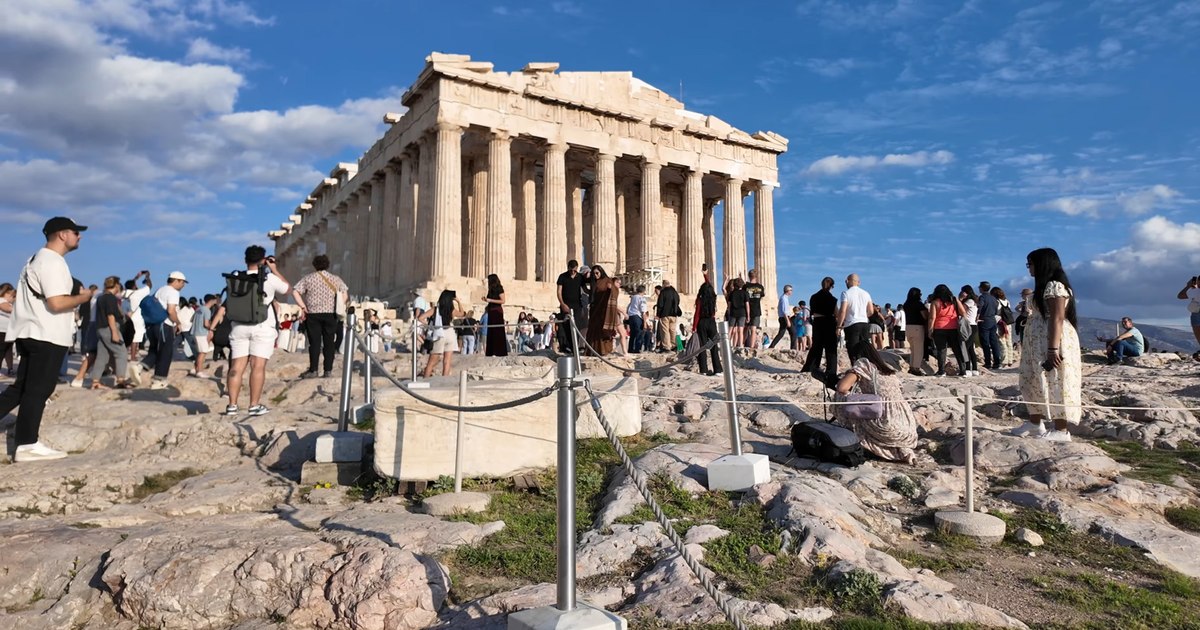
For the first time in 20 years, the view of the Parthenon is no longer shadowed by iron and scaffolding. Visitors to the Acropolis can now admire the western facade of the famous temple just as the ancient Athenians did it—free, bright, overwhelming in its simplicity.
A lesser-known detail: no part of the Parthenon is perfectly straight. Greek architects introduced optical curves and angles that correct the visual illusion, creating the impression of absolute balance. This calculated perfection is also precisely preserved in the modern restoration.
In this article, you will find out how the restoration of the monument went, what techniques the specialists used to preserve the optical perfection of the Parthenon, what excitement was caused by the reunion of the visitors with the temple of Athena freed from the scaffolding and why, even after two decades of work, the importance of its protection remains essential (SEE PHOTO AND VIDEO GALLERY).
Also here you will discover, in brief, the story of the Parthenon (Parthenon) – from the architectural genius of Iktinos and Phidias to the modern restoration efforts that restore the splendor of the temple of the goddess Athena.
Image 1/10:
The Parthenon on the Acropolis of Athens free of scaffolding after 20 years Photo Daciana Stoica for the Truth
Two decades of careful restoration of the Parthenon
The restoration of the Parthenon is considered one of the most complex conservation operations in the world. The project, started in the 80s and continued with a new stage in 2001, involved dozens of specialists, architects and archaeologists. Each block of marble was measured, digitally scanned and reassembled by hand to recreate the original proportions designed by Phidias and the architects Ictinos and Callicrates.
More than 2,000 fragments have been cleaned and fixed, using modern techniques that do not affect the ancient structure.
After two decades of painstaking conservation work, the outer metal scaffolding that covered the 5th century BC monument. they were dismantled at the end of September, providing for a short time (about a month) a completely unobstructed view of the most famous temple of the ancient world.
The western facade, from which the scaffolding has been removed, is the first image revealed to visitors climbing the Sacred Rock of Athens. Now, it offers a unique visual experience. Restoration work on this side was carried out by the Acropolis Monuments Conservation Service.
Visitors’ reactions: the thrill of a re-encounter with history
“It’s like seeing a completely different monument. For the first time in nearly 200 years, the exterior of the Parthenon is completely free of scaffolding”noted the Greek Minister of Culture, Lina Mendoni, in an interview granted to Skai station.
Among tourists, the reactions are both excited and surprised: “We visited the Acropolis (Acropolis) three times, but only now we had the feeling that we were really seeing it. Without scaffolding, the Parthenon seems alive, almost divine.”
The images posted on social media went viral within days under the hashtag #ParthenonUnveiledwhile a collective emotion is felt on the pedestrian streets surrounding the Sacred Rock of the Acropolis.
Photos are flooding social media, with many describing the experience as a “back in time”a moment when history breathes again without iron barriers.
Spring 2026 scaffold-free Parthenon: restoration almost complete
But this magical moment is temporary. Although the exterior of the Parthenon is being restored, work continues. Specialists warn that in November, the scaffolding will return – this time lighter, more discreet and adapted to the architecture of the ancient monument. The aim is to strengthen the internal structure of the Parthenon without obstructing the view of visitors.
The restoration will last until late spring – early summer 2026, when the Parthenon, the timeless symbol of the Acropolis of Athens, will finally be completely freed.
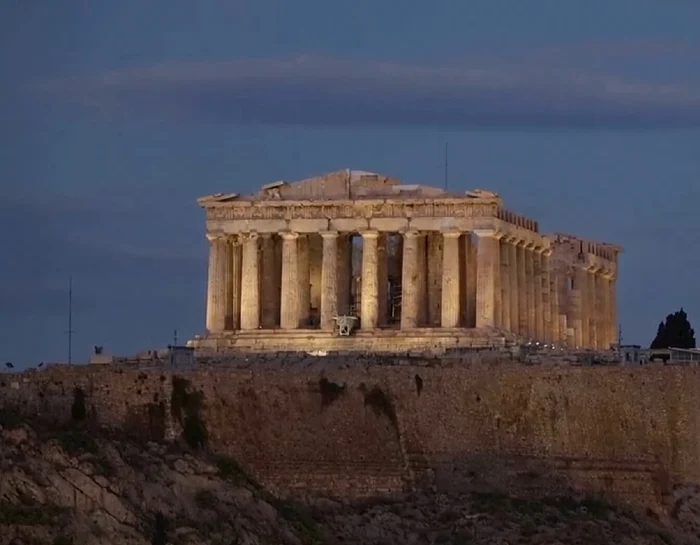
The Parthenon on the Acropolis of Athens free of scaffolding after 20 years Photo Daciana Stoica for the Truth
The Parthenon – the place where marble defeated time
The Parthenon – the temple that has watched over Athens for over two and a half millennia – stands on the Sacred Rock of the Acropolis, right after the Propylaean Gate. Seen from Philopappou Hill, the monument seems suspended between sky and stone, between myth and reality. In Antiquity, it was said that its marble shone so brightly in the sun that it could be seen even from the surrounding islands.
Built around 447 BC. by the architect Iktinos and the sculptor Phidias, the Parthenon was the gift of the Athenians to the goddess Athena – protector of the city and symbol of wisdom. Inside, a huge gold and ivory statue dominated the sacred space, for which, say the chronicles, half of the temple’s budget was spent.
Its construction was a revolution of ancient engineering. In fact, architectural design reflects a remarkable understanding of aesthetics, mathematics and engineering. The 136 Doric columns over ten meters high, silent witnesses of millennia of sun and wind, are not perfectly straight – they curve slightly inwards, correcting the imperfection of the human eye. The result: an illusion of absolute perfection.
The weathered marble whispers stories of gods, heroes and philosophical debates that have shaped Western thought. Brought from the quarries of Mount Pentelic, 17 kilometers away, each block weighs over ten tons. The stone used in the restoration of the temple is still quarried from the same place today – a process that is nearing completion, almost 2,500 years after its construction.
The Parthenon remains proof that true beauty is not reinvented – it is patiently preserved, block by block, generation after generation.
Bathed in golden sunlight, the Acropolis of Athens embodies the eternal human aspiration for beauty and knowledge. Here, stone meets sky, history embraces eternity, and man seeks transcendence—a reminder that even ruins can inspire awe and spark the imagination.
The Parthenon, an eternal symbol of beauty and endurance
The image of the Parthenon freed from the outer scaffolding is not only an architectural one – but a symbolic one. It speaks of rebirth, of the balance between past and present, reborn from marble, of the patience required to preserve authentic beauty.
For Greeks, but also for visitors from around the world, this moment represents a reaffirmation of the values that gave birth to democracy and inspired Western civilization.
Although many would prefer things to remain as they are, Greece – the land of the gods – cannot afford to risk the degradation of a symbol that has survived millennia. The white marble of the temple dedicated to the goddess Athena needs constant protection and treatments against pollution and erosion.
The Acropolis, a UNESCO World Heritage Site, remains the most visited tourist attraction in Greece, with more than 4.5 million visitors in 2024, according to statistical authority ELSTAT.
The Parthenon is more than a temple – it is a testament to classical perfection, a symbol of democracy and the human spirit. And now, for the first time in a generation, the world can admire it as it was designed: free, bright and eternal.
In a rapidly changing world, the Parthenon is a reminder that some masterpieces just need time and care. In the light of the Athenian sunset, the Parthenon is no longer just a relic of history, but proof that true beauty can be restored, but not reinvented. Athena regains, for a moment, her marble soul.
