
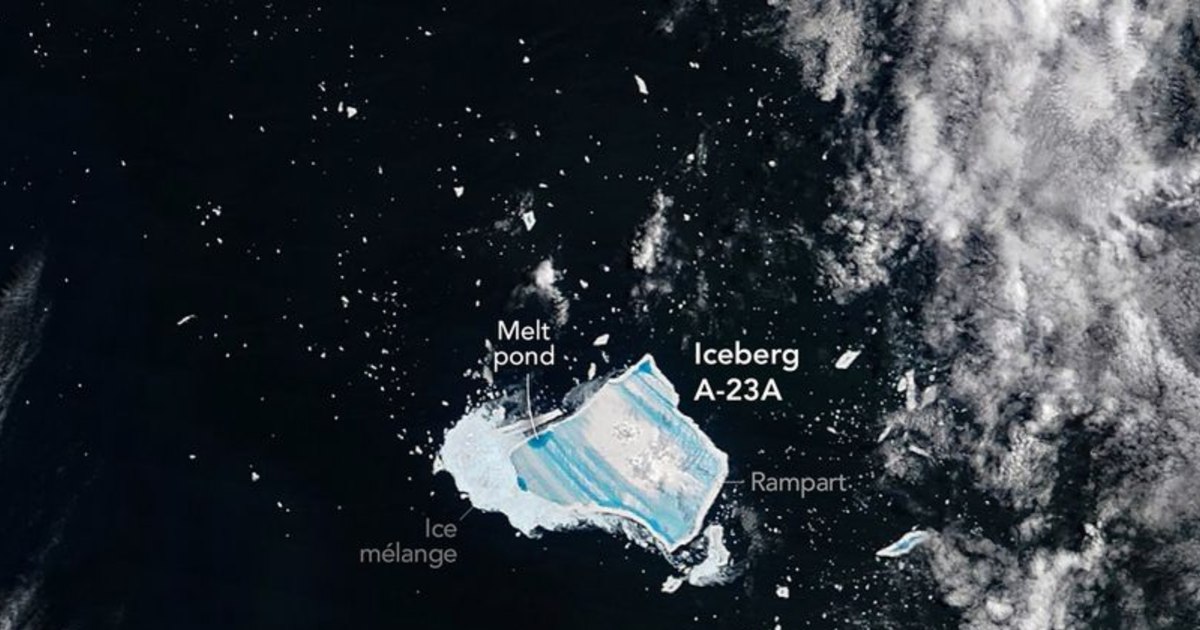
The A-23A iceberg, the world’s largest, has turned blue, and scientists warn that this transformation heralds its imminent disintegration. The iceberg first broke off from the Filchner Ice Shelf in Antarctica in 1986 and drifted into the South Atlantic
However, new images taken by NASA show that the former “King of the seas” is now covered by meltwater, writes the Daily Mail.
Experts warn that the A-23A iceberg could disintegrate in the coming days or weeks. Although at its peak it was more than twice the size of London, it is rapidly shrinking as it floats through the warmer waters of South America and South Georgia Island.
In January, researchers at the US National Ice Center estimated that the iceberg’s surface had shrunk to just 1,182 km².
Dr. Chris Shuman, a researcher at the University of Maryland, Baltimore County, who has followed this iceberg throughout his career, says: “I certainly don’t expect the A-23A to survive the austral summer.”
But the NASA satellite image suggests that “wall of protection” of the iceberg has given way.
In what Dr. Shuman describes as a “explosion”the weight of water accumulated in the melt pools became so great that it broke through the edges of the iceberg and flowed into the ocean below.
Dr. Tedd Scamboss, a researcher at the University of Colorado Boulder, explains that the water accumulated in the ice cracks forces them to widen, accelerating the degradation of the A-23A iceberg.
Once considered the world’s largest iceberg, it broke off in the 1980s, remained stuck in the Weddell Sea for over 30 years, then broke free in 2020.
As of January 2025, A-23A had an area of approximately 3,650 km². By September, however, this had shrunk to just 1,700 km² after several large chunks broke off.
The A-23A is already in waters about 3°C warmer than those around Antarctica, and currents are pushing it towards even warmer waters in “cemetery of icebergs”.
Dr. Shuman adds: “A-23A has the same fate as other Antarctic icebergs, but its journey has been remarkably long and eventful. It’s hard to believe it won’t disappear very soon.
I am extremely grateful that we had the satellite resources that allowed us to follow it and document its evolution so closely.”
