
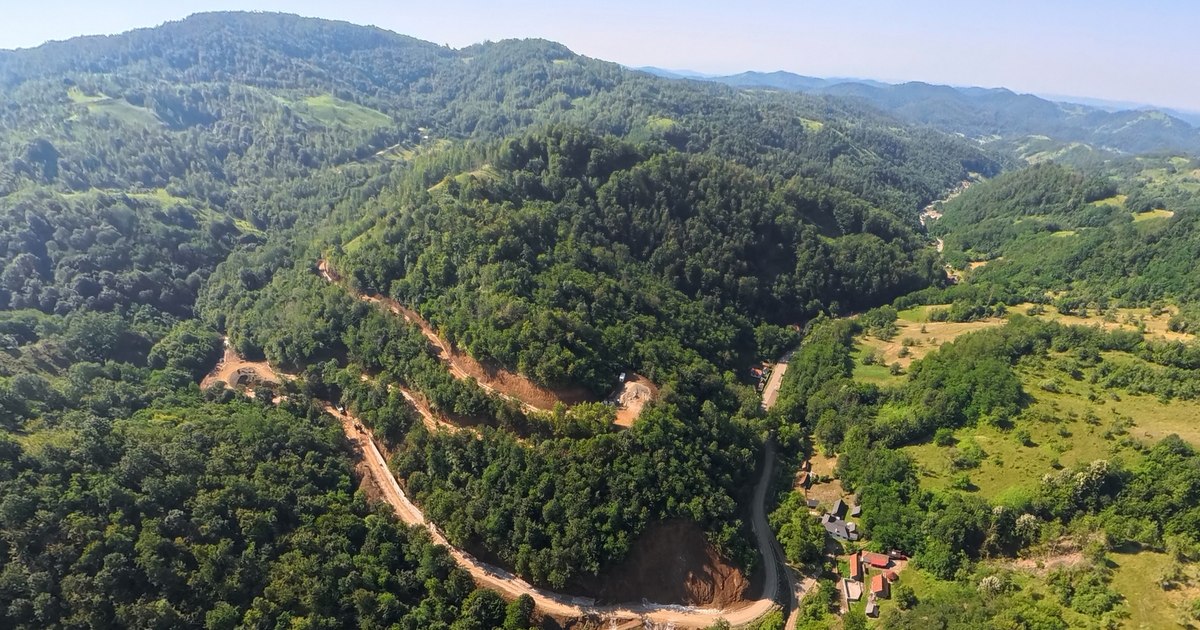
A new mountain road has entered construction in western Romania. The “King’s Road”, so named because of a legend that links it to the royal family of Romania, is being built with European funds in the counties of Arad and Hunedoara, linked by the Zarandului Mountains.
More than 42 million euros are invested for the construction of a 17-kilometer mountain road, which will connect, through the Zarandului Mountains, the Mureșului Valley with the Crișului Valley. The works are financed with European funds and were divided into two sections, with a completion date of 2027.
Kilometers of retaining walls
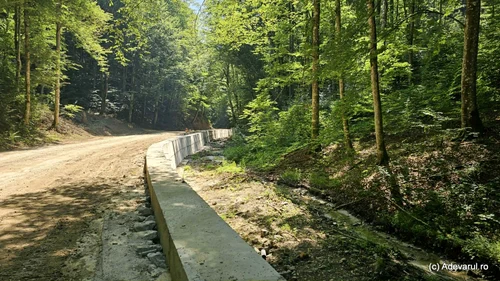
The first segment of the “King’s Road” (DJ 707), about four kilometers long, climbs in serpentines from the Arada commune of Petriș to “Cota Zero”, in the Săvârșin Mountains, at about 700 meters above sea level, a place on the border of Arad and Hunedoara counties. Work on this sector began in 2025, and the builders are currently erecting the concrete retaining walls, designed to prevent landslides. The embankment of the road was dug into the mountain, and the former forest road on which it overlapped was widened to two traffic lanes.
The place was named “Cota Zero” to mark the border between the counties and the beginning of hiking trails to the ridges of the Zarandului Mountains, which rise up to a maximum of 900 meters and are generally covered with forests. The second section of the “King’s Road” descends from here in serpentines, through the forests of the Baișor valley and the Vața river, on a route of 13 kilometers to the Vața de Sus resort.
The work on this segment started in the spring of this year and is at the stage of making the embankments and retaining walls. The new road passes through the village of Căzănești, the birthplace of the priest Arsenie Boca, and continues towards the Vața Bai resort.
“The works on the section located in Hunedoara county aim at restoring the road structure on the 13 kilometers, arranging 16 intersections with side roads, making rainwater drainage systems, repairing the four bridges, building 23 protective walls and arranging 29 accesses to properties”, shows the Hunedoara County Council.
The King’s Road from the Zarand Mountains
The new road in the Zarandului Mountains received the name “King’s Road”, due to the legend that its old forest route would have been used, in the interwar period, by the royal family of Romania to travel from the Săvârșin Castle, located on the Mureș Valley, in the vicinity of the Petriș commune, to the Vața de Sus thermal resort.
However, the locals remember that this road, although paved in the past, has always been difficult, being used by the villagers to reach the forestry operations in the mountains or the mines in the area.
“Other than the TAFs, I don’t think any car could go up this route, not even one of the royal family,” says a local from Obârsia.
Some locals from the villages located on one side and the other of the Zarand ridges, in Hunedoara and Arad, say that the new road will use them less, because the villages in the mountains have remained deserted, and the meadows where their grandfathers grazed their animals have become forested. Even the old mines in the Zarandului Mountains have not existed for at least two decades.
The resort with thermal waters in the Zarandului Mountains
Instead, the road is seen as a tourist route to the Vața Bai resort in the Zarandului Mountains, known for centuries for its thermal springs.
The waters rich in calcium, sulphur, sodium and magnesium, with a temperature of 36–37 degrees Celsius, became famous for their therapeutic qualities in the 19th century. Then, a small resort was established here, and publications from the Austro-Hungarian Empire and from Romania often presented the benefits brought by the waters of Vața.
Zorro from Transylvania. Who was “Black Face”, the Hungarian count who overnight became an outlaw on the high road
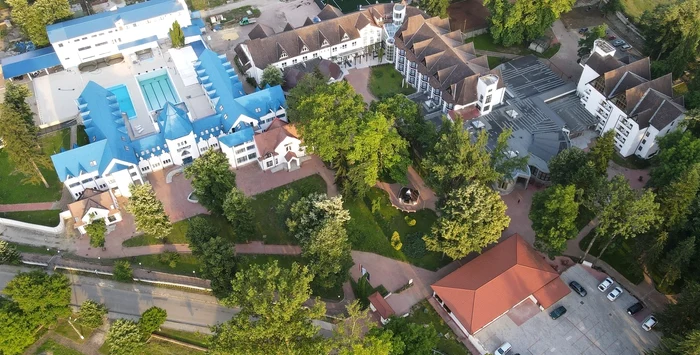
At the beginning of the 20th century, the Vața baths were frequently visited by King Carol II. In the 1970s, the communist regime expanded the resort, turning it into a treatment site for tourists with locomotor and peripheral nervous system conditions.
“Since I’ve been here, I’ve seen people come in canes and leave briskly, like athletes,” recounted the resort’s former balneologist, Marilena Suciu.
After 1990, the spa complex became the property of Romtelecom, but it was closed in 2010. For many years, the locals were left with only the “pig bath”, a small lake behind the complex, fed by a thermal water pipe.
“It was so named because here an emaciated sow was left to die near the springs, but after a few days she returned healthy to her master’s yard“, a local recalled.
For several years, the Vața de Jos complex has been purchased by private investors and restored. The Vața de Jos resort was reopened in 2022 and transformed into one of the area’s tourist attractions.
Arsenie Boca’s Pilgrim’s Way
Arsenie Boca (1910–1989), one of Romania’s great religious figures, was born and raised in the village of Căzăneşti, in the commune of Vața de Jos, also crossed by the “King’s Road”.
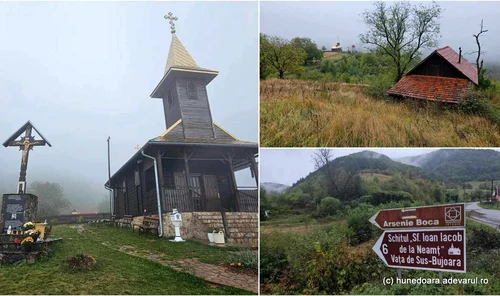
The hearth of the monk’s parental home, located on Bujoara Hill, on the edge of Căzănești village, has become a place of pilgrimage for many Romanians, although the house where Arsenie Boca was born no longer exists. The hill, also called “Hill of Happiness” by the locals, is home to a hermitage built almost a decade ago, cared for by two nuns. The last two kilometers of the road to it are marked by troits and icons, and at the foot of the hill is the old wooden church from Căzăneşti.
Near Vața de Jos is the town of Brad, a former mining center that houses the only gold museum in Europe, and the Apuseni Mountains attract with their numerous natural monuments and the archaic villages of the Moti. Also near Vața Bai, travelers find Țebea and Baia de Criș, historical places that preserve the memory of Avram Iancu and Horea, Cloșca and Crișan.
This is where Black Face’s outlaws were hiding
In Arad, the “King’s Road” will descend to the Mureș Valley, near the Castle of the royal family from Săvârșin and Zam, the site of the famous castle of László (Vasile) Nopcsa (1794–1884), baron and former Supreme Comite of Hunedoara. The count entered the legend as “Black Face”, a character associated with a band of outlaws who allegedly robbed, in the 19th century, the stagecoaches and gold transports on the great road of the Mureș Valley, between Banat and Transylvania.
Controversies of Arsenie Boca’s parental home. Where the “Saint of Transylvania” was born and raised
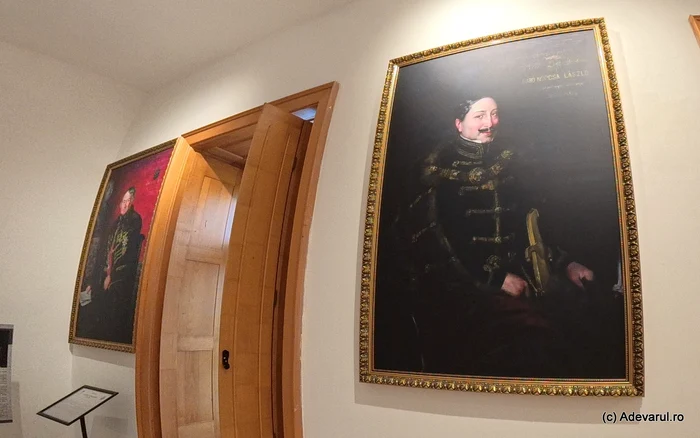
The nickname was given to him after the writer Mór Jókai turned him into a novel character, presented as a baron who hid his face under a black mask when he went out to rob.
The legend of “Black Face” was inspired by the many stories about the bands of outlaws hiding in the Zarand Mountains. They often attacked gold shipments from Apuseni or got in the way of postmen, Zam being a “customs” between the two historical regions.
“All of Zarand was roamed in the 17th and 18th centuries by gangs of outlaws, “lotrii”, as the documents call the Romanian peasants who took the path of the forest, exasperated by oppression, and attacked the nests of the nobles. The movement of the “lotrii” in Zarand had such a large scale that not infrequently armies were mobilized. It even came to close the borders of the county and demand passports for passage. And it is not surprising that such solutions were reached“, informed the magazine România Pitoreasca, in 1973, citing historical sources.
Some gangs of outlaws supported, according to historians, the gangs of serfs led by Horea, Cloșca and Crișan during the Uprising of 1784–1785. Starting from the 19th century, the Zarandului Mountains became more welcoming places for travelers, due to the increased importance of the surrounding mining towns, but also of the Vața de Jos spa resort.
However, in recent decades, depopulation has brought many villages in the Zarandului Mountains to the brink of extinction.
