
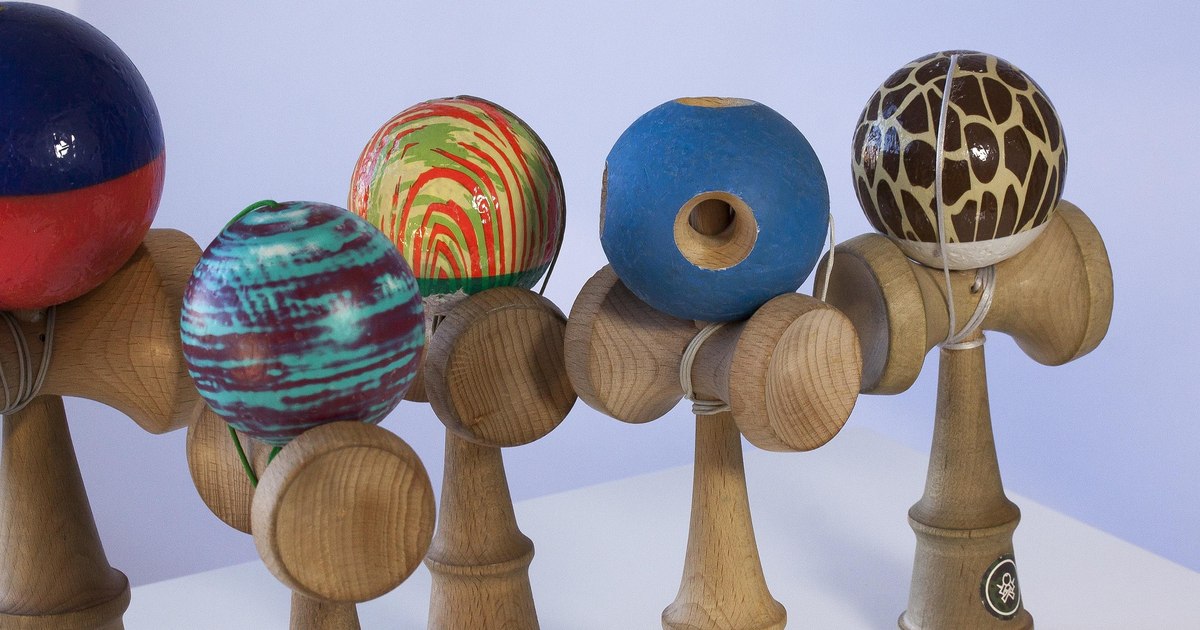
The toy recovered after a decade, the kendama, seems to have become a problem for some teachers, who are calling for a ban on its use in school. Parents oppose the decision and want clear rules so students can enjoy the benefits of using the toy that keeps them away from their phones.
Kendama remains at the top of children’s interest PHOTO: Pixabay
For fear of possible accidents, kendama, the toy for which parents are willing to pay considerable sums, just to see children playing with other children and leaving their phones aside, has become a scare in schools. There are educational units where access with such toys was prohibited, despite the fact that many parents opposed the decision.
“I think it’s more convenient for them to ban it completely”
The leader of the EDUPART National Federation of Parents – Bucharest branch, Dan Tița, told “Adevărul” that there are several such situations in the capital. It is also the reason why, beyond the discussions with the directors of the school institutions, carried out for each individual case, FNP EDUPART Bucharest also issued a press release in which it advocates for the regulation of the use of the toy, considering the prohibition measure as unjustified.
“Educational specialists point out that playing with kendama helps develop coordination, concentration and patience, while also providing an active alternative to spending time on electronic devices. Also, collective activities based on this game can stimulate team spirit and collaboration between students.
On the other hand, there have been instances where the kendama has become a source of distraction during class or caused minor incidents due to improper use. In this sense, it is recommended that the game be allowed only during breaks, in the school yard or during organized educational activities, under the supervision of the teaching staff”. the parents show in the statement.
“I had situations in Bucharest and in Ilfov, I spoke with the colleague from Ilfov. The problem is that they were very radical. Yes, normally the Board of Directors is in a position to decide, but that is by amending the Internal Order Regulation of the educational unit, passed by the Teacher’s Council, approved by the Board of Directors. I think it is more convenient for the teachers, the directors, to prohibit it completely. If we give them permission, they will we have to follow them, we’ll have to… So, let’s not give them permission at all. I also spoke with the directors and asked them the following question: OK, under these conditions, why don’t you also ban mobile networks?”, stated Dan Tita.
In the situations in question, the school decided that if students are caught with such toys on them, they will be confiscated and handed over to their parents, even if the same does not happen with mobile phones, the president of FNP-EDUPART Bucharest also specified.
Parents agree that for young students these toys can be dangerous if used inappropriately, which is why a set of rules is considered necessary.
“During recess, maybe kendamas are more useful than mobile phones. That’s what parents think, that’s what psychologists think, that’s what many teachers think too”Dan Tita added.
“Don’t you want them to stick to the hallway walls when we walk past them?”
Much more categorical reactions came even from among the teachers. Viforel Dorobanțu, director of the Curcani Secondary School, drew attention that the simple use of the word “ban” has nothing to do in such a context where some children spend their breaks in a way that is beneficial for them.
“That some teachers, principals and inspectors do not understand and do not “tolerate” this fact, in my opinion, is definitely the problem of adults! Phones and kendams are disturbing elements of peace in schools!
Good people, God forbid we have complete peace in the schools! It means there are no children there!
Don’t you want to tie the students with your hands behind your back?!
Don’t you want them to stick to the hallway walls when we walk past them?
People, let the children play, yes, especially in the school, it only makes them feel good in a rigid space, which is, by definition, the school!
I think that teachers should think about how to make the learning more adapted to this year for these children rather than thinking about how to secure their maladjustment to these times, by coercion!”, wrote director Viforel Dorobanțu, on his Facebook account.
“We’d like some nice and quiet baby-babies from the pedagogy textbooks of the 80s”
Gabi Bartic, an expert in education, points out that the explanation of the teachers who requested or even decided to ban kendama does not hold up.
“
The truth is that, in general, children are disruptive in schools. It bothers us when they make noise (but we don’t wonder why they are unsupervised and untrained in activities of any kind). It bothers us that they are energetic, that they can check us, that they can say “I’m bored”. We would like some kind and quiet baby-children from the pedagogy manuals of the 80s. Perfect, but non-existent. In fact, never-existed—my generation wasn’t too quiet either.” Bartic reacted.
Our school has a big problem: it defends itself from the children, Gabi Bartic also drew attention, giving the example of her own child whom the principal told, after a while, not to come to school with a Rubik’s cube, under the pretext that it disturbs his colleagues. At the opposite end, in another school, a math teacher caught his students playing cards during recess. They played poker by their own rules. “What did he do? He explained the rules, played with them, taught them probabilities (you have an ace in your hand, two were played, what is the probability of drawing one more?). He did, without teaching, an hour of thinking.
Not every play should be turned into a lesson — it’s not that ridiculous — but you can get life out of every play. You can learn presence, curiosity, your role and the place of others in the game and around you.” Bartic pointed out.
The reaction of schools that took the easy way out of the “problem” only reinforces the feeling that the school is protecting the children. “It defends itself from children. From kendame, from cubes, from laughter. From running. From attitude (wrong, as otherwise). From boredom (explicit). We are bothered by children, the life in them, and we have very little intention to influence any life for the better. We have another noble goal: science. What a shame that we have to build on children too. And they move too much. Who can build on land mover? Maybe that’s why we don’t do well in PISA either.
With music, as usual”, Gabi Bartic also wrote.
Professor Marcel Bartic, for his part, displayed his own form of protest, posting a video in which he uses kendama.
Psychologist: It is a physical, tactile, real activity that involves movement and presence and anchoring in the moment
The clinical psychologist Corina Lupău, for her part, made a list of the strengths and weaknesses of the toy, this after the general school inspector of IȘJ Gorj declared, on a local television, that he recommended to the principals who complained that they had a problem with the use of kendama in school to decide on the ban at the school level.
“I advised the directors to be careful and possibly, in their internal regulations, to insert also the ban, if they think it is necessary, to use kendama”said Marian Staicu.
“I read the news that a school inspectorate recommends that schools introduce into their internal regulations a ban on students bringing kendama to school. And just last night, I was talking to a mom about the benefits of this Japanese toy.
I summarize them without pretending to cover them all:
– Motor development
– Hand-eye coordination
– Cultivating patience and frustration tolerance (schemes emerge after many attempts)
– Discipline and perseverance (many repetitions are needed)
– Postponement of the reward (it does not come out of the first, therefore, the satisfaction is postponed)
– Increasing intrinsic motivation (repeat until I succeed)
– Attention training (if he doesn’t focus, he doesn’t really get out)
– Impulse control (he needs to think the scheme and then put it into practice)
– Socialization (children exchange tricks, share ideas)
– Increasing the sense of belonging to the players’ group
– It is a physical, tactile, real activity that involves movement and presence and anchoring in the moment
– Last but not least, it is a healthy alternative to screens
The risks could be:
– Physical-injuries (slight) to yourself or others
– Competition instead of collaboration
– Comparison with others
– Excessive time dedicated (I’ve seen kids passionate to the point of kendama obsession)
– Addiction. Careful! Intermittent reward works, which is a great dopamine activator (sometimes the scheme works, sometimes not)”, wrote psychologist Corina Lupău, on her Facebook account, in the post also advising parents how to maintain balance and protect children from risks.
“In school, safety comes first, obviously. But few non-screen activities have captivated our children more in the last decade”the psychologist also wrote.
