
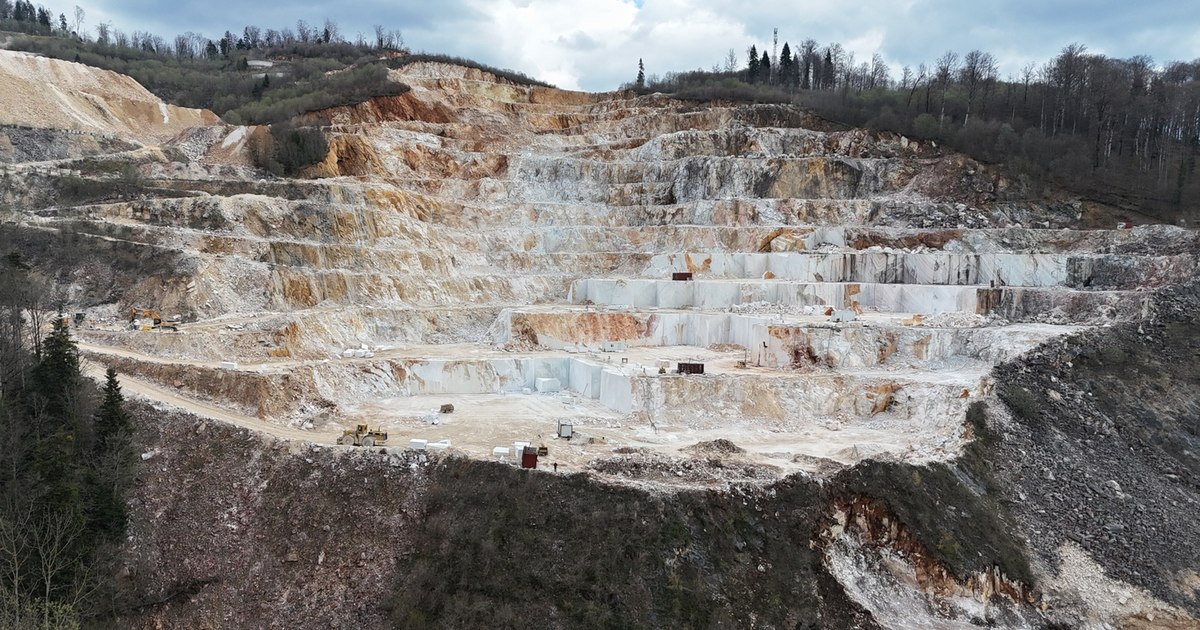
A new mountain road, planned to connect three counties through the Poiana Ruscă Mountains, opens the way for tourists to the oldest active marble quarry in Romania. The Ruschița quarry has a history of a century and a half and was one of the great natural riches of the mountain land.
More than 88 million euros will be invested for the modernization of a 56-kilometer road, which will connect, through the Poiana Ruscă Mountains, isolated localities in Timiș, Hunedoara and Caraș-Severin counties.
New road through Poiana Ruscă Mountains
The project “Modernization of DJ 684 on the route DN 68A (Coșava) – Tomești – Luncanii de Jos – Ruschița – Voislova (DN 68A) and the connection with Hunedoara county at DJ 687D” was recently launched by the Regional Development Agency (ADR) West, in partnership with Timiș, Caraș-Severin and Hunedoara county councils.
According to ADR West, the works are estimated at approximately 450 million lei, of which more than half are non-refundable funds, through the West Regional Program, the rest of the funding being provided by the county councils.
“More accessible tourist attractions for tourists, and the highway closer to the locals – these are the main benefits of the modernization of County Road 684, which will connect Caraș-Severin, Timiș and Hunedoara counties”informs ADR West.
The road will have two segments. The first will connect the counties of Timiș and Caraș-Severin, on the route Coșava – Tomești – Luncanii de Jos – Rusca Montană – Voislova, approximately 50 kilometers long, and the second will connect the counties of Caraș-Severin and Hunedoara, on the route Rusca Montană – Lunca Cernii de Jos, over a distance of seven kilometers. The new road will pass through the communes of Tomești (Timiș), Zăvoi and Rusca Montană (Caraș-Severin) and Lunca Cernii de Jos (Hunedoara), which have around 8,000 inhabitants, and the authorities have announced that it will bring them closer to the A1 highway in western Romania.
In reality, the road will only shorten the distance between the towns of Hunedoara and Caraș-Severin to the A1 highway by a few kilometers, but the time in which the drivers will travel the mountain route to the Lugoj area – Margina a highway A1 will not be reduced compared to the alternative routes. DJ 684 (video) will remain a difficult route, with steep slopes climbing up the mountain ridges, up to around 1,000 meters, with areas where fallen trees and landslides will continue to cause problems, and with risky sections in winter.
However, the route of the new road crosses several places with high tourist potential: the recreational area Valea lui Liman, the areas at the springs of Begăi, the clearings at the foot of the peaks Padeș (1,382 meters) and Rusca (1,355 meters) and other places located since the beginning of the 20th century in the tourist circuits of the Poiana Ruscă Mountains.
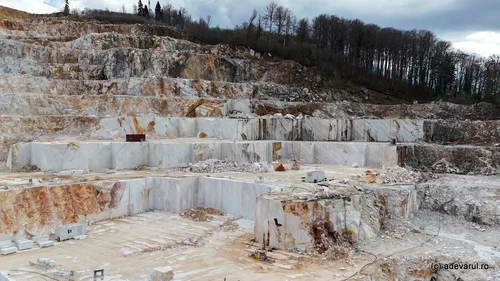
A special place, sought by travelers since the 19th century, is the marble quarry in Ruschița. The “marble mountain” at the end of Ruschița village will become more accessible to tourists from Timiş and Hunedoara. Although it is not considered a tourist attraction, being in operation, the marble quarry in Ruschița can be seen from the road that goes up from the village to Tăul Ursului, the mountain area on the border of Caraș-Severin, Timiș and Hunedoara counties.
The marble quarry, a century and a half of exploitation
The story of the Ruschița marble quarry began around 1883, when a worker in the region accidentally discovered the deposit. In Rusca Montană and Ruschița, forestry operations, iron and lead mines, “hammers”, i.e. industrial installations used for metal processing, and smelters were operating at that time, but the discovery of marble diversified the industrial activities in the area.
The quarry was opened in 1883 by Johann Biebel (1817–1900), a famous construction engineer from Banat, its first owner.
In the first years, the works were rudimentary, being carried out by the family of the entrepreneur Biebel, helped by a few Italian masons. In 1910 the first sawmills and a crane were installed, and in 1912 the cutting of marble blocks with wire began.
“At Ruschița, Mrs. and Mr. Biebel (no. Janos, son of Johann Biebel), the owner of the marble quarries at Ruschița, come across us and, with their well-known kindness, invite us to a hot dinner, which they had prepared for us. We spend an hour in this little corner of heaven, where you can see only two rows of houses, with gardens and hills, then the walls of the iron factory and the mines (bathrooms) of marble. It’s wonderful to see how the marble stone is cut into large pieces that barely fit into a wagon. Those are then cut with saws, like wood, into thicker pieces (for crosses, pillars) or thinner pieces (for tables, boards).”wrote Nicolae Brînzeu, in 1927.
Sought after by tourists for over a century
In the 1920s, the marble quarry became famous and was visited by tourists exploring the Poiana Ruscă Mountains. The first tourist routes in the Poiana Ruscă Mountains were outlined since the beginning of the 20th century, as evidenced by the oldest monument dedicated to the tourist, erected in Nădrag (Timiș county), in 1914.
The Transluncani road, the “Transalpine of the West” blocked in the forest. How does the beautiful road from the Poiana Ruscă Mountains look like
The stone monument bears the following inscription (in Hungarian): “If on your way you pass here, Enjoying these charming places, Cast the veil of oblivion over cares and thoughts, For only he who forgets can be happy.”
From the old mining town of Nădrag, travelers climb to the highest peak of the Poiana Ruscă Mountains – Vârful Padeș (1,382 meters), located on the border of Hunedoara, Caraș-Severin and Timiș counties, and can then descend to Ruschița (Caraș-Severin), Vadu Dobrii and Bătrâna (Hunedoara), Luncanii de Jos (Timiș).
A similar monument, almost as old, made of Ruschița marble, is at the entrance to Rusca Montană commune and seems to be a stylized replica of the oldest tourist monument, on the other side of the mountains.
Hundreds of people worked at Ruschița in the interwar years
In the interwar years, dozens of families from Ruschița earned their living by working in the quarry or transporting marble in the Ruschiță valley, through the villages of Ruschița and Rusca Montană, to Voislova, the town located 20 kilometers from the quarry, then crossed by the Hațeg – Caransebeș railway.
“A very important new industry was born in Rușchița, a village which, from an administrative point of view, is part of Rusca Montană, especially after the foundries and forges in this place were stopped and when the leading brakes were taken by Ioan Biebel, which is still held today. It is the marble quarry – marble of superior quality – which, under the rational and intelligent management of Mr. Biebel, became known all over the world, receiving orders even from America from South. In boom times, the marble quarry could employ around 250 to 300 people“, informed the publication Vestul, in 1931.
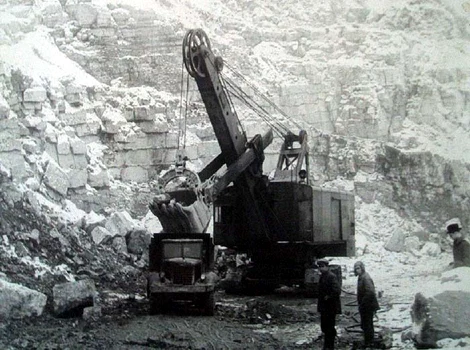
During that period, part of the works in the quarry were mechanized, using the installations of an electrical plant that operated on the Ruschița stream, at the foot of the quarry. The press of the time noted that the operation was then one of the best organized in all of Europe and, at the same time, it was the point of attraction for travelers arriving at the Rusca Montană train station.
“As well as the quarry itself is organized, the transport of the blocks, sometimes 10 and even 12 tons, is as primitive as it is on the 17 km distance from Rusca to the Valea Mare—Rusca railway station. Carts with solid wheels, pulled by 10 pairs of horses, are not rare on the very winding road between Rusca and Rusca”. informed the interwar publication Vestul.
In the late 1930s, more than 250 people worked in the quarry.
The marble quarry, nationalized and expanded under communism
In the first years of communism, exploitation was nationalized and expanded, and in the 1950s, a railway was laid out in the Ruschița valley for the transport of marble, but also of ore from the metal mines in Rusca Montană.
What is hidden in the depths of Poiana Ruscă Mountains. Industry secrets abandoned after two centuries
“Rușchița quarry is today the largest and best equipped in South-Eastern Europe. Its marble is white, light pink and dark pink, of exceptional quality. If polished it is not quite as beautiful as Carrara (which is only available in white), on the other hand, it is much more resistant to the weather. Carrara marble, being porous, absorbs water, which freezes in winter and causes it to crack; because of this the Carrara marble peels in the spring”, informed Free Romania, in 1948.
In the quarry, the press of the time noted, with the help of machines with chisels and pneumatic perforators, blocks of 30-80 tons were detached from the rock. The sawmills, driven by a water turbine, processed the marble by using 20-30 steel sheets, into slabs 2-3 centimeters thick. Other slabs 8-15 centimeters thick were obtained at a sawmill with fewer blades and using steel dust instead of sand. Generally, the quarry delivered slabs or slabs 3 meters long by one meter wide.
“At the sawmills the cutting operation takes place. Toothless steel blades begin to make a rectilinear motion, the same as that of the Schrem-machine. Pressing the marble with the help of steel filings or quartz sand, they cut deeply, penetrating 8 centimeters in 24 hours, so that after days they make those marble slabs so sought after for their beauty and durability.”informs Free Romania.
The marble from Ruschița was used in the construction of some of the emblematic buildings in communist Romania, such as the Casa Scânteii and Casa Poporului, but also in Europe, at the Palace of Banks in Vienna, the Parliament in Budapest or the renovation of the Duomo in Milan.
The quarries, the old one – Gropan and the new one – Dealul lui Ionel, spread over more than 40 hectares, and huge blocks of marble of different shades, gray, white and pink, whose quality makes them comparable to that of Carrara marble, are cut from here.
The quarry survived the closure of the mines
In the Poiana Ruscă Mountains, in addition to the marble quarry, several metal mines and factories operated. Uranium was also mined on Vârful Bouului, near the “marble mountain”. Most were established in the 18th century and were closed by the 2000s.
“During the Revolution there were about 4,800 workers at the mining complex. People started to leave when the mines closed”recounted Gigi, a former miner from Ruschița.
A few locals still work in the marble quarry today. Its steps climb up to almost 1,000 meters above sea level, above the estimated reserves of almost two million cubic meters of light-colored minerals, the largest natural stone deposits in operation in Romania.
