
Several Roman Catholic and Evangelical churches in Romania have become, over time, landmarks of the big cities in the Banat and Transylvania regions. On Catholic Easter, they welcome their visitors in a festive atmosphere.
More than a million Roman Catholic, Reformed and Evangelical Christians are celebrating Easter 2026 later this week.
The churches of Sibiu, Cluj-Napoca, Brașov, Alba Iulia and Timișoara are among the most spectacular religious monuments in Romania and attract during this period both believers who come to Easter services and tourists interested in their history and architecture.
The Evangelical Cathedral of Sibiu
The story of the city of Sibiu began eight centuries ago, when the settlement near the Olt Valley was attested as the first Saxon seat, under the name of Siebenbürgen, then Hermannstadt. Sibiu was one of the largest urban centers of medieval Transylvania, and its historical monuments show the importance it enjoyed.
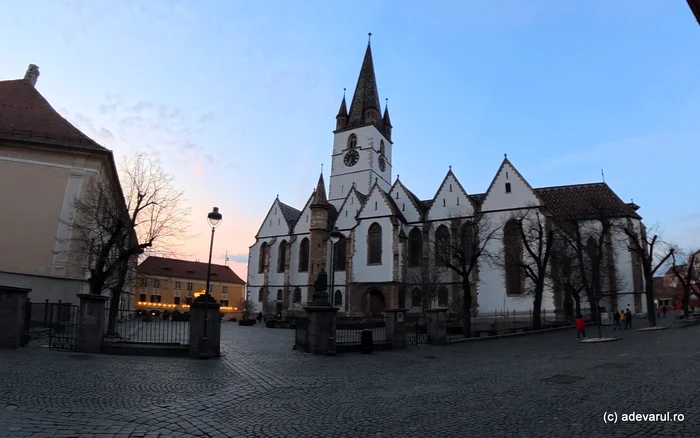
Located in the citadel of Sibiu, the Evangelical Cathedral was built in the 13th century, but its construction, which gradually transformed it into a Gothic building, continued until the beginning of the 16th century.
“Although the construction was completed around 1520, generation after generation continued to enrich and shape the church furniture according to their own needs and ideas. Thus, the most comprehensive and representative ensemble of tombstones and epitaphs in Transylvania was created here, one of the largest organs in the country and a brilliant treasury of medieval and early modern art, which can be seen today in the Brukenthal Museum”. shows the official page of the church.
According to historians, until the conversion to the Lutheran faith, which took place from Sibiu in 1545 for the entire Transylvanian and Saxon nation, the church and the city were completely integrated into Catholic religiosity.
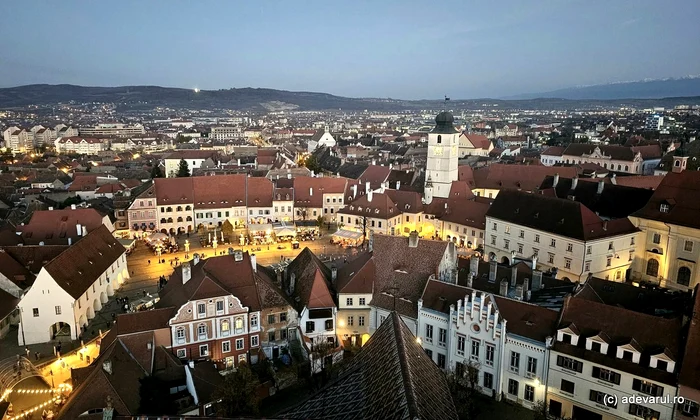
Sibiu remained the most representative city for the history of the Saxons. Along with its imposing church, from the towers of which the panorama of the city can be admired, the historic center hosts numerous medieval monuments, the most famous being the Council Tower, built in the 13th century and rebuilt several times. Originally intended for defense, the tower had various functions: warehouse, observation point and, later, museum.
The dome from Timișoara
At the beginning of the 18th century, the city of Timișoara was rebuilt from the ground up, after its conquest by the Habsburg armies, led by Eugeniu de Savoy. The former citadel ruled by the Ottomans until then and devastated by the war was transformed, in the following decades, into a modern, western-inspired city.
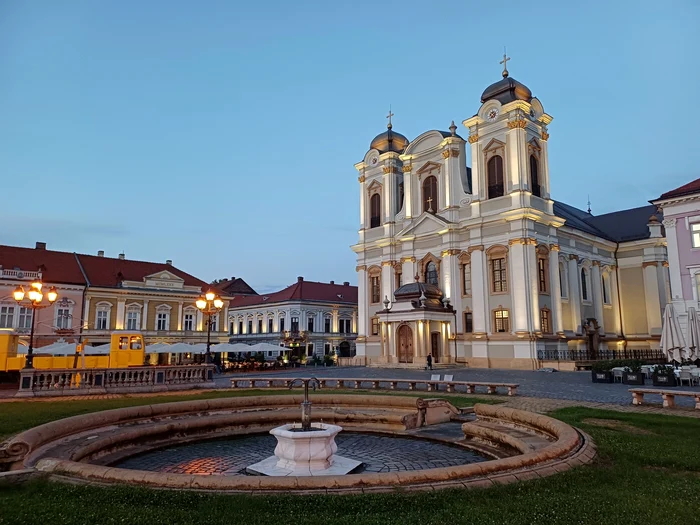
One of the most important landmarks of its reconstruction era was the Roman Catholic Cathedral in Unirii Square. The cathedral was built in the mid-18th century to house the episcopal seat of the Diocese of Cenad, a city that had lost its importance in the Middle Ages. He kept the patron saint of the cathedral from Cenad, that of Saint George.
“The cathedral has a complex history spanning over 280 years, the foundation stone being laid on August 6, 1736, during the reign of Bishop Nádasdy,” showed the Roman Catholic Diocese of Timișoara.
The plans of the Dome were made by architects of the Imperial Court, and the furnishing and decoration of the interior were entrusted to prestigious Viennese artists.
“In the crypt are buried the bishops of Cenad, starting with Nikola Stanislavich, the canons of the cathedral, starting with Carlo Tazzoli, as well as some Austrian dignitaries, commanders of the fortress, but also benefactors of the cathedral”its history shows.
In front of the Cathedral, visitors discover one of the most famous statues in Timișoara. The statue of the Holy Trinity, also known as the “Plague Column”, commemorates the victims of the plague epidemic of 1738–1740, a plague that decimated the population of the city and numerous settlements in Banat, killing thousands.
Plague columns, erected in several towns in Banat, are Baroque monuments specific to the 18th century, erected as a sign of gratitude for the end of epidemics. Their model was the Vienna Plague Column, and the composition includes representations of the Holy Trinity and other saints venerated by Catholics.
The black church in Brașov
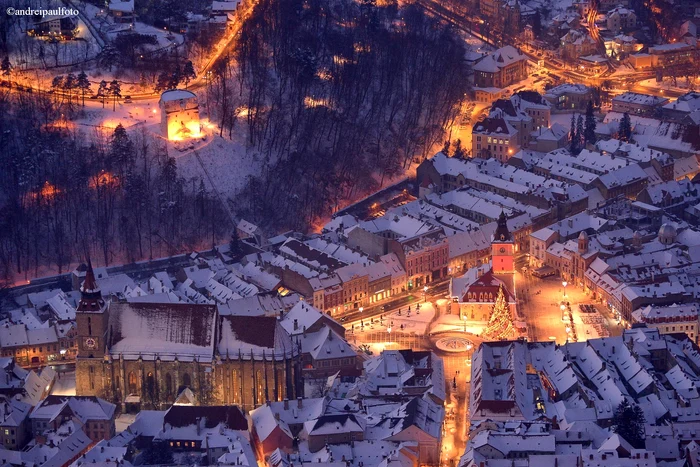
More than six centuries old, the Black Church in Brașov made the former medieval fair famous. The church was built between 1383 and 1477 and has been a symbol of Saxon culture and spirituality for centuries. Upon its completion, in 1477, the Brașov parish, then of the Catholic rite, received the patron saint of Saint Mary, but for almost five centuries the Black Church has belonged to the evangelical cult. Its name comes from the blackened walls in the fire of 1689.
Romania, abandoned by most of the Saxons, Swabians and Jews. How the demographic structure has transformed in a century
“It’s been six hundred years since the bells of the Black Church have been ringing every Sunday. Six hundred years of history, faith, beauty. Inside, the divine music of the organ, together with the warm voices of the people, rises beyond the vaults and brings the old walls to life. The Black Church is the spiritual center of the Saxon community in Brașov, being at the same time the most important scene of the ecclesiastical reform in Transylvania and the cradle of humanistic culture for the region”, informs its official page.
Its Gothic architecture would have been inspired by the trade and craft relations that linked, in the medieval era, Brașov to the royal city of Nuremberg, whose church, St. Sebald, would have inspired the construction style of the Brașov dome.
“In April 1689, a devastating fire destroyed significant portions of the town and also damaged the parish church. The huge frame caught fire, collapsed and buried the interior of the church under rubble and ash. The flames and smoke are said to have blackened the walls so badly that since then the nickname of the place is the Black Church. Reconstruction work began immediately and lasted almost a hundred for years”, show its history.
The church was also renovated between 1981 and 1999, and currently preserves numerous unique art objects, gathered throughout its existence of over six centuries.
The medieval cathedral of Alba Iulia, a millennium old
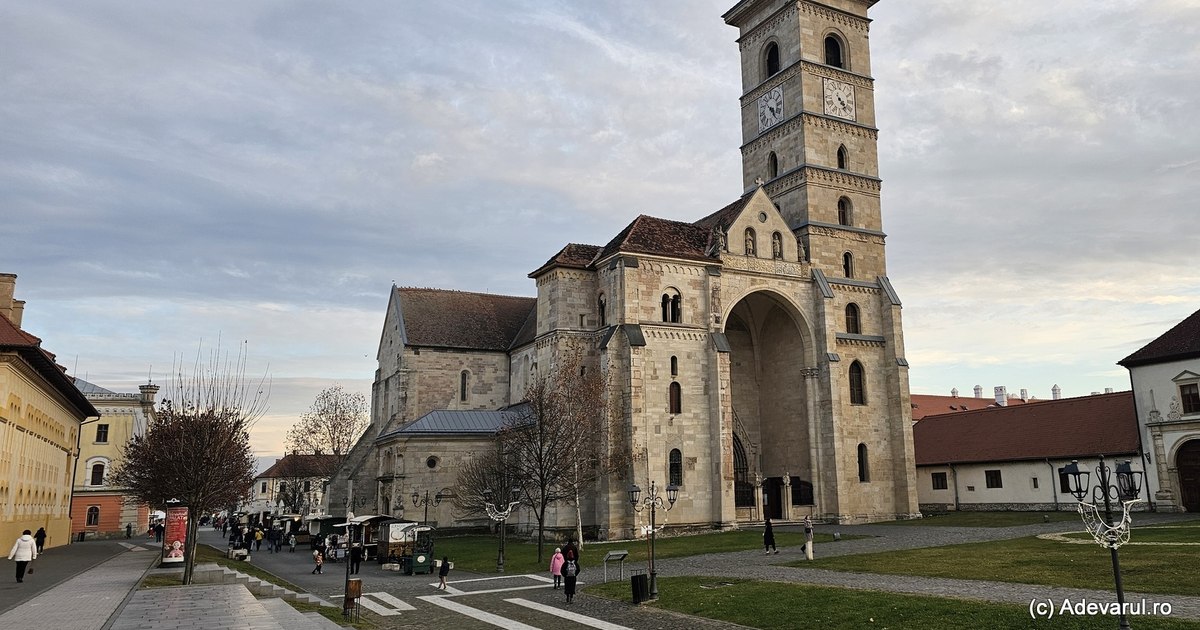
St. Michael’s Cathedral in Alba Iulia is, according to historians, the most valuable monument of medieval architecture in Transylvania, marking the peak of late Romanesque and being a prominent example of it in Eastern Europe. Its architecture has never been imitated, only a few formal details being copied sometimes, informs Alba Iulia City Hall.
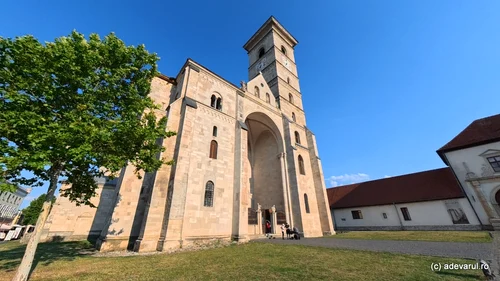
According to historians, the beginning of construction must be placed sometime in the 11th century, when it was presented as a basilica with three naves and a semicircular apse to the east. This first phase ends with the Mongol attack in 1241, when the cathedral and the fortress are destroyed.
After 1246, when the fortress ceased to be royal and was donated to the Catholic Church, turning into an episcopal fortress, the reconstruction of the cathedral began. In the following centuries, the cathedral went through several transformations, receiving elements of Romanesque and Gothic architecture. And Iancu de Hunedoara contributed to the restoration of the edifice, building the upper floors of the southwest tower.
“Between 1601 and 1603, the cathedral is looted several times and the tower on the south-west side is set on fire. Prince Gabriel Bethlen rebuilds the tower and raises the top floor, with the Renaissance cornice”, says the Alba Iulia City Hall.
After 1715, with the consolidation of Austrian rule in Transylvania, the cathedral passed into the administration of the Roman Catholic Church, baroque elements appeared and the sacristy was built (1728). The place of worship is endowed with an organ from 1877, having 2,209 pipes, still functional today. The cathedral is located in the Alba Carolina Citadel, built at the beginning of the 18th century, under the Austrian Empire, on the ruins of Roman and medieval settlements.
The Cathedral in Piata Unirii
The construction of the Roman Catholic church “St. Michael” in Cluj-Napoca began at the end of the 14th century and continued until the beginning of the 16th century, without being completely completed. The Hungarian kings Sigismund of Luxemburg, Ladislaus V of Habsburg, Matia Corvinus and Vladislav II, as well as the locals, supported the construction of the most imposing Gothic religious establishment in Romania.
The highways accelerated the development of Sibiu. The transformations of the strategic city for transport in Romania
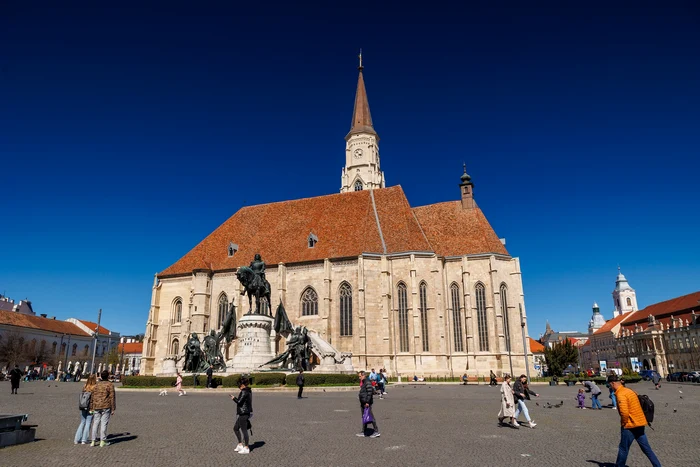
“At the beginning of the 16th century, in the last phase of construction, the western towers were erected. As with many other European churches, work was stopped at this stage. Only the northern tower was completed, and the southern tower was finally abandoned. The church is undoubtedly one of the most beautiful monuments of the flourishing Gothic style in Transylvania, and illustrates not only the limits of Western styles, but also the spread of Catholicism in Eastern Europe.”pointed out Radu Lupescu and Edina Szathmári, in the history of the medieval church in Cluj-Napoca, published on the page dedicated to it.
Starting from the 16th century, the church in Cluj was used both for services and as a venue for Transylvanian diets. Several princes of Transylvania were chosen here.
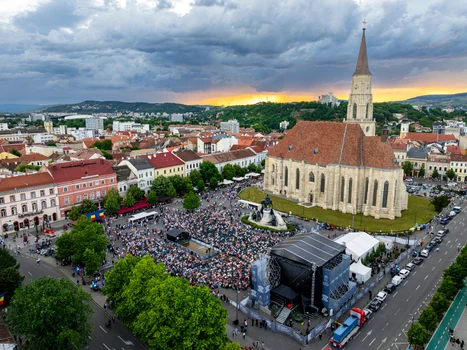
In the mid-18th century, the church underwent a spectacular Baroque reconstruction and new altars were installed. A century later, the old church tower, weakened by earthquakes and fires, was demolished and replaced by a neo-Gothic tower, built between 1837 and 1862, to house the old church bells.
“The new structure, with a height of over 80 meters, has merged with the medieval block of the church in such a way that it now forms an architectural whole”, historians pointed out.
The restorations continued in the 20th century, and in the 50s, as a result of such works, part of the paintings from the 14th-15th centuries were brought back to light.
Along with the churches in Sibiu, Timișoara, Brașov, Alba Iulia and Cluj-Napoca, and other cities in Romania preserve special religious monuments that can be visited on Catholic, Reformed and Evangelical Easter. Among them are Oradea, Târgu Mureș, Arad, Sebeș, Sighisoara, Bistrita and Mediaș.
