
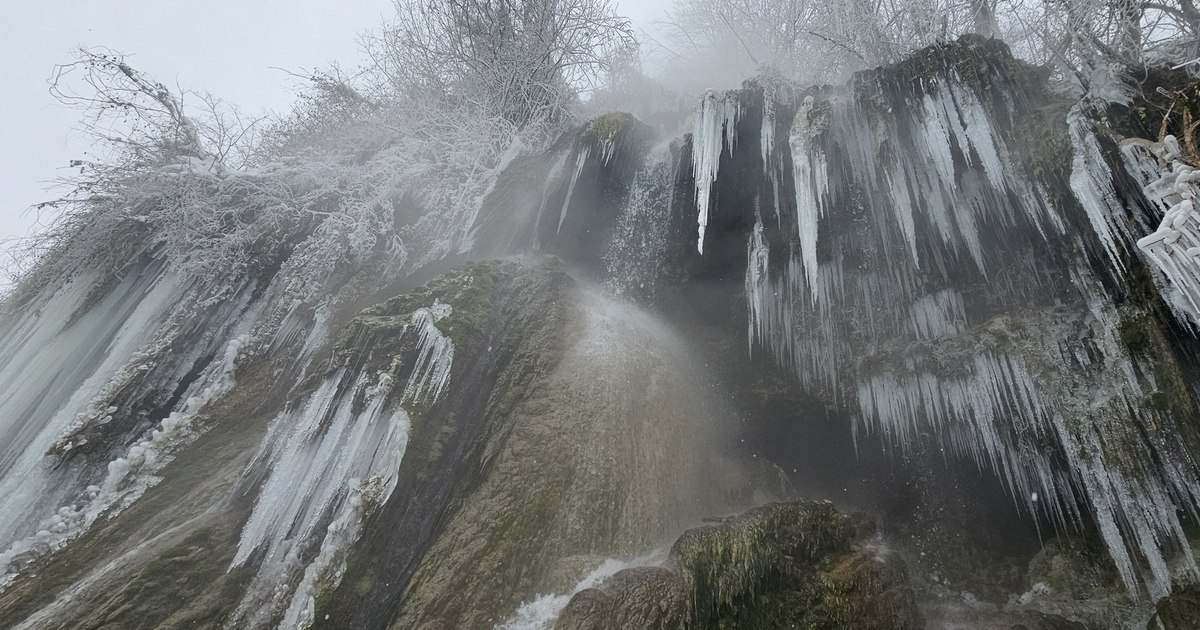
The frost of the first days of January changed the appearance of the Clocota waterfall in Geoagiu Bai, decorating it with large layers of ice. In winter, the waterfall with thermal waters produces a special phenomenon.
The Clocota waterfall in Geoagiu Băi (Hunedoara county) has become a place increasingly sought after by tourists in recent years.
Its thermal waters descend steeply from a height of almost 20 meters, over the limestone and travertine wall covered with vegetation. Mineralized waters shaped the waterfall, gradually changing its appearance.
Sometimes large rocks detach themselves from the body of the waterfall, collapsing at its feet and gradually dissolving into the water, while the passing of the seasons gives new forms and colors to the climbing plants and roots that adorn it.
The waterfall shrouded in steam
At the foot of the waterfall, but also a few hundred meters downstream, the Clocota stream forms numerous travertine thresholds, which give it a special appearance. In winter, its waters cover lush vegetation bathed in ice sheets, some several meters in size. At the same time, due to the temperature of the water, warm steam envelops the waterfall, offering a spectacular scenery.
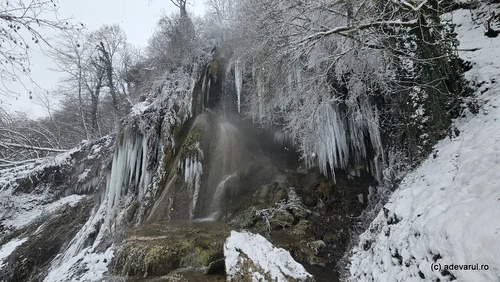
“It’s as if smoke is coming out of the waterfall, and the lower the temperatures, the more intense the steam. And in other places in Geoagiu, thermal waters produce similar phenomena, but none compares, as a spectacle, to the Clocota Waterfall”, says a local from Geoagiu Bai.
The Clocota waterfall registers a level difference of almost 20 meters on the water line. The water fall washed away the roots of some trees located at the top of the plateau, which collapsed and were partially or totally embedded in the recent travertine deposits of the waterfall, creating successive vertical folds along the entire height of the fall.
Moss and hanging plants have grown over them, enlivening the waterfall. Clocote’s water collects all the thermal mineral springs in the area, and thanks to its temperature, plants specific to thermal waters grow here and animals of the salamander species live here, which are no longer found in other parts, informs the Tourist Information Center of the resort. The 16 springs of thermal waters that flow into the Clocota river ensure that its water, famous for its purity, does not freeze.
The old resort from the time of the Romans
The Geoagiu Bai resort is located at the foot of the Metaliferi Mountains (Apuseni) and was established in Antiquity.
In the time of the Dacians and the Romans it was called “Thermae Germisara” or “Germisara cum thermis”, according to the Latin name, and archaeologists discovered here the remains of a prosperous settlement.
From the time of Roman Dacia, three spa resorts are attested on the current territory of Romania: Germisara (Geoagiu Băi), Aquae (Călan) and Ad Aquas Herculi Sacras (Herculane Baths), places where the ancients set up baths, which did not lack sanctuaries intended for beneficent divinities. According to historian Ion Horațiu Crișan, at least 20 localities with thermal baths in Romania have preserved vestiges of habitation from the time of the Dacians, a sign that the ancients paid special attention to these waters.
The old thermal baths of Germisara were rediscovered in the 19th century, and since then they have been sought by more and more travelers for the beneficial effects of their waters. In the second part of the 20th century, the settlement around the ancient Germisara was transformed into a resort for mass tourism, where guests were received in several hotels, erected among the modest houses of the locals.
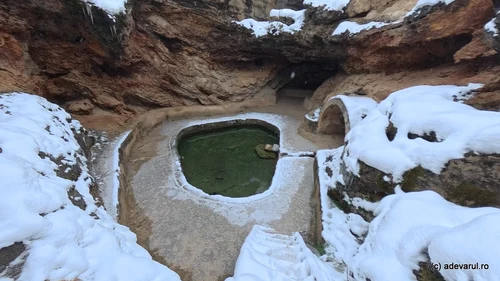
In 1935, when digging the small pool in the current thermal water beach, the statues representing the gods Esculap (Aesculap) and Egeea (Hygeea) were unearthed, which testify to the intense life of those times. A temple dedicated to the Nymphs was also attested, and other valuable discoveries date from the 1980s: deposits of altars, statues, coins and precious metal objects, among which are 11 gold votive plaques, brought by the ancients as offerings to the gods who patronized the beneficial waters. The votive plaques at Germisara were made from 22 carat gold leaf, one millimeter or less thick, in the “au repoussé” technique, using a wooden matrix. Seven of these plaques were deposited in the Germisara spring as an offering to the water nymphs by people who bathed in these thermal waters.
Another plate, discovered later, migrated about 18 meters through the connecting channel between the water source and the large pool of the thermal complex, archaeologists from the Deva Museum showed. At the time of their discovery, it was suspected that other artifacts had been stolen overnight by some workers. Three other plates, recently identified, would also come from Germisara.
