
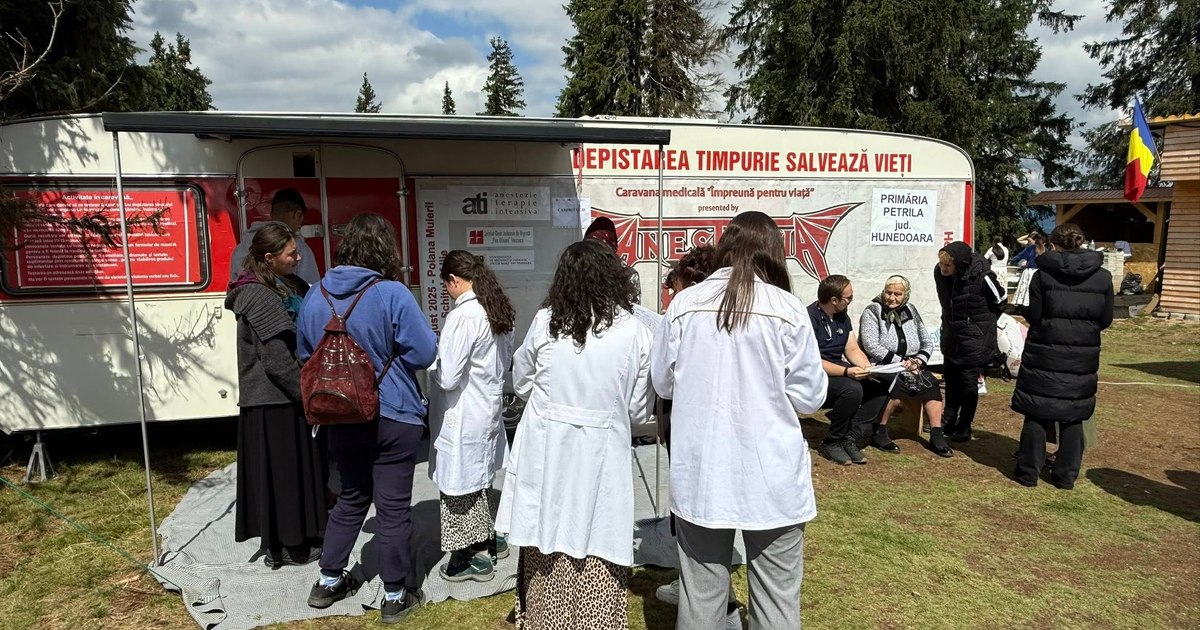
A medical caravan that changes lives – of people getting consultations after years of not seeing them and of the volunteer doctors who make it all possible. This is what Professor Dorel Săndesc, ATI primary doctor and manager of the Timișoara County Emergency Hospital, who initiated the “Caravan for Life” in 2018, managed to create. From then until now, medical teams have arrived in isolated villages in the mountains or in the Danube Delta, in penitentiaries, centers for street people and even in monasteries. “I came to realize by doing these things that there is no better investment that a person can make in this life than unconditionally helping those who need you and whom you can help, especially if they are unknown“, says the doctor.
The “Together for Life” caravan at the Oașa monastery, Alba county PHOTO Facebook/ College of Doctors
How the caravan started
The “Together for Life” caravan started its journey in 2018, after doctor Dorel Săndesc saw a series of reports on television that left a deep impression on him.
“Isolated in Romania” was the name of that series and it showed all kinds of communities living in isolated areas. Seeing this reality, realizing the conditions in which some of our people live, I said that if we still know they exist, we should try to do something to help them. And so we came up with the idea to do what we know best, that is, to offer them medical services that were inaccessible there.
And we started following the reports. The first time I went to the mountain Banat, to Ineleț, where the access to the top of the village is on certain portions of wooden stairs that are attached to some rocks, otherwise there is a much longer option through the woods, where you can only go on horseback or on foot“, says the doctor.
Word of volunteer doctors coming and offering free consultations spread quickly. And so the caravan crossed the borders of Banat.
“It spread like an oil slick, I would say. People find out and call us. From various localities. I have been to minority villages in Transylvania, I have been to prison several times, to night asylums, to shelters for street people. I reached several areas. Transylvania, Banat, I’ve also been to Oltenia, I’ve been to the Delta four times. We don’t go to a place just once, to mark another point on the map. We keep coming back, because they really appreciate it. And it’s natural to see them again, now they are somehow our patients.
Those we detect with serious problems, requiring hospitalization, operations, etc., we take care of them, we put them on the list and get appointments in hospitals where they can benefit from the best conditions and the best chances of being treated adequately.” says Prof. Dr. Dorel Săndesc.

Doctor Dorel Săndesc consults at the monastery, as part of the PHOTO Facebook/College of Doctors caravan
What happens in caravans
“From the beginning, we designed these caravans as a complex action, through which we would offer people as many medical specialties as possible, to be able to evaluate them as completely as possible. We have gone this way, from then until now, with a large group of doctors, from various specialties (Internal Medicine, Cardiology, Neurology, ENT, Orthopedics, Gastroenterology, Endocrinology, Nephrology, Surgery, Pediatrics, Ophthalmology) and with the necessary equipment to make the best possible assessment. We usually go with five to six ultrasounds, three to four to five EKGs, blood test machine with results on the spot for quite a long list of tests, spirometers, ENT equipment, ophthalmology equipment. Glasses are provided for those with vision problems. And the percentage is somewhere around 70% – 80% of the people who come to consultations who do not see well and need glasses, but they cannot afford them either financially, nor the access is good. And they get it for free. They are simply overwhelmed to find this out! All services are offered free of charge”says the Anesthesiology and Intensive Care doctor.
“We do it without any pretense and aura of heroes”
But the joy is not only for the people who receive. Volunteer doctors have learned the joy of giving without expecting anything in return.
“A pure and total voluntary action, I would say. In the sense that all the people, all the volunteers – more than 25 each time, sometimes 35 – work totally free, giving their free time, energy, skill and a lot of soul in these actions.
We do it without any pretension and aura of heroes. It is a great joy for us to do this! We fill up, we charge ourselves with extraordinary positiveness, because we have a special reward: when you see the satisfaction of those people, their astonishment, that they who have not seen a doctor for 10 years receive at home for free so many doctors from so many specialties, they receive glasses for free, tests – this reaction of their thanks, gratitude, emotion is an extraordinary reward!”, says the doctor excitedly.
And with this joy comes another kind of addiction:
“We have become addicted to this activity, addicted to doing good. Addiction that I wish to all people! I have come to realize by doing these things that there is no better investment a person can make in this life than unconditionally helping those who need you and whom you can help, especially if they are unknown. This ensures you a lot of reward in this life as well – simply soulfully – and somewhere there is a parabola and these things return to you multiplied. Not to mention the option, in which I believe, that there is something after this life and that surely at that entrance exam these actions, this solidarity will matter a lot”.
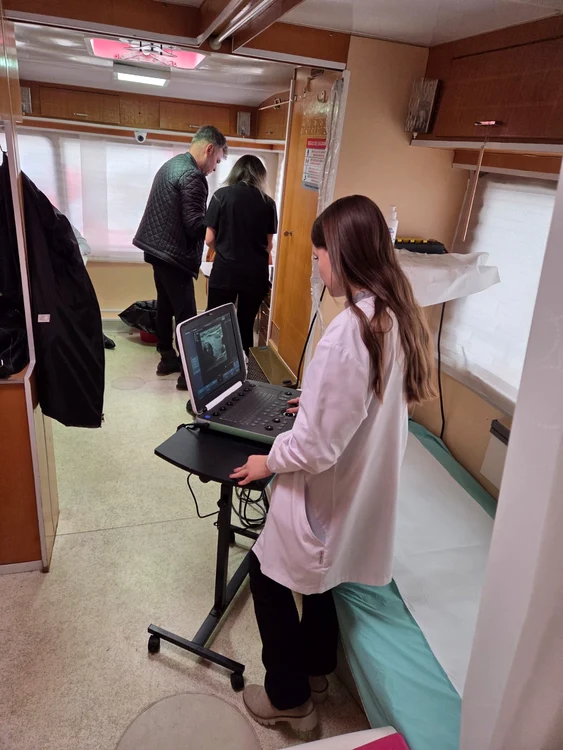
Resident doctor who volunteers in the caravan PHOTO Facebook/ DJST Hunedoara
From residents to university professors, together in caravans
If initially only resident doctors participated in the caravans, along the way senior doctors also joined.
“In time, however, their bosses, their teachers, seeing that they were leaving and coming very excited, asked them what it was about and started contacting me. And now we have a very nice combination of young people and personalities in our travels.
At the last action in Banatul Montan, from Anina, was professor Ioan Sporea, who is the president of an international society of gastroenterology and ultrasound. There are many, I will name a few: Professor Dana Stoian (Endocrinology), Professor Tibi Bratu (Reconstructive Plastic Surgery), Professor Pop Liviu (Pediatrics), Professor Cătălin Jianu (Neurology), the great expert surgeons who go and provide consultations”.
Meanwhile, the program was also enriched with medical education actions. In many of the trips they organize first aid courses and teach people about the importance of certain tests that can save lives.
The campaign that changes perceptions
Another great merit of these medical caravans is the change in perceptions, believes Prof. Dr. Dorel Săndesc:
“We believe that it is the only effective and recommended response in the face of often unfair, generalizing accusations, insults even to the entire medical body. I think that instead of responding angrily and blaming those who offend us, this is the answer, to do our job as well as possible and to do important things outside of the job description. I guarantee you that all the people I have seen – and there are already tens of thousands of people – stop thinking that doctors are all scumbags, jerks, egoists only interested in their own gain. This is the answer and slowly, slowly, stone by stone I believe we can rebuild the bridge of trust between us and our patients, our peers. An essential bridge, especially for the success of the treatment. Because if there is no such trust and connection, the evolution of the disease is also worse”.
The “Together for Life” program was also awarded. In 2022, it won the “Campaign of the Year” award at the Romanian Healthcare Awards.
How did this year’s campaign go?
In 2025, the caravan went on the road 11 times and reached 2,000 people. They even went to the monastery.
“It is an isolated monastery somewhere in the Șurianu Mountains, Alba County. And knowing the fathers and mothers there – some are people with degrees from Timișoara, doctors, architects, engineers – and seeing our profile, they invited us saying that in those mountains there are many people who would need it: foresters, shepherds, miners’ wives. And it was special. The altitude record was 1,700 meters, we set up the medical offices in tents equipped with everything needed. There I also had the pleasure of the president of the College of Physicians, Prof. Dr. Cătălina Poiană, together with Dr. Beatrice Mahler and Dr. Moise”, says the initiator of the program.
Because time no longer allows them, this year’s caravans stop here. But they will start again in the spring. Doctor Dorel Săndesc says:
“Almost a quarter of our weekends are spent away from family, through the mountains, through poor villages, through prisons, night shelters and homeless shelters. And it’s very cool! (…) We will go ahead with this. We don’t do it for fame or glory, we just do it because we love it. And maybe we have the chance to contaminate as many people as possible to participate in such actions, because they will never regret it”.
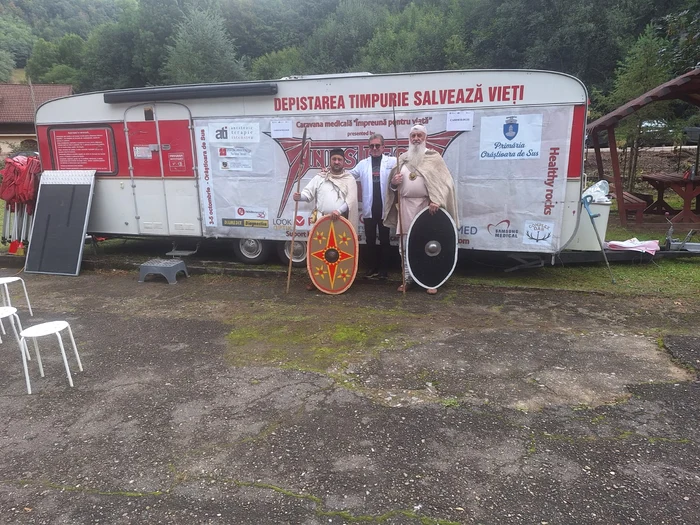
Image from the “Together for Life” Caravan PHOTO Facebook DJST Hunedoara
The campaign has a friend at the Ministry of Health
In the past, Alexandru Rogobete, then a resident of Professor Dorel Săndesc, also participated in the “Together for Life” caravans.
“He participated a lot in all our projects, including this one. On one of these trips, we ensure somewhere around 800-900 consultations, that 200 people come and each have several consultations. And we always talk about how much that means.
And now, in the new Health legislative package, the measure is included so that hospitals can run medical caravans (in collaboration with NGOs if they wish; we did it through our NGO) and these services can be settled by the Health House. Because they are specialized consultations and are perhaps the most useful, because they address people with the least accessibility to medical services. And I think this will be a very special thing, because it will stimulate the development of these services, it will ensure a financial reward for hospitals”thinks Prof. Dr. Dorel Săndesc.
“We do not want, if this measure is introduced, to necessarily pay the staff. Because they volunteer tremendously, we always have trouble cutting them off the list, so many want to come, more than are needed. And if we paid people, maybe something would change from the superb spirit of volunteering”.
