
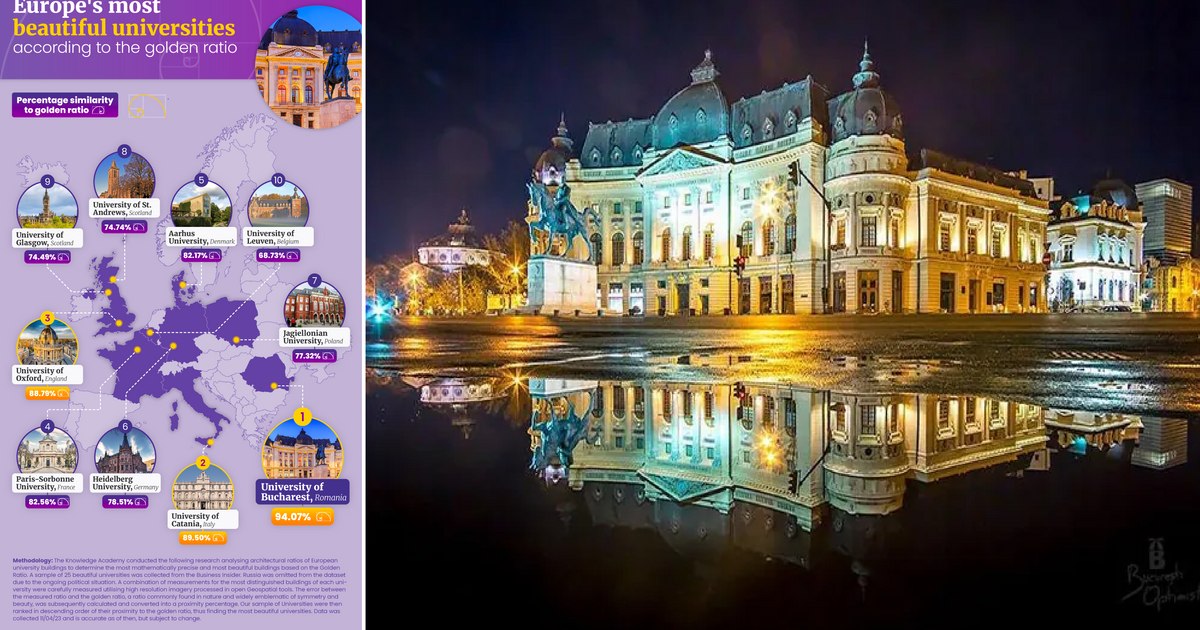
A top with “The most beautiful university buildings in Europe” conformable “golden ratio” places Romania at the top of the ranking. Practically, a building in our country approaches perfection.
European top of the most beautiful university buildings through the prism of the Gold Collage Report
There are over 2,700 universities in Europe, with some of the most iconic landmarks and buildings, the old continent being known around the world for its outstanding architecture.
And as it is also home to some of the most prestigious higher education institutions in the world, Knowledge Academy wanted to find out which of these European universities has the most beautiful building, according to the rule “the golden ratio in architecture”.
The surprise was to discover that there is a construction in Romania that comes closest to perfection, harmony and beauty and that was positioned first in this European ranking.
The Carol I Central University Library – the architectural treasure of Romania
It is about the Central University Library of the University of Bucharest, known as the Carol I Library, which obtained the highest score regarding “golden ratio” which in this case refers to the balance between height and width, a ratio that makes it almost perfect from an aesthetic point of view.
The amazing building is one of heritage, being a historical monument whose construction was completed in 1893 and inaugurated in 1895 by King Charles I. It is the work of the French architect Paul Gottereau, author of the Palace of the House of Deposits, Consignments and Savings and of the old Royal Palace. It is one and the same as the library burned down during the Revolution of December 1989.
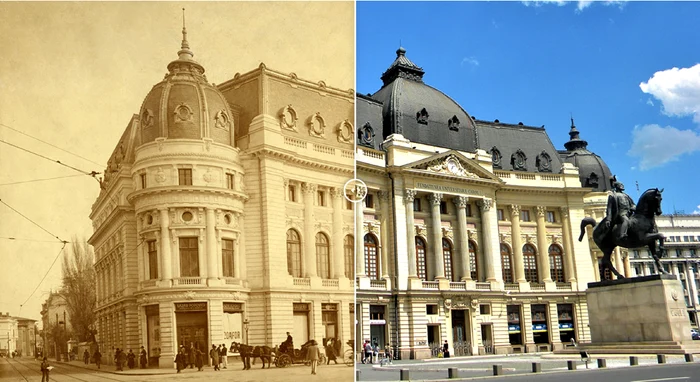
Charles I University Library on first place in a European ranking Photo BCU
The score “golden ratio” in its case it is 94.07%, which makes it the most pleasing to the eye among all university buildings in Europe taken into account for the study.
“Golden Treasure” from Bucharest has surpassed the real estate heritage of prestigious universities in the world such as Oxford or the Sorbonne.
Oxford and Sorbonne are ranked third and fourth
Second place in the European ranking, which did not take into account Russian universities, is occupied by the main building of the University of Catania, Italy. The Baroque-style building, built following an earthquake in 1693, has benefited from several renovations and repairs over the years, especially after the earthquake of 1818. Its golden ratio is 1.7879, and its similarity percentage of 89.5%.
And the “Radcliffe Camera”, also a baroque building of the University of Oxford in England, is on the podium in the third position. It took its name from the doctor John Radcliffe who bequeathed the necessary funds for its construction in 1749, being considered the main attraction of the Oxford University campus. It houses the Radcliffe Science Library. He scored 88.79%.
The famous Sorbonne University in Paris has a building with the same name, which ranks it in fourth place in this top university. The university has given the world incredible graduates, including Nobel Prize-winning scientists such as Madame Marie Curie, but also the writer Honore de Balzac. Gorgeous from all angles, the Sorbonne Building, with an incredible history, scored 82.56%.
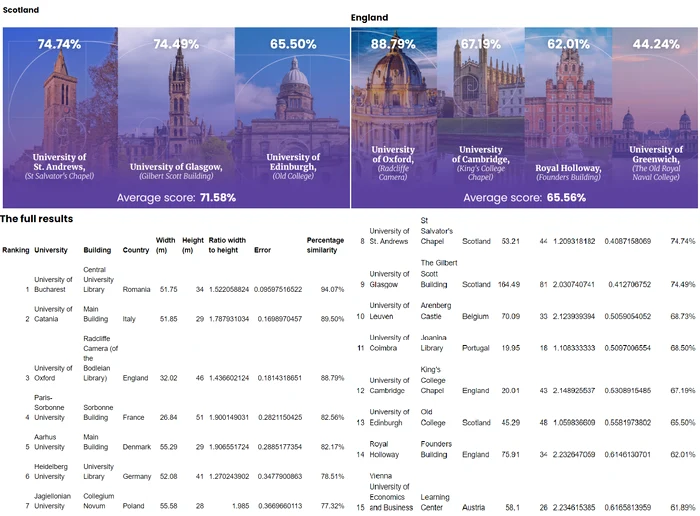
The European top of the most beautiful university buildings – Gold Report The Knowledge Academy
Romanian students study in some of the most beautiful university buildings
Another university, to which many Romanian students are heading in recent years, is Aarhus in Denmark. The main building, different from those mentioned so far, stands out for its functionalist architectural style. It is officially recognized as one of the twelve most important architectural works in the cultural history of Denmark. Compared to the main building of the University of Copenhagen, the one in Denmark scored a golden ratio of 82.17% versus 14.27%.
In this European top among the first 10 “golden” buildings we also find the Heidelberg University Library – Germany, one of the oldest buildings on this list (1386), with romantic, Gothic, fairytale-style architecture (78.51% ), but also the Collegium Novum of the Jagiellonian University in Poland, rebuilt at the end of the 19th century to match the original building erected between 1363 and 1365. 183 professors of this university were arrested and sent to concentration camps, moment marked by a memorial plaque that can be found in the building in Krakow. Its width is almost double its height, with a ratio of 1.985 and a score of 77.32%.
Scotland, in the top 10 with two gorgeous buildings
The eighth and ninth positions on the list are held by two university buildings in Scotland: St. Salvator from the University of St. Andrews, founded in 1450 and frequently renovated, was built in the late Gothic style. It boasts alumni such as Prince William and his wife Catherine, the Duke and Duchess of Cambridge, and Benjamin Franklin received an honorary degree from here. The building scored 74.74%, while the University of Glasgow's Gilbert Scott Building scored 74.49%. The latter represents the main building of the university, being also the largest of the buildings in the top 10, with over 164 m wide and 81 m high. Its tower is iconic in Glasgow.
The final position goes to the Arenberg Castle at the University of Leuven in Belgium. It took its name from another 12th century castle on the site of which it was built in the Flemish style. Repeated renovations have made today's construction have a ratio of 2,124 in terms of the “golden ratio” with a score of 68.73%.
The country with the most university buildings that strive for perfection
The Knowledge Academy study also includes an analysis of the countries with the most gorgeous university buildings, taking into account the same “golden ratio”. A top 25 of such buildings showed that the first place in Europe in this respect is held by Scotland, with three buildings to the disadvantage of England, with two buildings that are stunning, in terms of proportions and implicitly beauty.
The ranking in question highlights the “perfect” or almost perfect architecture of university buildings in Romania, Scotland, England, France, Italy, Germany, Denmark, Austria, Poland, Belgium, Ireland, Norway, Sweden, Finland and last but not least Spain row.
What is the “golden ratio”
“The Golden Ratio” represents the ratio between two numbers that equals 1.618…, which is why it is also called “divine proportion”, “golden ratio”, “golden number”, “golden section” or even “God's Number”, being studied and used since ancient times. The template dictated by “fibonnaci string/sequence” (after the name of the Italian mathematician Leonardo Pisano / Fibonacci) – which represents a series of numbers with remarkable properties -, or the golden ratio, we find it everywhere.
It was found that any reporting as close as possible to the number 1.61803399, considered to be unique by its mathematical properties, by its prevalence throughout nature and not only, is all the more pleasing to the eye. That is, this proportion determines beauty in all its forms.
In the present case, it was the ratio between the width and height of the studied buildings that made them so beautiful to look at.
Other famous buildings that respect the “golden ratio”
Moreover, throughout the ages, numerous architects and artists have proportioned their works to approximate the golden ratio, so that the result is as aesthetically valuable as possible.
In Romania, the golden proportion in architecture was also used for the facades of other buildings, such as the Romanian Athenaeum, and in the world we can find it in the Great Pyramids of Cairo (Egypt), Kukulhan's Pyramid – Chichen Itza in Yucatan Mexico, the Sydney Opera House ( Australia), the National Gallery in London (England), but also at the Parthenon in Athens (Greece) or the Great Mosque of Kairouan (Tunisia).
