

Chocolate with crickets, the grandmother of the president of the European Commission shaking hands with Hitler, the imminence of a nuclear war are narratives intensively promoted by Russian propaganda two weeks before the European elections. Professor Dumitru Borțun explains how the Russian propaganda machine works.
A joke by the Germans at Ritter Sport became the subject of Russian propaganda. PHOTO: Ritter Sport
Two weeks before the European Parliament elections, Russian propaganda has intensified the wave of fake news and conspiracy theories aimed at promoting far-right, anti-European, pro-Russian and anti-Ukrainian parties.
Belgian prosecutors have opened a file on Russian interference in the European Parliament after allegations were made that lawmakers were paid to spread Kremlin propaganda, Belgian Prime Minister Alexander De Croo said, quoted by AFP. The Belgian official stated that the Belgian intelligence services confirmed the existence of a network operating in several European states, including Belgium, to undermine the support given to Ukraine, “Le Monde” reports.
One of the most widespread themes of misinformation is related to European regulations regarding the consumption of insects. The joke about German Ritter Sport chocolate containing a “whole cricket” was repeated as a news story that “exploded” last month on social networks in Hungary. It all started with a post that suggested the imminent sale of chocolate with crickets. The shared image shows what appears to be a chocolate bar produced by the German company Ritter Sport. A cricket appears on the packaging, and underneath the German name “Ganze Grille”, which would translate to “whole cricket”. The company said it was a simple joke, but it ended up being used for propaganda, Veridica.ro reported.
Another example of fake news is the archive photo that would capture European Commission President Ursula von der Leyen's grandmother shaking hands with Adolf Hitler.
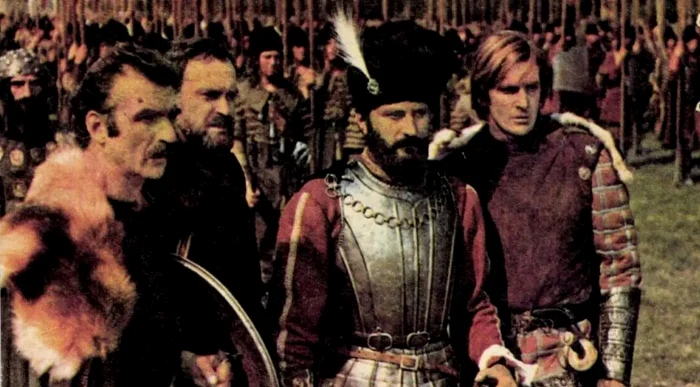
Russian propaganda uses nationalist-communist propaganda from the “Ceaușescu era”. PHOTO: The truth
What kind of propaganda catches on in Romania
Communication specialist Dumitru Borţun, professor at the Faculty of Communication and Public Relations of SNSPA Bucharest, claims that some of the narratives are specific to former communist countries, while others are addressed to Western countries.
“They want to recover ground in countries where they know that there was a strong influence of communist-type, nationalist-type education and propaganda, as was the case in Romania with Sergiu Nicolaescu's famous historical films, in which the Romanian rulers spoke as if quoting from the program of the Romanian Communist Party. All these things are speculated in an attempt to turn the peoples towards a nationalism, towards an autochthonism, so-called sovereignist, which means nothing more than moving away from the EU“, detailed Borțun.
Moscow's goal is to break up the Union
Asked what type of propaganda catches the best in Romania, Borțun claimed that, in general, the one that proposes moving away from EU values by demonizing the West, by turning it into a caricature. “Cricket feed news has this purpose of devaluing the West. Everything happens against the background of a social psychology that the authors of the manipulation know very well: it is an elementary, primitive identity, according to which we are the best in the world, we are the most original, the most creative, the most authentic, we we keep the true traditions”.
This kind of nationalist propaganda favors any attempt to demonize the West.
“It induces the confusion of the entire ideology of progress with the LGBT, the transformation of all progressives into promoters of the ideology of gender, of transgenders and of homosexuals. This false labeling catches very well on the background of ignorance, there is a lot of ignorance that is speculated”the teacher explained.
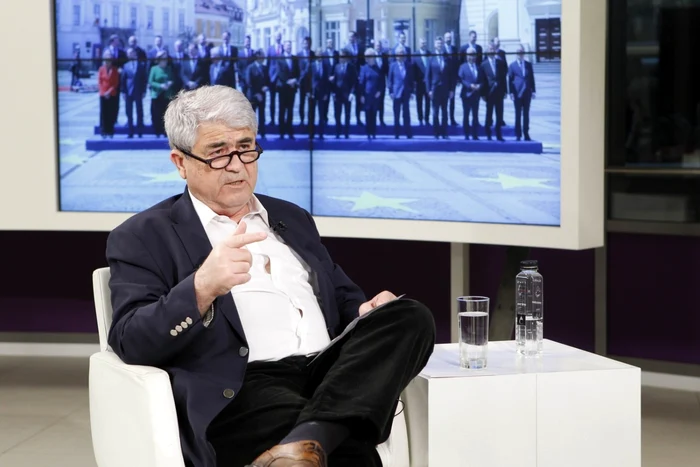
Professor Dumitru Borțun explains the mechanisms of Russian propaganda. PHOTO: The truth
“People believe as a reaction to fear and as a need for certainty”
The professor claims that these conspiracy theories are the offspring of rumours. “Rumors are as old as the world and have been used in many historical moments, when it was about changing the political order. Only at the present time the rumors are elaborated and acquire the coherence and elaboration of a theory, that is why they are called conspiracy theories, which are actually rumors placed precisely to meet the fears and dark expectations of the population”explains Borțun.
People tend to believe them because they tend to confirm their own suspicions and feel that they are true. “They are not true because they correspond to an objective reality. They are true in a subjective sense, that they correspond to a subjective expectation of the one who reads or hears them“, he adds.
Asked how deeply these narratives penetrate into the mentality of the Romanian population, Borțun claims that in general Romanians are skeptical and reject affiliation to some ideas, to some theories to follow “to the white cloth” like other peoples.
“We don't have that business. Instead, in conditions of crisis, economic, social, political, moral crisis, people get scared, become vulnerable and come to believe. And I think as a reaction to fear and a need for certainty. Uncertainty is hard to manage, it's hard to bear. So the fact that it penetrates the social consciousness in Romania is primarily caused by the crisis that Romanian society is going through and after that our way of being Romanians”explained Borțun.
The professor claims that the only short-term solution is for the state institutions to respond and communicate what the truth is, to dismantle these theories.
In the long run, the solution is education and critical thinking, which have been ignored. “The state must make a policy of protection, because the state is obliged both morally and politically to protect the population of a country from all threats, from all dangers, including this extraordinary threat which is the wave of lies and counterfeiting“, the teacher concluded.
