
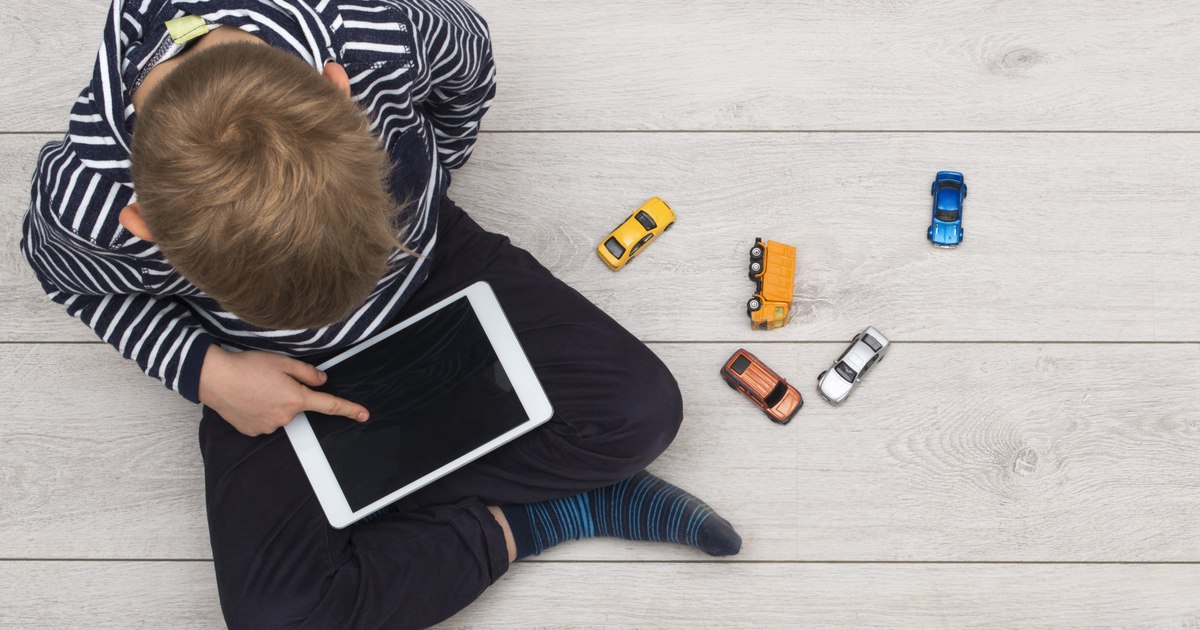
Children's screen addiction has become an almost out-of-control phenomenon in recent years. Exposed to devices from an ever younger age, many of them suffer from conditions that we had not even heard of 10, 15 years ago. This is the reason why the Ministry of Education proposes a series of recommendations aimed at empowering parents. Because addiction is formed with the tacit consent of the family.
Children under the age of 2 should not have access to a phone, laptop or tablet at all, and those between the ages of 5 and 7 should spend no more than an hour in front of screens. And don't leave them alone, on their own, but in the company of adults who will offer them only educational activities. We are talking about one of the most important recommendations of the Ministry of Education, included in an extensive draft law that will enter into force next year. Specialists, however, demand concrete measures to protect children from addiction, but also the imposition of sanctions for those who violate the provisions
Screen addiction, one of the great diseases of the century. Photo source: archive
Children under the age of 2 should not have access to phones, tablets and implicitly to games, apart from using the video camera to talk to loved ones, recommends the Ministry of Education in a project aimed at “Fundamental milestones in learning and development early childhood from birth to 7 years old”. In the case of children between 2 and 5 years old, specialists recommend a maximum of one hour of exposure to screens, together with the parent or educator and only for certain activities. Children between 5 and 7 should use technology sparingly and only in the presence of an adult.
Specialists demand concrete measures, because we are tired of advice
The recommendations of the Ministry of Education are more than welcome, psychologists say, but they will hardly be put into practice. “The project is doing well exclusively on paper and on TV before the elections. A tip is just a tip and that's it. It may or may not be considered. It is not an obligation. This project is dust in the eyes as long as it does not have a concrete basis of application“, psychologist Radu Leca declared for “Adevărul”. The specialist is of the opinion that the initiative is useless as long as those concerned – educators, teachers, parents – are not sanctioned if they do not comply with the provisions. The specialist refers not only to the attitude of parents who abandon their children in front of screens from the earliest ages, but also of many teachers. “In kindergartens, especially in private ones, but also in after-schools, exposing children to different devices has become a very common practice“, said the specialist.
Who controls these educators? Who sanctions them? No one! The reason? Most of the time, everything is done with the tacit consent of the parents who do not advertise them. And why would they, if they themselves let their little ones access the internet? “The power to change this practice lies in the hands of parents. They should not allow this and intervene if it happens. These things must be flagged. Children go there to socialize, to learn, to have activities, and not to watch TV or a laptop like they can do at home.” psychologist Keren Rosner is of the same opinion. The statement is also reinforced by many parents. “Many times when I go to pick up my child from after-school, I take it in front of a laptop on which the lady plays music, cartoons, all kinds of videos and clips. It doesn't seem normal to me, but I can't help it. If I said anything, I would probably be the only one of all the parents who would have something to comment on“, Amalia Pârvu, the mother of a 6-year-old child, told us. It's a very difficult practice to control, and that's because parents generally don't mind. “A few days ago, Matei asked me to buy him VR glasses because he has a colleague from after-school. I told him he won't get them because they're not for his age, he's too young. Do you know what he asked me? But why does my colleague have it? Why? Because the parents of that child are not aware of the dangers, the risks…“, the woman told us. She told us that it is difficult to maintain the perfect balance as a parent. “You cannot prohibit the child from accessing the phone, laptop, tablet, etc. at all. You can't totally ban his devices. That we don't live in the forest. The child must be initiated in everything that means technique and technology. But everything must be done in moderation, with a head, for the good of the little one, not to his detriment. We have a rule: one hour on the phone, once every two days. And only play games I agree with”said the father.
The effects of screen addiction
In the case of small children, the effect of frequently used devices is almost destructive. “As long as color screens, laptops, gadgets, mobile phones and other devices replace parents, they will raise, without realizing it, a child without family consciousness. Prolonged exposure to screens leads to the appearance of psycho-emotional diseases, affective and behavioral disorders among children aged between 1 and 10 years. Then, let's not forget that in the last five years the number of cases of children with special educational needs has exploded”, explains psychologist Radu Leca. More precisely, it tripled, reaching over 70,000. Specifically, according to the data provided by the Ministry of Education, the number of students with CES in mainstream education is 51,784, and those in special education is 19,450. Thus, officially, Romania has over 71,234 schoolchildren with special educational requirements.
“As conditions caused by prolonged exposure to screens, we have light autism in first place. In second place we have anxiety and depression. In third place we have obsessive-compulsive disorder. Then we have anxiety about sleeping at night or eating, which can put the child's life at risk. Children addicted to computer games, especially network games with a high degree of violence, can also become angry and aggressive. And the parents end up in a situation where they simply can't communicate with the teenager at all.” psychologist Radu Leca explains what addiction means and entails.
Dependence on screens is also reflected in the school performance of children who have turned the smartphone into an extension of their own self and cannot be separated from it even during class. “Students are addicted to the mobile phones with which they come to school every day”, Andreia Bodea, director of the “IL Caragiale” National College in Bucharest, told us. She told us that she managed to solve the situation in the small classes by imposing a rule from which no one deviates. “Before going to class, the children of grades I-VIII leave their mobile phones at the secretariat, in specially arranged metal boxes. These boxes are locked. When the lessons are over, the boxes are opened and the students take their devices“. The teacher admits that the process was quite difficult for the children, but beneficial in the end. “In the first week, the students went into withdrawal. It was crazy. They didn't know what to do during breaks. The little ones came to me and said: «Madam director, are you teaching us a game too? What do we do now?”. I went out with them in the school yard and told them how I used to play when I was a child. After which they got used to it. And now everyone, teachers and parents, have noticed that it is much better this way”. The teacher witnessed a major change in the behavior of the students. “First of all, not having the phones in class, the children had to be attentive in class. They had to look at the blackboard because they had nothing else to do. Then see them during the breaks. They started talking to each other, telling stories, socializing, communicating, interacting with each other”.
Solutions
The solution to prevent children's addiction to screens lies first and foremost in the family. “Parents are the first to prevent addiction. And this is done through a well-established program. The child must know when he is allowed on the computer and for how long. Just the other day I spoke with a parent whose child only has access to the phone on the weekend.” explained psychologist Keren Rosner. “And so during the week the child can focus on school, homework, different activities without thinking about the internet. It's a healthy program that I recommend.”
Radu Leca comes up with an even more drastic solution: “Fining the parent if they allow the child to take the phone to school and/or excluding the child from academics for a period of 7-9 days if caught using the phone at school. Low student performance is highly correlated with time spent on the phone.” he proposes.
Last but not least, there is a need for awareness campaigns for parents in this sense, for their responsibility. Because device addiction is, after all, a serious disease from which children are suffering more and more.
