
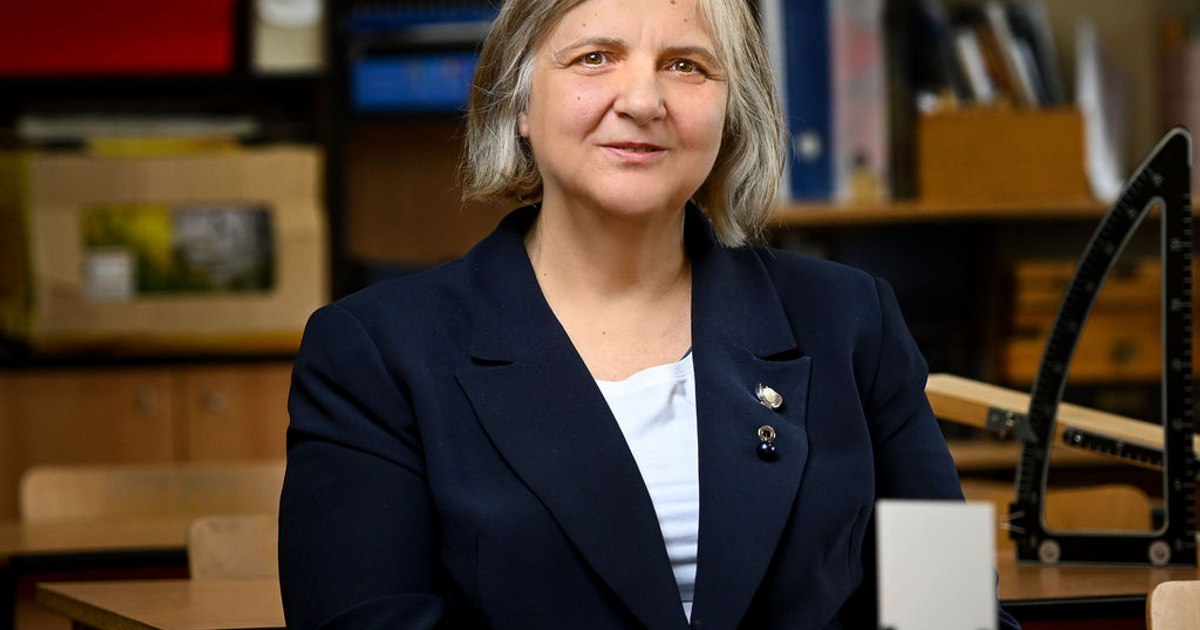
Daniela Țepeș teaches Physics through the investigation method, building in the students' minds the answers to the questions she asks about physical phenomena. It starts from children's everyday reality and uses virtual experiments, through which they learn through exploration and discovery.
Daniela Țepeș PHOTO projektmerito.ro
Daniela Ţepeş, Physics teacher at the “Ioan Cotovu” Theoretical High School in Hârşova (Constanța), was appointed MERITO teacher in 2023 for her different teaching methods of this subject. He graduated from the Faculty of Mathematics and Physics, majoring in Physics, from the “Alexandru Ioan Cuza” University in Iași and could have worked in any field he wanted, but he chose education for the love of children, and for 35 years he is at the chair.
Her preferred teaching method, especially in middle school, is the inquiry method, which involves the teacher asking questions to help students formulate hypotheses.
“I have always started from the world in which the child lives, from the things he observes daily, and on his life experience I have tried to build and lay the foundations of scientific knowledge.” explained Daniela for “Adevărul”.
The method of investigation means, in fact, starting from simple things, such as a question from the children's universe related to the theme that the teacher proposes in class. If this does not happen, students will not be curious to engage in that topic and will not give any answers.
“The great art of teaching by inquiry is finding the right questions“, points the teacher. Starting from here, Daniela never simply gives her students information.
Everything starts from a question. If the answer doesn't come right away, she asks another question, and then another, and basically builds a mental scaffolding for her students, like erecting a building. In the end, they manage to answer the question from which it started.
“There are several advantages to this method. The student begins to think beyond the concepts they are learning. He tries to explain himself, to connect information he has with observations from everyday life and information from other disciplines, with all his life experience. That's already a benefit for him, even if he doesn't necessarily find the answer to the question,” says Daniela.
The answers children arrive at from this process is something they will forget much harder than a definition the teacher would give them in class.
Physics learned through virtual experiments
He never misses an opportunity to show the students in the classroom that physics is all around them, that it is enough to look out the window and see a physical phenomenon. It also creates stories that make it easier for children to understand.
“Why does the cat or dog stick out its tongue? Why do chickens puff up their feathers when they are very hot or roll around in the dirt? They are questions from their world”, explained the teacher. He really likes to involve his students in virtual experiments.
“Physics is a modeled reality. When you teach kids physics, you don't exactly tell them about reality. I cut a slice of reality in which we look with a magnifying glass at a certain phenomenon. For example, the child has no way of seeing in everyday life the absence of friction. And then we use the virtual experiments, where the students see what happens when the friction force is zero”, explains Daniela.

Daniela uses virtual experiments in class PHOTO projektmerito.ro
He works extensively in the classroom with phet.colorado.edu, an educational platform founded in 2002 by Nobel laureate Carl Wieman, through which students create free interactive simulations that actively engage them through an intuitive, game-like environment where learn through exploration and discovery.
Her stated goal is to bring as many students as possible very close to what they should know and do at the end of a school year.
“When you focus on skills, somehow it's not so important to go through all the content that year, you can do it the next year,” explained the teacher.
At first it is more difficult, but as the students get used to the teaching method, their rate of information accumulation increases significantly.
Put the teachers in the shoes of the students
Daniela Țepeș is also a trainer and passes on all the methods and approaches from the classroom to the teachers she works with at the Center for Educational Evaluation and Analysis. He wants teachers to understand that their work must be centered on the student, on his pace and needs.
And in this role, he applies the same strategies. After putting herself in the students' shoes, through games and stories, she challenges them to answer why they would apply the methods she explains.
“I teach teachers the method of investigation through games. For example, it's a game about some cows crossing a bridge. It may seem trivial, but it's a game where teachers go through all the stages a student goes through to find out the answers.” says Daniela.
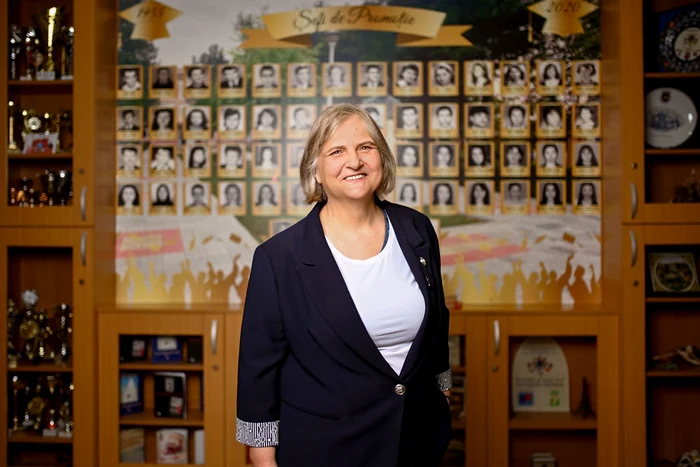
It also uses the investigation method with the teachers it trains PHOTO projektmerito.ro
Thus, teachers have a question to answer, they observe the phenomenon and formulate hypotheses. They then further observe the phenomenon and analyze whether their hypotheses are verified or not, arrive at the final result and formulate the conclusion.
They also go through the most difficult moment, when they have to discover the repetitive pattern in the phenomenon they are investigating. He thus learns a lot about them, but especially what he needs to change in their teaching methods so that they guide students to the answers, not hand them out on a tray.
“If you don't have any questions, you can't grow”
In 2010, Daniela joined the “Noi Orizonturi” Foundation and established an “Impact” Club in the school because her son was then in the 7th grade and she wanted to find a pleasant alternative for him to spend his free time.
The students coordinated by her had performances with an interactive play about human trafficking in Hârșova and on the coast, organized activities with disabled children, Christmas shows and a “The people of Hâršov have talent”, designed so that almost the whole school participates.
“First of all, the club helped me grow professionally and as a person. The people from Noi Orizonturi helped me to understand things that I knew theoretically and I went through many courses organized by them to have a lot of
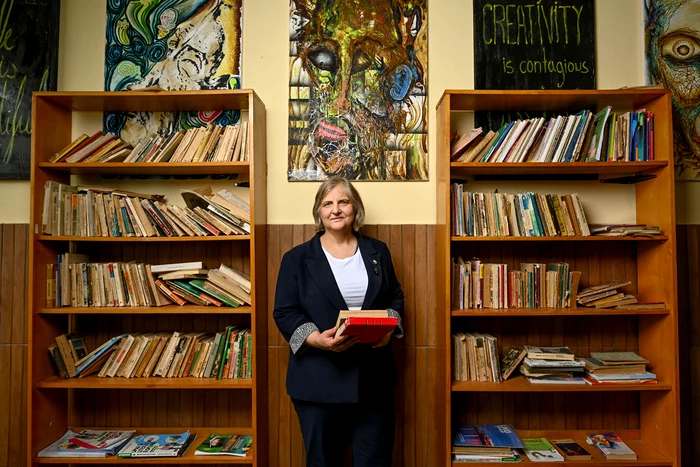
Daniela wants her students to always ask themselves questions PHOTO projektmerito.ro
He confesses that if he could transfer to a high school in a big city, he wouldn't do it because at school he feels like family, and Hârșova gives him the feeling of intimacy, because it is a small town, where everyone he knows just about everyone.
“I want my students to be left with a way of thinking, with an openness to understanding the world in which we live. I always tell them that it is very important to look around and ask questions. If you don't have any questions, you can't grow. It is equally important to use your mind and not take what others give you for granted, to never give up, to look for solutions and to understand that, in fact,
failure can be the most powerful source of learning“, is the wish of Physics teacher Daniela Țepeș from Hârșova (Constanța) for the children who pass through her hands.
