
The local and international speakers of Dare to Learn – the largest event in Europe dedicated to teachers, HR trainers, managers and entrepreneurs – encourage teachers, as well as the rest of the pre-university and university education staff in Romania to approach differently the challenges they often face faced in the educational activity.
Challenges can be transformed into as many opportunities, with the help of modern learning methods and techniques, tested and applied by the best education experts in the country and globally, leaders who will gather, in the fall, for the first time on the same stage, at the first edition of the Dare to Learn event.
“At Dare to Learn, you don't have lectures, but models that demonstrate that it is possible and that where it is possible, we will adapt”, CONSIDERS Radu Szekely, President of the Dare to Learn Foundation and organizer of the Dare to Learn event, former Secretary of State in the Ministry of Education and co-founder of the Finnish School ERI Sibiu.

One of the most reported and acute problems within the local education system, also addressed by the organizers and speakers of Dare to Learn, during the conference announcing this event (in April this year), is school dropout, which has a weight of three times higher in rural areas than at national level. Radu Szekely, President of the Dare to Learn Foundationdraws attention to this growing phenomenon: “We also have new isolated areas where students don't get to school very easily, and by trying to get them to the same school, which may no longer suit them, we fail to make them stay in school. School dropout has increased. We aim to find a model that suits today's generation, which doesn't want to spend two hours on a bus or a minibus to go to school”. This problem could be turned into an opportunity, Szekely points out, with the help of a method developed by another expert and speaker at Dare to Learn 2024 – Victoria Colbert.
After studying sociology and education in Latin America and the United States, in the mid-1970s Victoria returned to Colombia to introduce the Escuela Nueva (New School), a model that combined the elements she had studied. With this approach, she transformed dysfunctional rural schools into schools that connected with students, developed relevant skills, were connected to community life, and offered students self-paced and participatory learning. The model worked, the strategy to introduce this approach proved effective, and the Ministry of Education made it a national policy, implementing it in 18,000 rural schools in Colombia.
A school that speaks the same language
Liliana Romaniuc, also organizer of the Dare to Learn event and president of the Romanian Literacy Association (ARL Romania), it also mentions the benefits for Romanian teachers of participating in the autumn event and their interaction with global leaders in education. “I think Dare to Learn is more than an event. It's a movement through which we try to support schools and the educational system in Romania. Better said, let's help them become aware of this need for transformation, innovation, learning”. scored Romanian. She believes that John Hattie, one of the world's best-known experts in education, who will be present in Bucharest, put the point on the i: “The factors that influence learning the most are the teachers, the teacher and the quality of teaching. We hope it will be a challenge and, equally, an invitation to, but also a responsibility to our teachers to look at what the studies and research tell us about with the factors that most influence learning.”
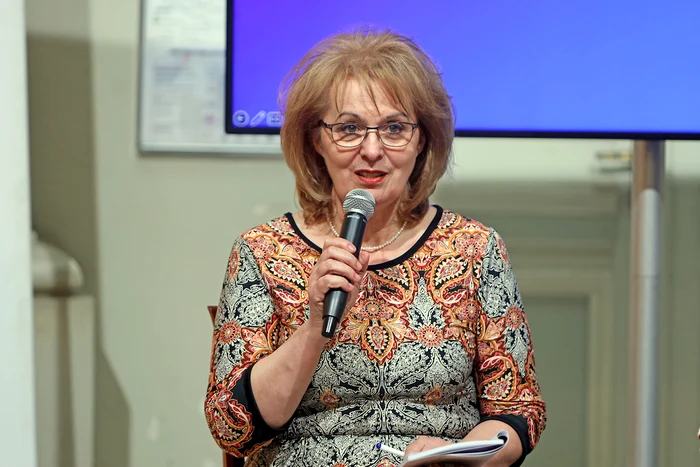
Liliana Romaniuc believes that other challenges, often perceived as real problems of the education system in Romania, can be transformed into fantastic opportunities: “The second thing we propose is to bring those factors that most influence learning into our classrooms. The third thing John Hattie proposes is to measure the impact. Because we might use methods and we apply tools that don't give results in our didactic efforts. And we don't know this, because we don't measure, we don't evaluate. This explains the fact that many of the good efforts in the local education system did not end well , precisely because we haven't evaluated and measured the impact. And the fourth thing that John Hattie proposes is this collaborative approach at the school level. It's not enough that just one teacher wants to do things, it takes a whole pedagogical team , for school leadership to speak the same language so that learning becomes visible and the school becomes a space where every child progresses in learning”. concludes Liliana Romaniuc.
Reducing inequities in education
Iuliana Pielmuș, Executive Director of Teach for Romania and organizer of the Dare to Learn eventemphasizes the importance of the educational act and how an apparent barrier can become a learning opportunity, with the help of teachers. “We work especially with teachers and principals in vulnerable public schools. In Romania and in the other 60 countries where the Teach for All network is present, we have the same priority – reducing inequities in education”, NOTES
Iuliana Pielmus.
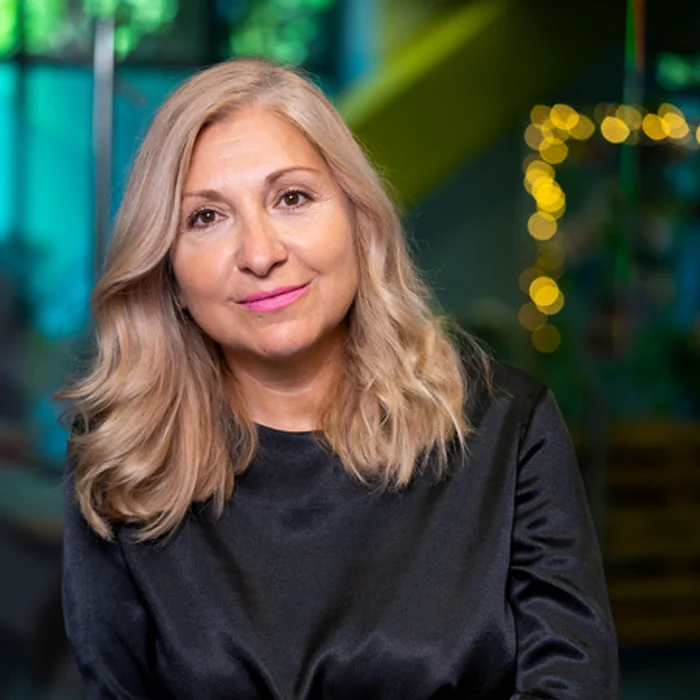
“Not only in Romania, in most countries of the world, the overall picture and the average statistical data fail to reveal an increasingly present reality – the growing gaps, including in terms of academic results and chances for quality training , between vulnerable communities and those with access to financial resources. The average student does not exist, it is an imaginary product. We have an enormous difference – and not only in Romania – between the performances and the opportunities available to students from vulnerable backgrounds and those of their peers who come from big cities and wealthy families. In Romania, the learning gap is the equivalent of more than three years of schooling. It is a difficult barrier to break, but not impossible. A well-trained teacher, who knows how to work together with the community, who knows how to look at the child and his potential in a way that gives him chances, can break this vicious circle.” Rate Pielmuş.
With the AI in the first bank
Elena Lotrean, Director of the Finnish Teacher Training Center and partner of the Dare to Learn eventexplains the role of artificial intelligence both in the fall event and especially in schools. “We will have invited Zack Kass, one of the brightest and most innovative minds in the field of artificial intelligence, one of the founders of Open AI, the most famous profile platform. There are now more than 10,000 such platforms and applications in the world that we can use, some free, some paid. From this need, we created a fundamental course in artificial intelligence for teachers, to see how to approach this resource, use it for what we want, produce learning, increase the quality of the educational act and give access to as many many pupils and students to what a quality education means”, conclude Elena Lorraine.

Starting on May 1, access to the Dare to Learn event on October 25 and 26, 2024 was also open to the general public (other professional categories, except for those in education), online, on the www.d2l.ro platform. More information about participation packages can be found here.
the event Dare to Learn is the result of a partnership between Foundation Dare to Learn, the Romanian Literacy Association (ARL Romania), Teach for Romania and the Finnish Teacher Training Centre.
ING Bank Romania is the presenting partner of the event.
EducațiePrivată.ro is the main media partner of the event. The list of media partners also includes Antena 3 CNN, Hotnews.ro, Adevarul.ro and
Stiripesurse.ro.
