
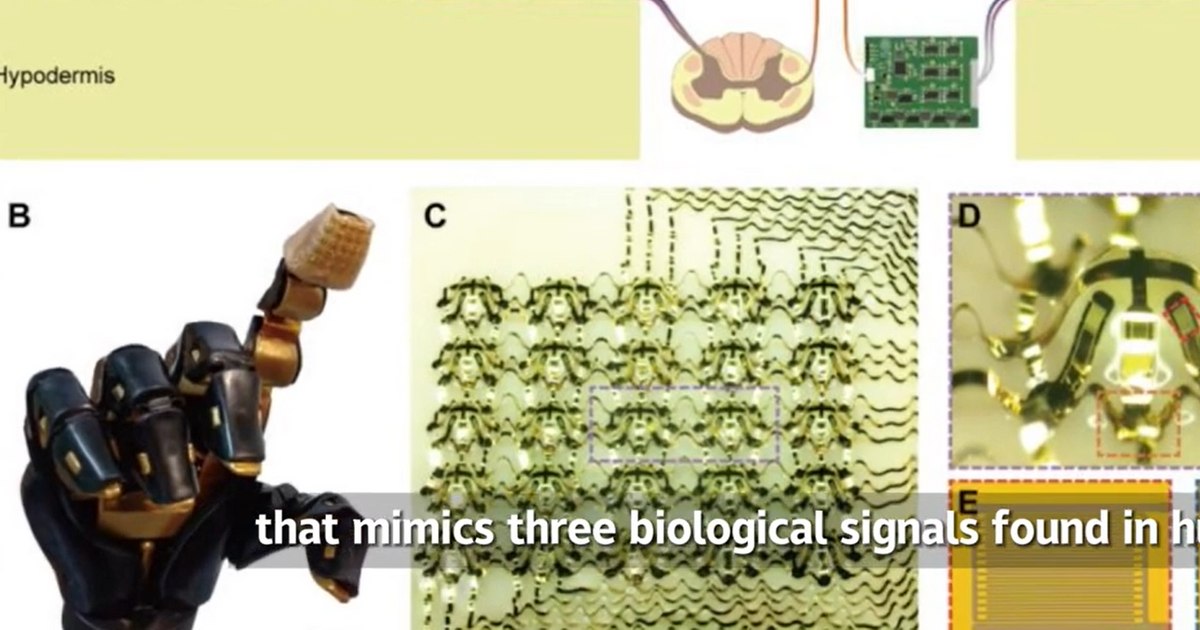
Chinese researchers have made a remarkable discovery. They invented the world's first electronic skin, inspired by the biological structure of human skin. This electronic skin features a 3D structure that mimics three mechanical signals identified in our skin.
The Chinese invented artificial leather. PHOTO capture International Channel Shanghai / Youtube
Due to their complex 3D distribution, the sensory receptors in human skin accurately perceive external forces and stresses, according to Xinhua, cited by Agerpres.
By mimicking this spatial distribution, researchers at Tsinghua University in China have developed an electronic skin that reproduces the structure of human skin and has its own “epidermis”, “dermis” and “subcutaneous tissue”.
This electronic skin is capable of simultaneously decoding and perceiving three mechanical signals – pressure, friction and tension – at the physical level, according to the study recently published in the journal Science, says chinadaily.com
“A patch of electronic skin, comparable in size to the tip of an index finger, is equipped with 240 metal sensors, each measuring between two and three hundred micrometers. Their spatial arrangement closely mimics the distribution of tactile receptor cells in human skin,” said Zhang Yihui, corresponding author of the study.
The sensors collect signals that are meticulously processed and later refined through deep learning algorithms, allowing the biomimetic skin to distinguish the texture and contours of objects with remarkable accuracy.
Electronic skin can perceive the position of pressure with a resolution of about 0.1 millimeters, rivaling the sensitivity of genuine human skin.
Electronic skin has the potential to be integrated into the fingertips of medical robots for accurate diagnosis and interventions in the early stages of some diseases. It can also be used as a patch to provide real-time monitoring of vital health parameters, including blood oxygen saturation and heart rate.
