
The European Tourism Commission (ETC) and Eurail BV published on Wednesday 19 June 2024 a report on the latest international trends in tourism, related to long-distance travel in particular in Europe.
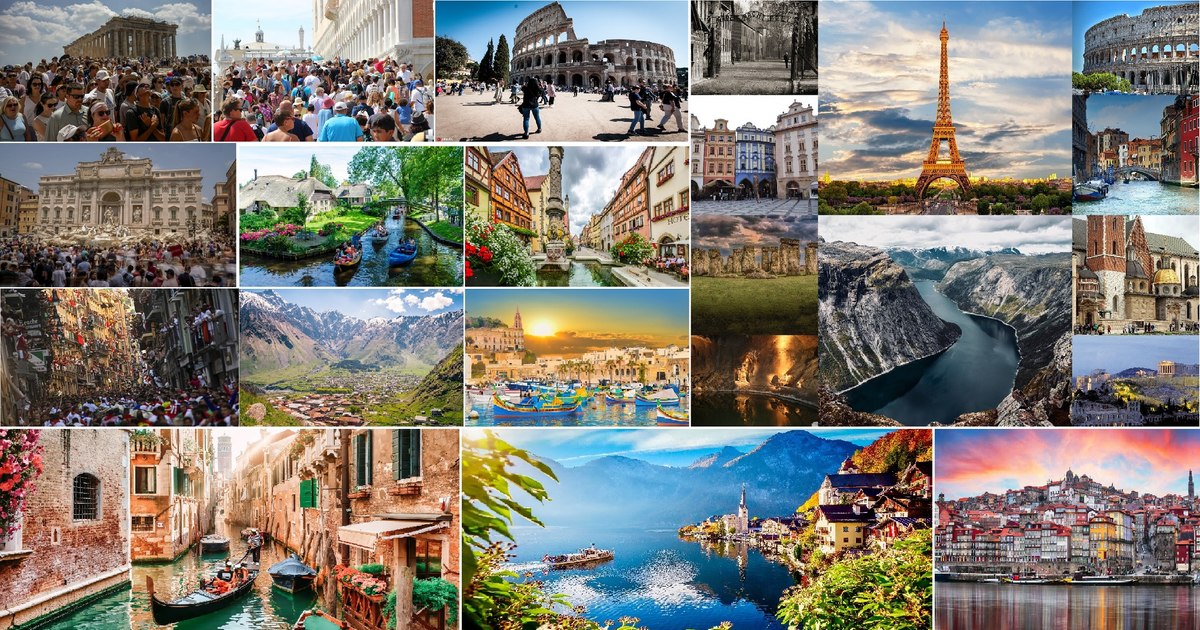
Tourist interest in European destinations is increasing in the summer of 2024 Collage
The report contains the results of a survey made on the basis of the preferences of 7,000 travelers (meaning all those who travel for various reasons, not just for recreation or to visit places of interest) from seven major markets outside the old continent: Australia, Brazil, Canada, China, Japan, South Korea and the United States, to analyze travel trends in Europe for the summer months, May – August 2024.
And the findings of the latest Long Distance Travel Barometer (LHTB 2/2024) show that international tourists are more interested in traveling to Europe than before the pandemic. Practically the appetite for travel is growing in key international markets, with 59% of respondents interested in coming to Europe in the summer of 2024, which represents a significant increase of 9% compared to 2019 (taken as the reference year, being the peak before pandemic).
Eurail BV is the company that manages and promotes the Eurail Pass and Interrail Pass, the rail travel passes for non-European tourists and European residents interested in traveling through several European countries with a single ticket.
The Japanese seem the least interested in Europe
The study by ETC shows that Europe’s attractiveness is gradually increasing, but at a slower pace, due to concerns about security and accessibility. However, the old continent remains a top destination, with 41% of respondents planning to visit this summer, but down 4% from 2019.
The most interested in Europe this summer were the Chinese and Brazilians (62% and 52% of travelers planning a trip, respectively). In both countries, wealthier people made such vacation plans for the most part.
Instead, Americans and Canadians appeared more cautious, with their interest in Europe increasing slightly compared to last year, reaching 40% and 42%, respectively.
Australians and Koreans (South Korea) showed moderate enthusiasm with 37% and 35% interest respectively. But the least interest was shown by the Japanese (only 19%), as the resumption of travel in this market continues to be slow, as mentioned in the same study.
The young and the rich are planning vacations on the old continent
In all markets, however, those most interested in traveling to Europe were young people between the ages of 18-24 and those in the 34-49 category, as well as those with higher incomes.
“The positive trends we are seeing in travel behavior are a win-win for tourists and destinations. We are seeing increased interest in longer stays, allowing tourists to develop a deeper connection with local culture and support the businesses that make each destination unique. In addition, opening up to off-season travel presents a golden opportunity to distribute tourism more equitably throughout the year. This can help reduce social and environmental pressure from peak periods and better support the economy tourist destinations“said ETC President Miguel Sanz after the publication of LHTB 2/2024.
Safety, tourist infrastructure and iconic landscapes, among the preferences of tourists
Respondents were this time more concerned about safety during long-distance travel than accessibility to points of interest in Europe.
Almost half (45%) of those surveyed said they perceive European tourist destinations as safe, marking an increase of 9% compared to summer 2022 and 6% compared to summer 2023.
Quality tourism infrastructure ranks second (38%) in the top tourism requirements, followed by a 7% return in preference for iconic landscapes, from 29% in summer 2023 to 36% in summer 2024.
Hassle-free travel on a budget
For the first time in this survey were also included “stable weather conditions” – which were the main factor for 31% of respondents. 20% of travelers opted for destinations accessible by a direct flight, while another 20% said they opted for tourist destinations with good train connections to places of interest.
Compared to last year, when 32% of tourists prioritized accessibility to areas of interest, this year, the percentage dropped to 23%. The change, tourism officials say, indicates a growing interest in quality and safety, with hassle-free travel experiences being valued over tight budget constraints.
Travelers want longer vacations and see more countries at once
67% of long-haul travelers in Europe were interested in multi-country itineraries, and 51% of them said they preferred full-service airlines for international travel. Second in preference is train passes as a popular option (30%), due to the flexibility and cost-effectiveness of navigating between multiple destinations in Europe. Low-cost airlines (29%) and one-way/return train tickets (24%) also proved popular with budget travellers.
Only 21% of respondents mentioned that they had made plans for a detailed visit to a single European country. For these domestic journeys, single/return train tickets are the most popular choice (32%), providing a convenient and efficient option to travel between cities over short or medium distances. Tourists looking for more freedom and flexibility instead opt for car rentals (29%).
Tourists increasingly interested in deeper and longer travel experiences
Overall, travelers are demonstrating a shift in priorities, with a growing interest in deeper, immersive travel experiences that allow them to learn about, understand and appreciate local culture and life, as well as the traditions of the areas they visit
Despite the increasing popularity of mid-level daily budgets (€100-200) compared to 2019 (+8%), there is also a greater interest in tourism in Europe in terms of extended holidays. While trips of one to two weeks remain the most popular choice (57%), holidays longer than two weeks are on the rise, from 13% in 2019 to 21% in 2024.
Travelers are torn between responsible behavior and prioritizing familiarity.
Most travelers are still looking for popular attractions
For the first time, the survey looked in depth at travelers’ flexibility in certain travel behaviors associated with increased social and environmental sustainability. Notably, 53% of respondents said they were open to traveling to Europe during off-peak periods, attracted by the potential savings and the opportunity to experience iconic attractions in a more intimate way.
However, when it comes to choosing specific destinations and experiences, travelers often prioritize familiarity. 61% of respondents go to destinations in Europe with well-developed infrastructure and well-known attractions. While the appeal of popular destinations remains strong, 39% are interested in exploring Europe’s lesser-known locations.
The alternation between new and familiar experiences can also be seen in the way travelers interact with businesses in the international tourism industry. Half of respondents want to support local suppliers, while the other half prefer familiar brands of accommodation, restaurants and shops.
