
The results of the 2024 National Assessment show that there are, on the one hand, thousands of children who did not graduate from secondary school, and on the other, even more who did not manage to obtain at least a 5 average. The discrepancy between the counties is also worrying.
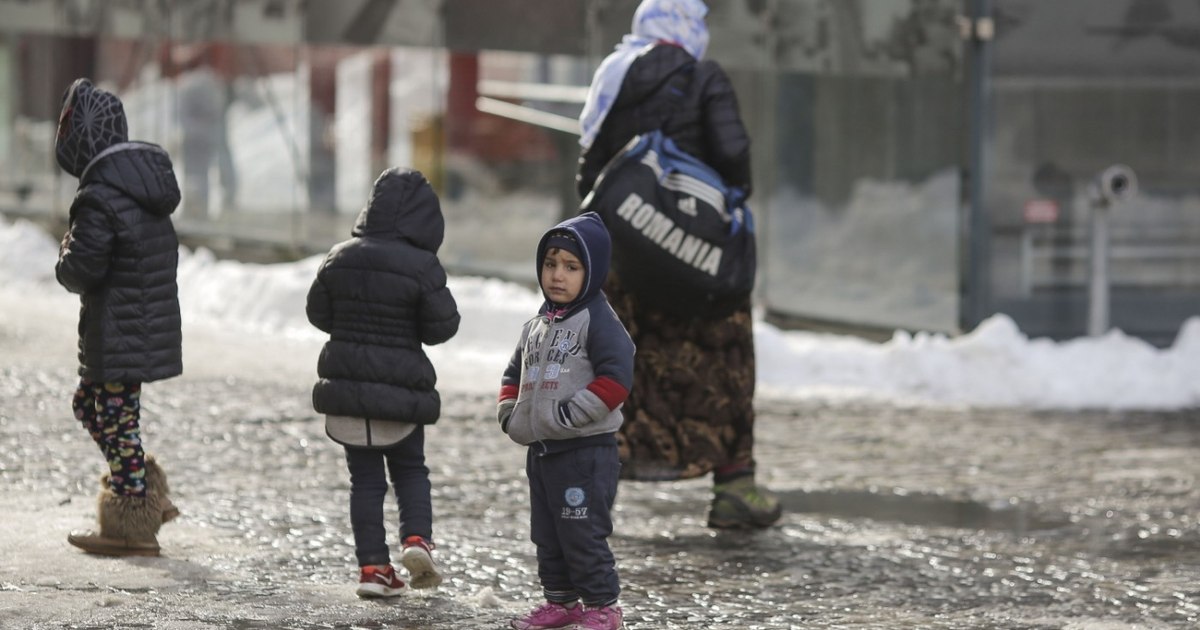
Poverty and poor quality of education, ingredients for abandonment and failure PHOTO: archive
At the national level, more than 15% of children have not even reached the end of the 8th grade, draws the attention of the Save the Children organization, which published the national map with data for each county of the country. There are counties where the average was far exceeded, with more than a quarter of the children who started school nine years ago failing to complete the eighth grade. If the rate of averages below 5 obtained in the exam is added to the data on students who did not get to take the National Assessment exam, it can be seen that in six counties these totalized figures represent more than half of the students who started school nine years ago.
County champions at dropout
At the national level, according to the analysis carried out by Save the Children, just over 15% of the children who entered the preparatory class nine years ago did not get to take the National Assessment exam. The territorial distribution is uneven, being counties where the percentage increases up to 25% and even exceeds this figure. In this situation are the counties of Giugiu – 27.26% and Călărași – 25.9%, but Covasna – 24.51%, Mureș – 23.65%, Ialomița – 23.43%, etc. are also close. Two are the main explanations for early school leaving, the authors of the study show: abandonment and the phenomenon of migration.
“The current generation of 8th grade students/graduates started with 189,730 children (the number of students enrolled in the preparatory class in the 2015-2016 school year – the figure includes all types and forms of education). This year, a number of 160,467 students were enrolled in the National Assessment, i.e. 15.42% of the children enrolled in the preparatory class did not reach the end of the 8th grade. mention Save the Children.
To the number of children who could not be registered for the National Assessment (registration was carried out automatically by the schools for all students who graduated from secondary school) are added the students who, although registered, did not show up to take the two written tests. There are explanations for this fact as well, says Save the Children:
“On the one hand, the difference can be explained by the situations of coherence or repetition. This year, registrations for the National Assessment took place between June 11-14, and classes for 8th grade students ended on June 14. We can see that this year there was a desynchronization between the methodological tools – the older methodological framework, but also applicable this year, had the automatic enrollment in the National Assessment only for the graduates of the 8th grade, but the 2024 National Assessment calendar left room and for such cases in which the registrations also included students whose school situation, which was later clarified, was of correctness or repetition”, show the authors of the analysis. Another part of the number of absentees is represented by students with special educational needs (SEN) who followed the special education program or benefited from curricular adaptations (regardless of whether they studied in mainstream or special schools). “These students are also automatically enrolled, but they take the National Assessment only at the express request of their parents or legal representatives. And such requests are not submitted in all cases, especially given that the adaptations available for these students only concern the exam conditions, not the subjects”, show Save the Children. The lowest number of absentees is represented by the Olympians who, based on the results obtained, secured places in the desired high schools.
For a decrease in the number of those who do not show up to take the National Assessment tests, the authors of the analysis have three solutions: coordination of the enrollment calendar for the National Assessment with the structure of the school year for 8th grade students; monitoring the incidence of corrigencies and repetition (to avoid the abusive use of these tools at the level of the 8th grade); introducing the possibility of adapting the subjects to the National Assessment in harmony with the curricular adaptations benefiting students with SEN.
Dropping out of school, the phenomenon we are afraid to report correctly
Save the Children also points out in the analysis that there are large differences between the data on school dropouts reported by the Romanian authorities and the data from Eurostat reports. Thus, while the most recent data, those for the 2021-2022 school year, give the official dropout rate, in the primary cycle and the gymnasium cycle, at 1.2% (and 1.2% – the year 2020-2021, respectively 1 .3% – year 2019 – 2020), Eurostat shows that, in the year 2021 – 2022, 12.2% of Romanian children of secondary school age were out of school, and the percentage increases to 15.86% in the school year 2022-2023.
There are, say the experts of the Save the Children organization, solutions to improve reporting. Thus, it is proposed to improve the procedures and mechanisms for identifying, monitoring and counteracting the risk of school dropout or failure, but also to support the European efforts to create a system to ensure the monitoring of the respect of the rights of migrant children, in the context of the existence of such discussions at EU level.
How did you get to such high failure rates?
The loss and failure map also shows huge differences between counties. Călărași is the champion county for this indicator, the number of children who abandoned school, to which is added that of correctors/repeaters and that of students with averages below 5 in the National Assessment, reaching 58.15% of the total number of students who started school nine years ago. The next county is Teleorman – 53.16%, followed by Caraș-Severin – 53.10%, Vaslui – 53.03% and Mehedinți – 51.87%. The best data are recorded, instead, in Bucharest – 19.13% and Cluj – 27.93%.
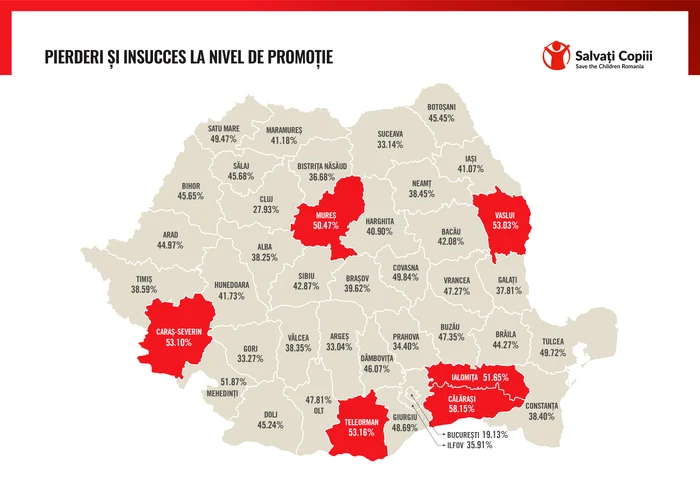
Loss and failure map by Save the Children
It has arrived here, say the representatives of the Save the Copii organization, for the reasons that are also the basis of the PISA results. Socio-economic status and the environment of the school attended are the main explanations. Students who come from poor families and study in rural schools perform much worse, statistics show, including statistics based on National Assessment results. This year, the percentage of grades below 5 in the National Assessment was 15.35% in urban areas and 42.27% in rural areas. To the two main reasons are added the support and involvement of teaching staff, the climate of discipline, the involvement of parents in school life and the feeling of safety in the school environment.
Real intervention is needed to improve the data, so that every student feels the support that Education officials talk about in every review, but also the assessment and review of the school curriculum and the role, structure and organization of National Assessment.
More than a third of families cannot afford to provide their children with adequate food
The data presented by Save the Children show that in 2023, over 1.3 million children in Romania (39% of the total number of children) grow up at risk of poverty or social exclusion.
“A survey conducted in 2022 regarding the impact of the economic crisis on families in Romania revealed that 40% of households recorded a decrease in income compared to 2021, while expenses increased for 98% of families. At the level of the same year, 2023, in families with three or more children, over a third of them (33.2%) cannot afford adequate food for their children (EUROSTAT)”. show Save the Children.
The gap in school performance between children affected by poverty and their peers from well-off families is one of the highest in the world. Half of the children are functionally illiterate, and one of the main reasons is the poor quality of education in vulnerable communities.
“Chronic functional illiteracy remains at the level of the first PISA assessment in 2009, i.e. almost half of the children affected: between 41.7% (reading) and 48.6% (mathematics) (PISA, 2022). The results of the analysis reveal the fact that the Romanian education system is the most inequitable of all the more than 100 participating countries (OECD, 2022)”also shows the Save the Children analysis.
