
Greenland was largely ice-free during the last million years, when atmospheric CO2 levels were much lower than today, according to a new study published Monday, providing the clearest evidence yet now, according to AFP.
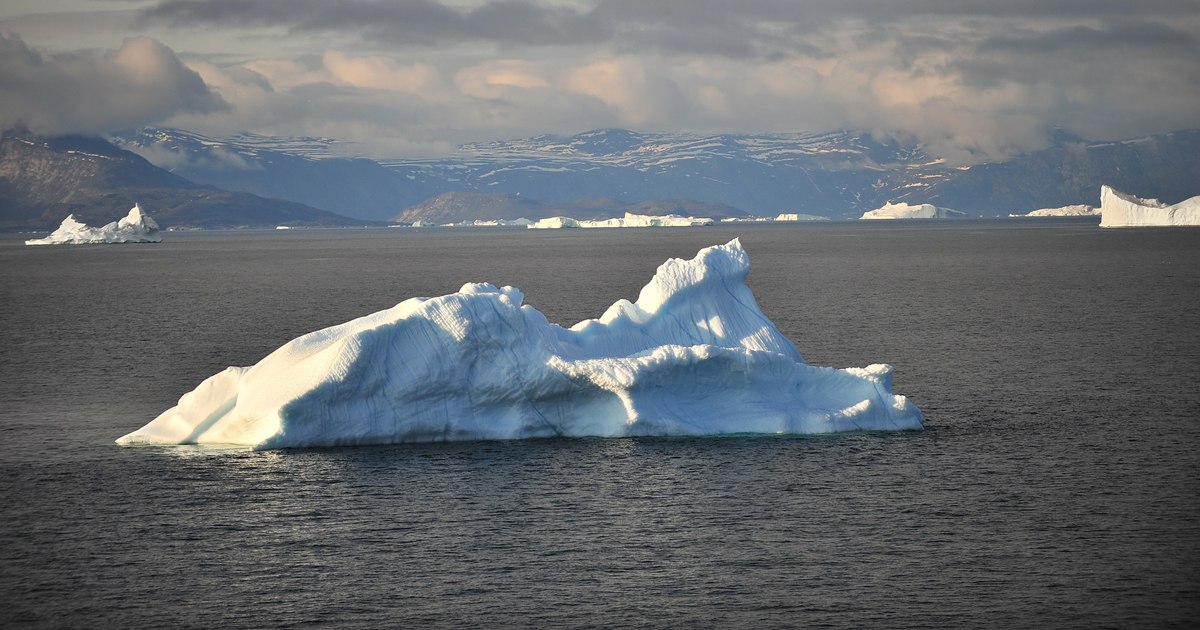
Iceberg in Greenland. PHOTO Shutterstock
The conclusions of this study have far-reaching implications for humanity, as this research raises fears about a greater risk of sea level rise than previously predicted, according to Agerpres.
“We now know that the entire ice cap is vulnerable to the risk of melting“, said Paul Bierman, professor at the University of Vermont and lead author of the study.
His team discovered remains of plants and insects in an ice sample taken from a depth of three kilometers, in the center of the ice-covered island.
“I literally saw those fossils”
The ice sample, called GISP2, was taken in 1993 and has already been studied. But because the idea that Greenland was ice-free in the recent geological past seemed highly unlikely, no one had thought to look for fossils in its center until now.
“I literally saw those fossils in the first hour or even the first half hour of work”Paul Bierman recounted.
An entire ecosystem existed in Greenland
The researchers were amazed to discover, in a layer about eight centimeters thick, willow wood, mushrooms, a poppy seed and even the eye of an insect.
The conclusion of the study, published in the journal PNAS, is that an entire ecosystem existed in this place and in this period.
If the ice in the center of the island has melted, then it is almost certain that it has been missing from most of this vast territory, says Paul Bierman.
And this does not bode well given the current global warming.
Greenland’s ice sheet could melt almost entirely
The bad news is that if current greenhouse gas emissions are not significantly reduced, the Greenland ice sheet could melt almost entirely in the coming centuries or millennia, leading to a sea level rise of about seven meters and would make coastal cities all over the world disappear.
“Hundreds of millions of people in the world will lose their place of residence“, warned the same researcher.
Small dark spots
In 2016, researchers studied the same sample from 1993 using a dating technique and determined that it could not be older than 1.1 million years.
If the ice melted in that place (and allowed the appearance of flora and fauna – ed.), then 90% of Greenland should have been ice-free, according to the researchers’ estimates.
The findings were met with skepticism at the time because, according to the widely accepted theory until then, Greenland had been an ice fortress for several million years.
The disappearance of the ice in that area took place over 400,000 years ago.
In 2019, Paul Bierman and an international team re-examined another ice sample, this time extracted in 1960 from an abandoned US military base, Camp Century, near the coast of Greenland.
The team was surprised to discover that the sample contained leaves and moss. Advanced dating techniques have helped scientists estimate that the disappearance of the ice in that area took place 416,000 years ago.
This discovery led Paul Bierman to return to the 1993 sample to look for similar traces. Finally, researchers found irrefutable evidence of melting ice.
“Now we know for sure that the ice has disappeared not only at Camp Century, but also at GISP2, in the center of the ice sheet”he pointed out.
Halley Mastro, co-author of the study, emphasized the importance of continuing to collect ice samples in Greenland, in search of even older organisms, whose discovery could have major implications for the future of humanity, writes Agerpres.
“It’s so obvious once you know something’s there, but if you didn’t expect it to be there and look for those little dark spots that float a little differently, you’d never see them.”she stated.
