
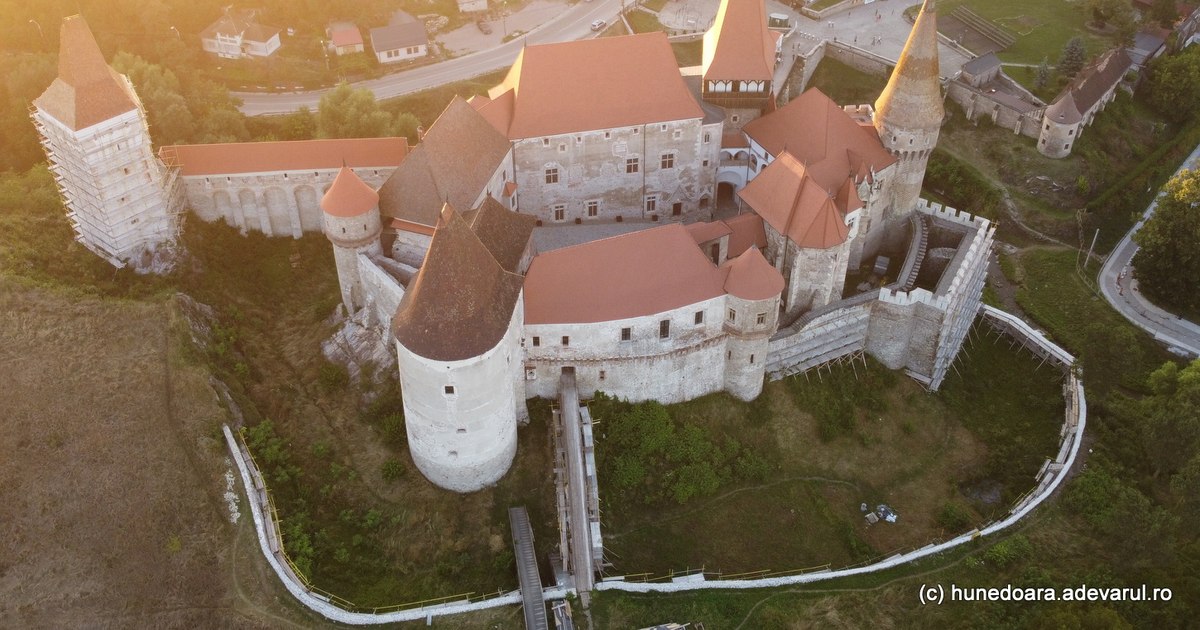
The most famous medieval rulers left behind precious castles and fortresses spread throughout Romania, but those who visit them and admire their spectacular architecture might get the wrong idea about the daily life of most medieval people.
Corvinor Castle from Hunedoara. Photo: Daniel Guță. TRUTH
In the 15th-16th centuries, Transylvania, Moldova and Muntenia seemed to pass, according to some historians, through the “dark middle ages”, although they have since preserved the memory of some of the most famous rulers in Romanian history: Ioan de Hunedoara, Vlad Țepeș, Mihai The Brave and Stephen the Great.
The daily life of the medievals was most often marked by deprivation and brutality, by dangers at every turn, life expectancy was extremely low and infant mortality reached extremely high levels.
Epidemics, wars and natural disasters often led to the desolation of regions, and in the face of unexpected events, people were often left defenseless.
Treatments for diseases were almost unknown. According to some historians, when they fell ill or were injured, the medievals could ask for help from healers, monks or barbers, but the treatment they received and the interventions they were subjected to often caused them suffering and death.
Surgical interventions were rare. The most common of them were aimed at “removing bad blood” – which would have led to the revival of the body, trepanation – for headaches, cataract operations without anesthetics, red-hot iron cauterization of hemorrhoids, removing stones from the urinary bladder
Torture, cruelty and witch-hunting were accepted by the medievals and sometimes became forms of entertainment for the masses. Death sentences were carried out in public squares, in the midst of crowds, and the agony of the victims was prolonged. The instruments of torture, of unlimited diversity, were part of the arsenal of investigators, inquisitors and executioners and were used on every occasion.
Torture, common practice in Transylvania
Women were not exempt from the tortures, and some instruments were specially reserved for them. Often, they were killed on charges of adultery or witchcraft, and with the help of the beasts available to the inquisitors, the “evidence” needed for convictions was easy to find.
Witches were blamed for the calamities in the region, for the disaster of the harvests, for the death or illness of the locals and for the charms on the men. A simple testimony could bring their destruction.
In Transylvania, the first trials against witches were recorded in the 13th century, researcher Maria Roşu said.
The accused were put to the red-hot iron, and during the torture, they confessed whether they had done magic or not. Those “proven” as practitioners of magic were burned at the stake. The persecution of women suspected of practicing witchcraft continued in the following centuries in Transylvania, encouraged by the desire of the authorities and society to find scapegoats for the disastrous social situation or for the troubles of the communities.
And the dead were suspected of contributing to the plight of the medievals. People suspected that after death they can return among the living in the form of impure spirits no longer had peace “even in the grave”.
The dead were nailed to their wrists and ankles or in their stomachs, others were impaled or butchered. The liver and heart of the “suspects” were burned and sometimes even eaten by their families.
Transylvania – a huge fortress guarded by mountains
The scholar Anton Verancsis traveled to Transylvania in the middle of the 15th century, lived in the Alba Iulia fortress, and left posterity a detailed description of the region. The author noted that the lands of Transylvania were protected by the Carpathians and extremely rich in natural resources.
“Transylvania is fortified within by various obstacles, both of mountains, and of waters, and of roads, and is guarded without in all directions by the highest and most precipitous mountains, as if surrounded by the strongest walls. By herself she could for the most part supply the Turkish power with grain, and support it with pecuniary aids, so dexterous is she in food, abounding in vineyards, rich in cattle, and full of all kinds of metallic and salt ores “the 16th century scholar pointed out.
Although considered a fertile country, Transylvania went through terrible times at the end of the 15th century.
“There were ten troubled years, of unheard-of riots and destruction, of invasions by outlaws and Turks, of robberies by Walloons and Tatars, of burnings by the Romanians, and natural calamities, destruction and exhaustion of the population caused such a great famine that some wretched people supported their wretched lives on human flesh. Even the year 1608 was not spared from calamities, because it was caused by a plague, but this year otherwise alleviated the miseries of the previous ones”informed the historian Szilágyi Sándor (1827-1899), in a volume about the Transylvanian prince Gabor Bethlen.
What the villages of Moldova looked like in the 15th century
Much more vulnerable to Turkish invasions, drained by wars in the medieval era, Moldova and Muntenia were in a much worse state than Transylvania in the 15th century.
Because of the Turks, the locals did not have the right to establish their fortresses and surround their cities with walls and fortifications, their defense power lay in the bravery of the locals, pointed out the erudite Anton Verancsis
“There are no cities in these countries at all, and no urban civilization, and no more imposing buildings. In Molodova there are only three stone fortresses, first of all Suceava, the princely residence, then Hotinul and Neamțul, one located on the border of the Szeklers, and the other on that of Poland. The villages look like shepherds’ huts scattered all over the place, the fairs are not fortified with fences of any kind, and the peasant houses are raised a little from the ground and made of wood, stuck together with clay, and covered with straw and reeds. In Wallachia, Târgoviște is the only more important city, quite extensive and the capital of the country, and there are two stone fortresses. All the others are almost like in Moldova”informs the chronicler.
The customs of the inhabitants of the two countries were barbaric, for those times, the erudite pointed out. “The people are very unwelcoming, they obey no rules, they think it no great thing to kill a man, they are greedy for money and born to steal, They are not good-looking either in stature or appearance. They are black-faced, with locks and beards, of a very rough appearance, and are very patient with all labors and privations”, said Anton Verancsis.
The cruelty with which some of the voivods showed themselves towards their subjects had become legendary. Vlad Tepeş (1431 – 1476) was accused by Turkish chroniclers of ordering several massacres.
“He was a merciless tyrant towards the beasts. His cruelty was so great that if a man in a village committed any crime, he impaled all the inhabitants of that village, men, women and children together.”showed the Ottoman chronicler Tursun Bei, a contemporary of the ruler,
Most voivodes of the time could enjoy, however, only a few years of reign, which ended tragically, due to the numerous conspiracies that often led to their assassination, pointed out Anton Verancsis, quoted in the volume “Călători străini about the Romanian Countries” (the volume I, 1968).
