
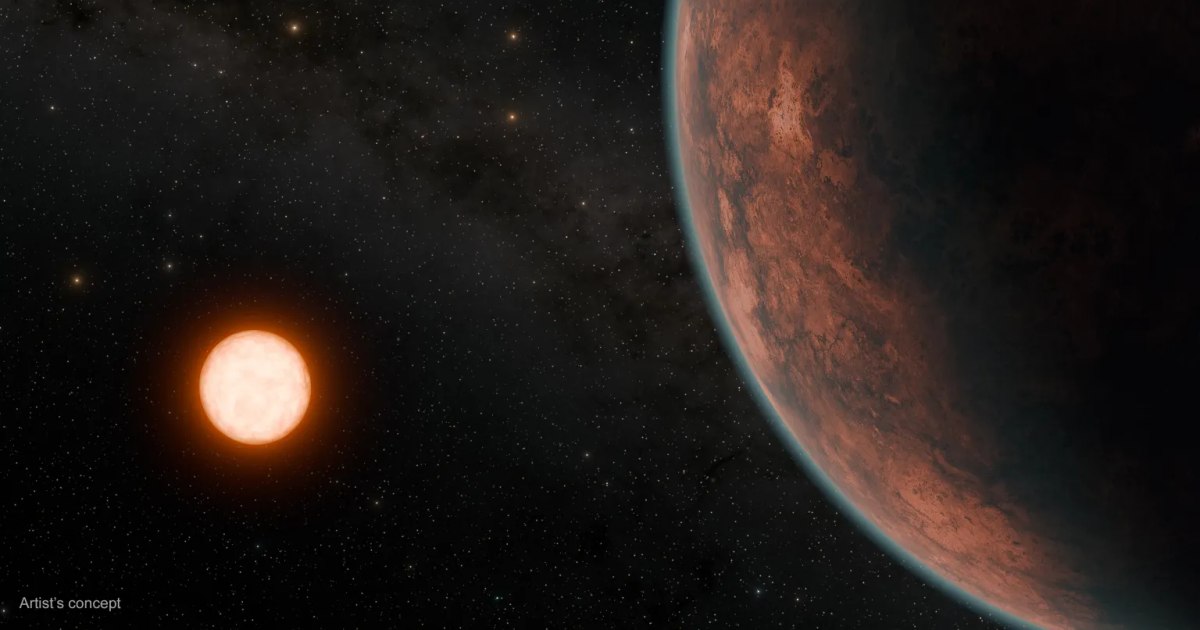
A planet comparable in size to Earth and Venus has been located just 40 light years away. It is not known still if it has an atmosphere, but it measures approx. 42 degrees Celsius and has several other characteristics that recommend it for further study with NASA’s James Webb Space Telescope.
Gliese 12 b orbits a red dwarf star. PHOTO artistic representation
Using observations made by NASA’s Transiting Exoplanet Survey Satellite (TESS) and many other facilities, two international teams of astronomers have discovered a planet between the size of Earth and Venus, only 40 light-years away, according to NASA Science.
TESS surveys a large part of the sky for about a month, tracking the brightness changes of tens of thousands of stars at intervals of 20 seconds to 30 minutes. One of the main objectives of the mission is to capture transits, i.e. short and regular dimming of stars caused by the passage of orbiting worlds/planets.
“We have found the closest transiting temperate Earth-sized world located to date. Although we don’t yet know if it has an atmosphere, we thought of it as an exo-Venuswith dimensions and energy received from its star similar to our planetary neighbor in the solar system,” said Masayuki Kuzuhara, project assistant professor at the Tokyo Astrobiology Center, who led a research team with Akihiko Fukui, project assistant professor at the University of Tokyo.
The host star, named Gliese 12is a cool red dwarf star located nearly 40 light-years away in the constellation Pisces. The star is only about 27 percent the size of the Sun and about 60 percent the surface temperature of the Sun, according to NASA Science.
The planet orbits every 12.8 days
The newly discovered named planet Gliese 12 borbits every 12.8 days. Assuming no atmosphere, the planet has an estimated surface temperature of about 107 degrees Fahrenheit (42 degrees Celsius).
The lower luminosity of red dwarf stars also means that their habitable zones—the range of orbital distances at which liquid water could exist on a planet’s surface—are closer to them. This makes it easier to detect planets transiting habitable zones around red dwarf stars than those around more energetic stars.
Between the host star Gliese 12 and the new planet is a distance of only 7% of the distance from Earth to the Sun. The planet receives from its star 1.6 times as much energy as Earth receives from the Sun, and about 85% of what Venus receives.
“Gliese 12 b is one of the best targets for studying whether Earth-sized planets orbiting cool stars can retain their atmospheres, a crucial step in advancing our understanding of the habitability of planets in our galaxy,” said Shishir Dholakia, a PhD student at the Center for Astrophysics at the University of South Queensland in Australia.
Dholakia led another research team with Larissa Palethorpe, a PhD student at the University of Edinburgh and University College London.
Both one team and the other suggest that the study Gliese 12 b could shed light on certain aspects of the evolution of our solar system.
“The first atmospheres of Earth and Venus are believed to have been stripped away and then remade by volcanic outgassing and bombardment from the remnant material in the solar system. Earth is habitable but Venus is not due to complete loss of water. Because Gliese 12 b lies between Earth and Venus in temperature, its atmosphere could teach us a lot about the habitable paths planets take as they develop“Palethorpe explained.
An important factor in maintaining an atmosphere is the storminess of its star. Red dwarf stars tend to be magnetically active, leading to frequent and powerful X-ray bursts.
However, analyzes by both teams conclude that Gliese 12 shows no signs of extreme behavior.
The conclusions expressed by the first two researchers mentioned – Kuzuhara and Fukui – was published on May 23 in The Astrophysical Journal Letters, and the conclusions of the other two scientists, Dholakia and Palethorpe, were published in the Monthly Notices of the Royal Astronomical Society in the same day.
Why is this discovery important?
During a transit, the host star’s light passes through any atmosphere. Different gas molecules absorb different colors, so the transit provides a set of chemical fingerprints that can be detected by telescopes like Webb.
“We know of only a handful of similar temperate planets DirT which are both close enough to us and which meet other criteria necessary for this type of study, called transmission spectroscopy, using current facilities To better understand the diversity of atmospheres and evolutionary outcomes for these planets, we need more examples like Gliese 12 b“said Michael McElwain, a research astrophysicist at NASA’s Goddard Space Flight Center in Greenbelt, Maryland, and co-author of Kuzuhara and Fukui’s paper, according to NASA Science.
About the TESS mission
TESS is a NASA Astrophysics Explorer mission managed by NASA Goddard and operated by MIT in Cambridge, Massachusetts. Its partners include Falls Church, Va.-based Northrop Grumman; NASA’s Ames Research Center in Silicon Valley, California; Astrophysics Center | Harvard & Smithsonian in Cambridge, Massachusetts; MIT’s Lincoln Laboratory; and the Space Telescope Science Institute in Baltimore.
More than 20 universities, research institutes and observatories from around the world are participating in the mission.
