
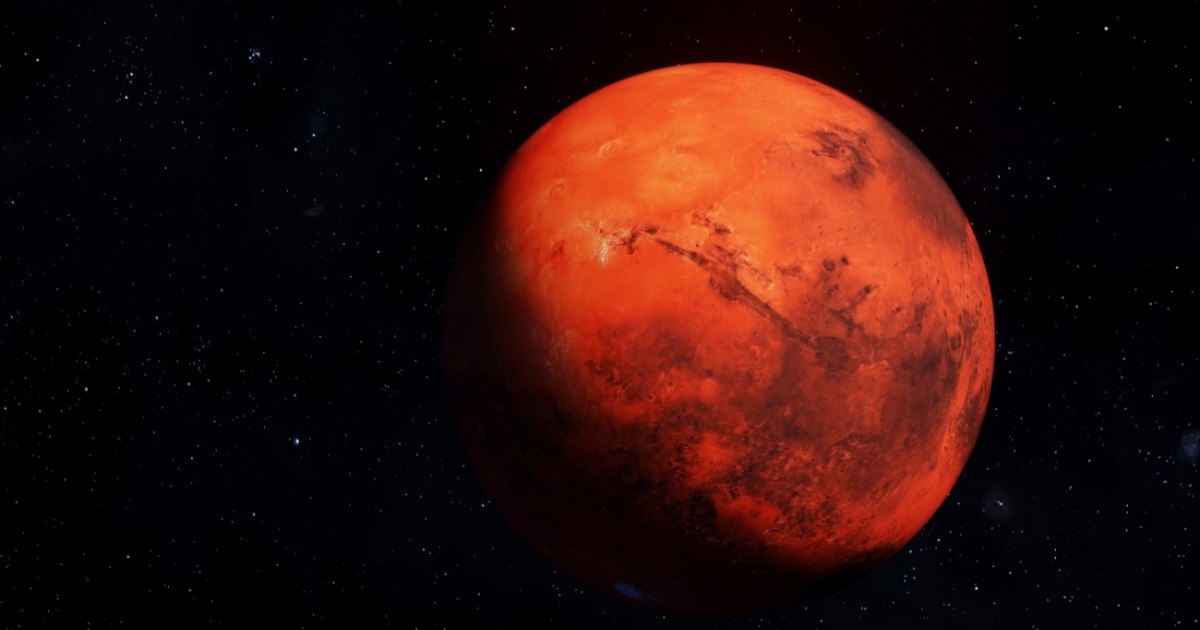
Data provided by a NASA mission indicates the existence of a huge underground reservoir of water beneath the surface of the planet Mars. The discovery suggests a new place to look for life on the red planet.
Planet Mars. PHOTO Shutterstock
A team of researchers estimates that there could be enough water, trapped in small cracks and pores in the rock in the middle of the Martian crust, to cover the entire surface of Mars to a depth of 1.6 kilometers (1.6 miles), according to CNN.
Scientists rely on data from NASA’s InSight lander, which used a seismometer to study the interior of Mars from 2018 to 2022.
The study, published Monday in the journal Proceedings of the National Academy of Sciences, shows that future astronauts exploring the planet Mars will face a whole series of challenges if they try to access water, as it lies between 11.5 and 20 kilometers.
The discovery provides new details about the geological history of Mars and suggests a new place to look for life on the red planet, if water could ever be accessed.
“Understanding the Martian water cycle is critical to understanding the evolution of the climate, surface, and interior. A useful starting point is to identify where the water is and how much is there“, says the study’s lead author, Vashan Wright, assistant professor and geophysicist at the Scripps Institution of Oceanography at the University of California, USA.
In search of ‘lost’ water on Mars
Based on evidence of ancient lakes, river channels, deltas and water-altered rocks studied by other NASA missions and observed by orbiters, researchers say Mars was – probably – a warmer and wetter place billions of years ago . But the red planet lost its atmosphere over three billion years ago, ending the wet period on Mars.
How Mars lost its atmosphere is still a mystery. In recent years, a number of missions have been developed to learn more about the history of water on this planet, where it went and whether it ever created conditions for life.
Although water remains trapped as ice in the planet’s polar ice cap, researchers don’t think it can account for all of the planet’s “lost” water, CNN reports.
According to existing theories, there are several likely scenarios for what happened to Martian water after the planet lost its atmosphere.
“We’ve identified a place that should, in principle, be able to support life”
One of them suggests that the water turned into ice or was lost into space, and others, that it was incorporated into minerals below the planet’s surface or seeped into deep aquifers.
“Establishing that there is a large reservoir of liquid water provides a window into what the climate was or could be like. And water is necessary for life as we know it. I don’t see why (the underground tank) is not a habitable environment. It’s certainly true on Earth – deep, deep mines host life, the ocean floor hosts life. We found no evidence of life on Mars, but at least we identified a place that should, in principle, be able to support life,” says Michael Manga, co-author of the study and professor of earth and planetary sciences at the University of California, Berkeley.
If the crust of Mars is similar across the planet, it is possible that there is more water in the middle zone of the crust than “volumes proposed to have filled hypothetical ancient Martian oceans”the study authors concluded.
“Some kind of deep underground mud”
The hypothesis that liquid water could exist at great depths beneath the Martian surface has existed for decades, but this is the first time that actual data from a Mars mission can confirm such speculation, says Alberto Fairén, interdisciplinary planetary researcher and visiting astrobiologist at the astronomy department at Cornell University, who was not involved in the study.
He said it would be about “a kind of deep underground mud”.
“These new results demonstrate that liquid water exists in the Martian subsurface today, not as discrete and isolated lakes, but as liquid water-saturated sediments or aquifers”, Fairén stated.
Bruce Banerdt, principal investigator of the InSight mission — whose seismometer collected crucial data from Mars — and geophysicist Vashan Wrigh hope to send more seismometers to Mars and other planets and moons in our solar system in the future.
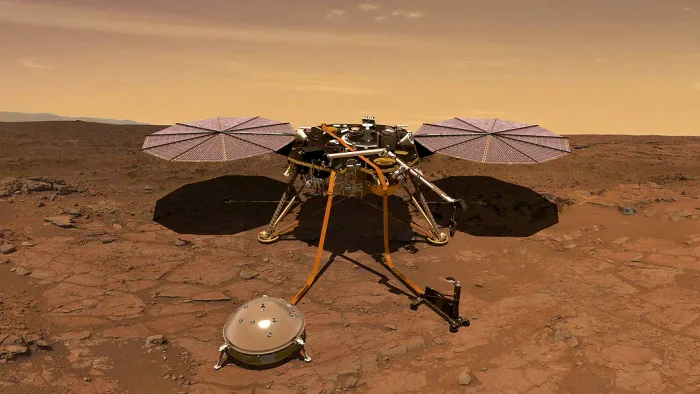
Artist rendering of the InSight lander operating on Mars. PHOTO nasa.gov
“Just as on Earth, where groundwater is connected to the surface by rivers and lakes, the same was certainly the case on early Mars. The groundwater we see is a record of that past”Wright said, according to CNN.
.
