
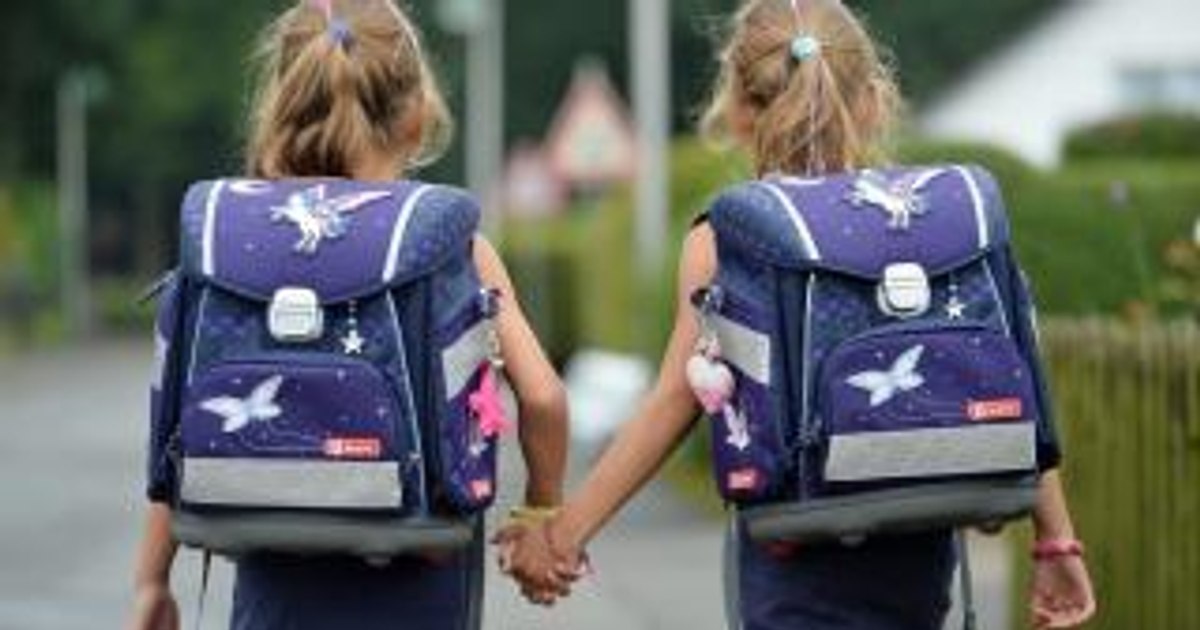
Students completing grade 1 must possess a certain set of skills that have been listed in an assessment report from the Ministry of Education. The document must be completed at the end of the school year by the teacher and is mandatory for children who entered the preparatory class in September this year. The assessment will form part of the student’s educational portfolio.
Students who finish first grade must be able to read, count and write by hand. Archive
Students should have a well-developed set of skills in several areas essential to their development: language and communication development, cognitive development, social-emotional development, and physical and motor development. Specifically, a child who completes first grade must be able to read words and short sentences written in printed or handwritten letters, write handwritten letters, write and count to 100.
Language and communication development
In terms of language and communication, students who finish grade 1 should be able to understand an oral message when it is delivered to them on topics accessible to them. They must be receptive and able to easily identify sounds, syllables, words and utterances. Also, children should be able to easily express messages themselves in various communication situations, formulate their own statements, be able to transmit information, be able to participate in simple dialogues, in different contexts.
At the end of the 1st grade, students must be able to read words and short sentences, written in printed or handwritten letters, identify the massage in a text that presents familiar happenings, phenomena, events, identify the meaning of some symbols from the familiar universe, which convey simple messages and express interest in reading simple texts, supported by pictorial support. Also, a 7-year-old should know how to write letters by hand, be able to write short messages.
Cognitive development
Students who finish the first grade of the primary cycle must know how to write, read and form numbers up to 100, be able to compare them with each other, order them on the number axis. Children must master addition and subtraction up to 100, mentally and in writing, use certain mathematical names and symbols (term, sum, total, difference, , =, +. -) in solving and/or composing problems.
Other skills:
- Highlighting the geometric characteristics of some objects located in the surrounding space;
- Orientation and movement in space in relation to given landmarks/directions using phrases such as: in, on, above, below, next to, in front of, behind, left, right, horizontal, vertical, oblique, inside, outside;
- Recognition of figures and geometric bodies in the immediate environment and in accessible planar representations (including drawings, art reproductions, schematic representations);
- Solving certain problems by observing regularities in the immediate environment;
- Generating simple explanations by using elements of logic;
- Solving simple problems involving addition or subtraction operations in the center 0-100, with support in objects, images or schematic representations;
- The use of conventional standards for measures and estimates, the use of non-conventional measures for determining and comparing capacities and lengths, the use of units of measure for determining and comparing the durations of everyday activities;
- Knowledge of common units of measurement for length, capacity (centimeter, liter) and some appropriate tools;
The socio-emotional development of learning capacities and attitudes
Children must show interest in self-knowledge, have a positive attitude towards themselves and towards others, present elementary personal traits, in various contexts, know personal hygiene rules. Students who finish the 1st grade must know how to adequately express their emotions in interaction with familiar children and adults, associate basic emotions with simple elements of nonverbal and paraverbal language, convey simple verbal and nonverbal messages about their own life experiences. They need to know what friendship means and be able to identify characteristics necessary to be a good friend.
Also, students need to be able to identify simple work tasks in varied contexts, to be able to recognize the importance of learning and familiar or preferred jobs.
Physical and motor development, the most important skills
Recognizing the influence of air and water on health, adopting the correct body posture, but also knowing and following the rules of personal hygiene.
Children must perform motor actions specific to some forms of manifestation of motor capabilities, they must know how to apply motor skills in game and competition conditions, how to apply bodily expressiveness skills and those adapted from different sports disciplines. Moreover, students must be able to participate in organized or spontaneous games and motor activities, to notice the rules necessary to carry out games and other motor activities, to participate in specific physical education activities, organized in groups, but also to show cooperation, help and fair- play during motor activities.
