
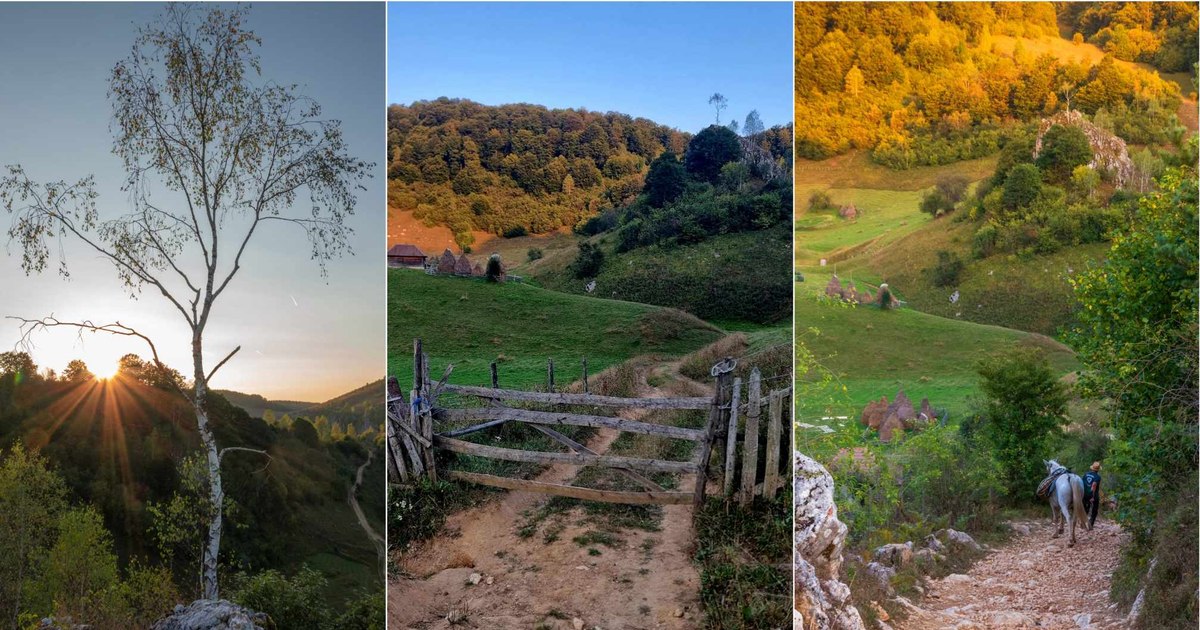
At the beginning of autumn, the locals who graze their animals in Fundătura Ponorului in the Șureanu Mountains prepare to go down with them to the villages at the foot of the mountains, instead the place also called “God’s Palm” is sought after by many tourists.
Ponor’s dead end. Photo: Lucian Ignat.
Lucian Ignat, a photographer from Hunedoara, captured in images the charm of Ponorului, one of the most sought-after places on Via Transilvanica.
“The road to Fundătura Ponorului is quite difficult for the last kilometers starting from Pui commune, being a mountain road, mostly practicable only with off-road vehicles. Then the travelers walk down the dead end. We arrived here at sunset, one of the best moments for photos. I climbed the Wolf’s Rock, from where you can see the entire meadow and its meadows. It was wonderfult”, says Lucian Ignat, the author of the images (video – Lucian Ignat).
Only a few locals from the villages of Federi and Ponori have remained with the animals in Funătura Ponorului, but people are preparing to bring them closer to home, with the cooling of the weather. They will return in the winter to the cul-de-sacs to bring hay. However, the number of tourists remains high. In autumn, the place in the Șureanu Mountains, also called the Palm of God due to its beauty, is decorated in the warm colors of the season, and the milder sun enhances the quality of photographic compositions.
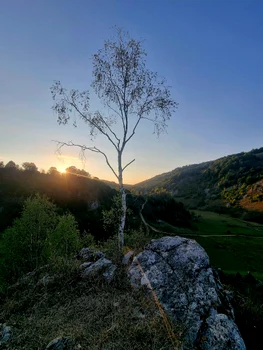
Image 1/25:
Ponorului dead end in autumn Photo Lucian Ignat (10) jpg
The end of Ponorului is crossed by Via Transilvanica, one of the most popular tourist routes in Romania.
The Ponor, a spectacular river in the Șureanu Mountains, crosses a wild land, studded with the remains of flocks established in the time of the Dacians, and, about 10 kilometers from its sources, disappears underground, in the Ponorului.
The cottages here, summer homes for animal breeders – appear in a picturesque setting, scattered on the hills surrounding the smooth meadow of Ponor, adorned with its many loops. Under the rocks bordering the dead end, the Ponor stream is lost under a rock wall, exiting a few kilometers into the valley, through the spectacular opening of the Șura Mare cave.
Over 50 ponds in the Grădiștea Muncelului Cioclovina Natural Park
The sinkhole is located on the territory of the Grădiştea Muncelului-Cioclovina Natural Park, where numerous sinkholes have been identified, some of them temporary in nature. The most famous of them are the Sinkhole and the Sinkhole.
“Sinkholes are places where surface water drains underground. On the territory of the Grădiştea Muncelului Cioclovina Natural Park, a number of 57 ponds were identified, some of them having a temporary nature. After traveling for kilometers through underground karst systems, the waters emerge from resurgences (eruptions) or from caves. The most spectacular sinkholes are Fundătura Ponorului (the palm of God), Lunca Ponoriciului and Poiana where the beauty is given by the rock walls, the winding course of the rivers, the vegetation specific to the calcareous area and the size of the karst depression”show the representatives of the Grădiştea Muncelului Cioclovina Natural Park.
Above the stream, the gentle peaks, over 1,000 meters high, that surround the Ponorului meadow have been crossed by shepherds from ancient times who took their sheep from the pasture to the alpine pastures of Retezat, Șureanu, Țarcu and Cindrel.
