
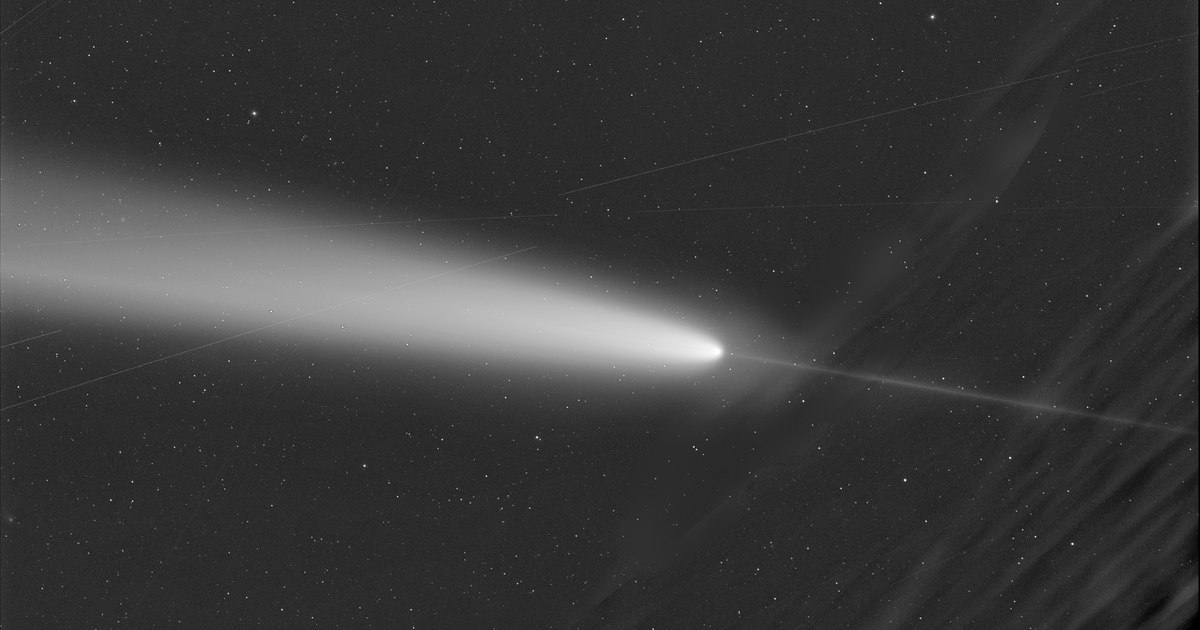
Comet Tsuchinshan-ATLAS, known as the “comet of the century,” was recently observed with the naked eye, revealing a rare and fascinating phenomenon: a second tail pointing forward in the direction of travel. The explanation: a rare optical illusion.
The “Comet of the Century” was visible in October – Photo X Michael Jager
Comet Tsuchinshan-ATLAS, dubbed the “comet of the century”, has become a subject of fascination for astronomers and astronomy enthusiasts after it was spotted with the naked eye in recent weeks. Recently, new images captured by astrophotographer Michael Jäger revealed a strange phenomenon: the comet appeared to have a second tail, pointing forward in its direction of travel, Live Science reports.
This rare optical illusion occurs when the Earth is in a specific position relative to the Sun and the comet. So while the comet’s tail, made up of streaks of dust and gas that are kicked off its body by solar radiation, always points in the opposite direction from the Sun, the new “anti-tail” seems to defy that rule. This is actually a dust trail recently left by the comet, which, illuminated by the sun’s rays, reflects the light back to Earth, creating the impression of a second tail.
When Earth crosses this plane, as it did last weekend, the debris is illuminated by the Sun and reflected back toward Earth, creating the illusion of a second tail that precedes the comet, Live Science explains.
On October 13, astrophotographer Michael Jäger captured the comet as it crossed the night sky near Martinsberg, Austria. After editing the photos, he noticed that in addition to its accompanying bright tail, Tsuchinshan-ATLAS also had a faint streak of light, known as the “anti-tail,” pointing forward in its direction of travel. The next day, Jäger took an even clearer photo of the comet, revealing this extra appendage that seems to defy the laws of physics.
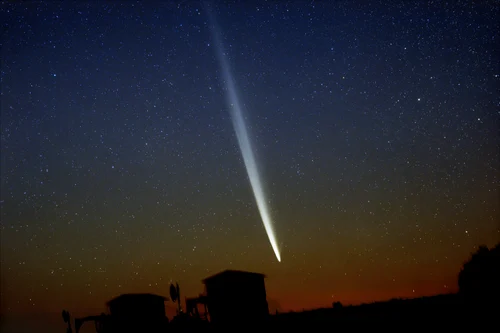
Image 1/3:
comet of the century Photo x Michael Jager 2 jfif
Tsuchinshan-ATLAS peaked on October 12, when it was about 70 million kilometers from Earth, equivalent to half the distance from Earth to the Sun. This proximity allowed millions of people to observe the comet with the naked eye in various corners of the world.
Comet Tsuchinshan-ATLAS is also an unusually bright comet, possibly originating from the Oort Cloud, an icy region in the outer solar system. Discovered in early 2023, it has passed between Saturn and Jupiter and is on a trajectory that will bring it close to Earth in another 80,000 years.
In addition to Tsuchinshan-ATLAS, other comets recently visible from Earth, such as the green comet C/2022 E3 (ZTF) and Devil’s comet 12P/Pons-Brooks, also showed similar phenomena of “anti-queues“. These cosmic events continue to delight and inspire astronomical observers around the world, demonstrating the beauty and complexity of our universe.
Comet of the century, visible at sunset, in Romania
Comet Tsuchinshan-ATLAS can be easily observed with the naked eye, especially in the evening, at sunset, according to the information provided by the “Admiral Vasile Urseanu” Astronomical Observatory.
“Comet C/2023 A3 (Tsuchinshan-ATLAS) can be seen faintly with the naked eye, in the evening at sunset. To see it, look starting at 19:00 towards the part of the sky where the Sun has set. Not far from the horizon you will see, as it gets dark, a very bright point-shaped star which is the planet Venus. To the right and above Venus (depending on the evening you are looking at) a less bright star will be seen as a diffuse line with a brighter end. This is the comet. The comet’s brightness is waning, so look as soon as possible”informed the representatives of the observatory, on Facebook.
Comet Tsuchinshan-ATLAS, returned to the vicinity of the Earth after an orbit around the Sun, became visible to the inhabitants of the Northern Hemisphere starting Saturday evening and will remain so for about ten days, according to AFP and DPA, quoted by Agerpres.
Discovered in January 2023 by the Purple Mountain Observatory in China, the comet, known scientifically as C/2023 A3, was last observed on Earth during the time when Neanderthals lived. After being visible in the Southern Hemisphere in September, Tsuchinshan-ATLAS was spotted again Friday evening in North America, said astrophysicist Eric Lagadec of the Côte d’Azur Observatory.
As it approaches the Sun, the ice in the comet’s nucleus melts, forming a characteristic plume, and the comet will become less and less bright as it moves away from the Sun. Also, the comet will be “a little higher” in the sky each evening, visible to the west.
