
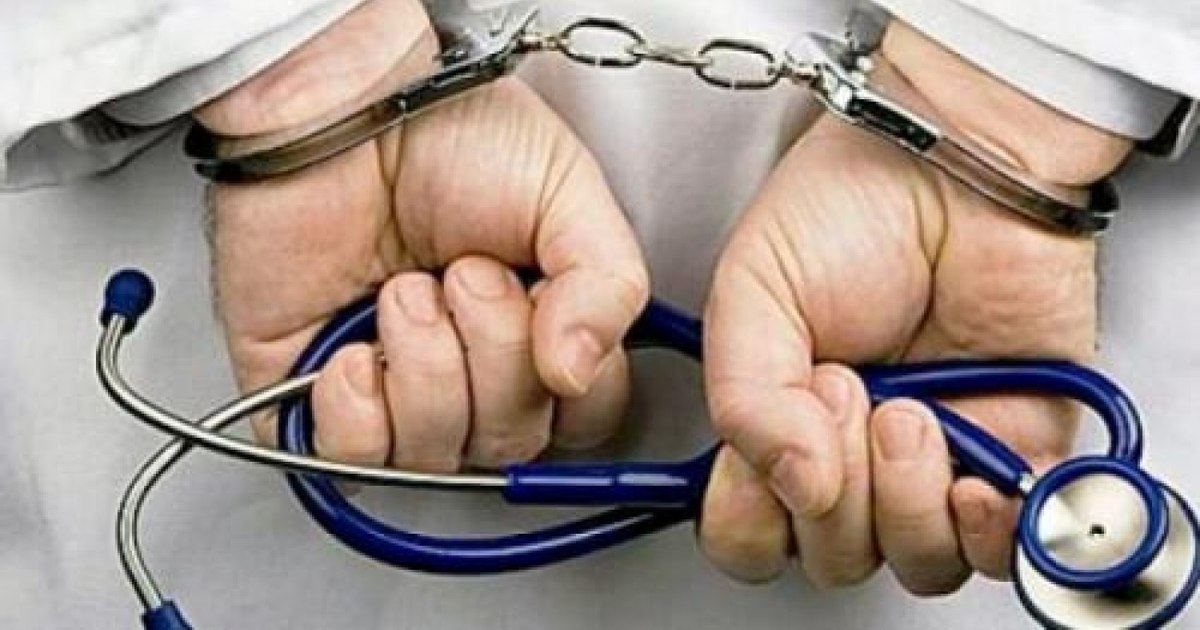
Doctors who are not paediatricians, but treat minor patients in emergency situations, they will no longer be liable for any damages and injuries caused in the exercise of the profession when they act in good faith. We are talking about a regulation provided by an Emergency Ordinance proposed by the Ministry of Health and published in the Official Gazette. The decision comes after the tragedy at the County Hospital in Târgu Jiu, where a 16-year-old child lost his life after the surgeon on duty refused to operate on him. For what reason? Out of fear!
Doctors for adults, more protected by law when treating children. Source; archive
In September of this year, an Emergency Ordinance entered into force according to which doctors who are not paediatricians are allowed to intervene in the case of minors, in situations that would put the children’s lives in danger. However, the law did not make any reference to the situations in which, following the respective medical act, the patient would have suffered or, worse, would have died. Basically, once you’ve made the decision to intervene, if something unforeseen happens, you, as a doctor, answer to the law, and for one, you can even go to prison. Obviously, there were few who took such risks. Consequence? The responsibility for the emergency treatment of these children was still given to pediatricians. But what happens when the only pediatrician who could take on the case is hundreds of miles away? What happens when it is not possible to transport the patient to a larger hospital? The answer? Your child dies in your arms, as happened in Târgu Jiu.
Following the tragedy that took place there, the Ministry of Health returned to the law and amended it. All in the hope that it will encourage adult doctors to intervene themselves and stop waiting for help from pediatricians. The manager of the Târgu Jiu hospital, Dumitru Vienescu, told “Adevărul” that through this change, doctors will be encouraged to get involved, be more active and responsible, show empathy and truly respect their oath . “I think now things are much clearer and I think now the doctor will intervene without fear every time it is needed. Because he will be more protected”. In reality, however, say other voices in the system, this regulation is totally useless.
Doctors have come to practice defensive medicine
Cătălin Smarandache, surgeon at Bucharest University Hospital, told “Adevărul” that the new law is only a “bandage”, not a real solution to the problem. “In recent years, we have seen nothing but doctors put up against the wall. From different parts of society, for different reasons, there was a concentrated attack on the entire guild. But the most exposed, the most fingered, the ones to whom the most and most serious accusations are brought are the surgeons and doctors of ATI. Basically, those who are on the front line when it comes to saving lives. And for this reason we have come to practice a defensive medicine.”
The doctor Cătălin Smarandache commented on the new regulation brought to the law, and the conclusion is that this emergency ordinance does not solve the problem. “What does it mean that the doctor will not be held accountable? It means that if a parent is unhappy, they can file a complaint. Which is normal. At that point, the doctor will have to justify himself. Now, with this new regulation, there is less likelihood that he will be fined again. But even so, he will still end up in front of a hospital disciplinary committee, in front of a board of the College of Physicians, he may even have to pay for a lawyer if the complaint is for personal injury. Therefore, even without sanction, that doctor becomes an outcast. I think that all these regulations are just band-aids that cover a problem, they don’t solve it”, considers the surgeon.
The doctor from Bucharest comes up with a simple example that proves that the law in Romania is poorly designed, has big flaws and loopholes. It protects neither doctors nor patients. “Let’s say we have a driver who has a category B license. And it is absolutely necessary to move a tipper from one side to another. He knows how to drive the dump truck, but something happens during the move. Will he not be judged that he got into a car of another category, because he did not have a license? Indeed, justice will take into account the force majeure, the context. But those are only mitigating circumstances, because the driver in question will not be absolved of guilt in front of those around him”.
Why do doctors run away from small hospitals? “Out of fear!”
For fear of being held accountable and penalized in court, surgeons, but not only, choose to work in large, properly equipped, modernized hospitals that have entire teams of specialists. “It is not only the salary of doctors that matters, but also the environment in which they work. In large medical centers they are more protected”, explained the surgeon. “They have someone to consult with, someone to guide them, various mixed commissions can meet, treatment plans are discussed. These people are not alone. While, in a small hospital in the countryside, the surgeon centers, he also nods.” And, many times, it happens that he is held accountable for the decisions he makes, although the fault is not his but the badly designed system. “We need a certain mental comfort to do our job. In large hospitals, the surgeon has an anesthetist next to him, another pediatric surgeon or someone who has performed such interventions over time. Liability is automatically shared. You are not alone. It doesn’t happen like that in rural areas”. Reason why the doctor tends to refuse the minor patient.
Radu Gănescu, patient representative: “Not all hospitals have the infrastructure ready”
Radu Gănescu, the president of the Association of chronically ill patients, is of the opinion that the new regulation added to the law cannot, for now at least, be put into practice. “Not all hospitals are ready for this. To treat a minor in a non-pediatric hospital, you need to have a specific protocol and separate circuits. If we are talking about pediatric hospitals that receive children, but also adults up to 21 years old, they must have separate wards. In Gomoiu, for example, there is no such thing. And there are children who have turned 18, who come to the hospital but are sent home. On the other hand, if we are talking about adult hospitals where children can also be treated, they must have a pediatric ward”, explained Radu Gănescu.
Then, the patient says, the law does not speak at all about the medical documents that a doctor can provide to these little patients. “In the Târgu Jiu case, we are talking about a child who needed surgical services. But, I tell you honestly, if another minor patient needed surgery tomorrow, the doctor might refuse it. The reason? Where does it say in the newly adopted law that you have to operate on the child? So, it’s still up to the doctor whether he intervenes or not.”
Solutions
The doctor Cătălin Smarandache is of the opinion that in order to survive the health system needs an infusion of labor, but also of capital. “In the small hospitals in the country, we need more doctors, in different specializations. A surgeon in such a hospital should have an assistant in the operating room, a second hand to consult with. Maybe even a pediatrician, not necessarily a surgeon but who knows the child’s pathology in detail”. The specialist believes that small hospitals in the country should conclude contracts with various doctors whom, in other words, they can call from home in case of need, force majeure. “This doctor should be medico-legally covered and be paid for his activity. The local authorities under which these hospital units are located should allocate a budget in this regard”.
The health system cannot function as long as there are on the one hand very well equipped centers with human resources and centers that lack both doctors and essential equipment. “And we will build new hospitals for nothing if you don’t have doctors working there. If we don’t solve the problem of human resources, those hospitals will remain empty walls”, believes Dr. Smarandache.
As for the restructuring of medical units that do not produce anything but eat money, the doctor believes that people in the countryside also need medical services. “I think even a small community has the right to a doctor.”
