
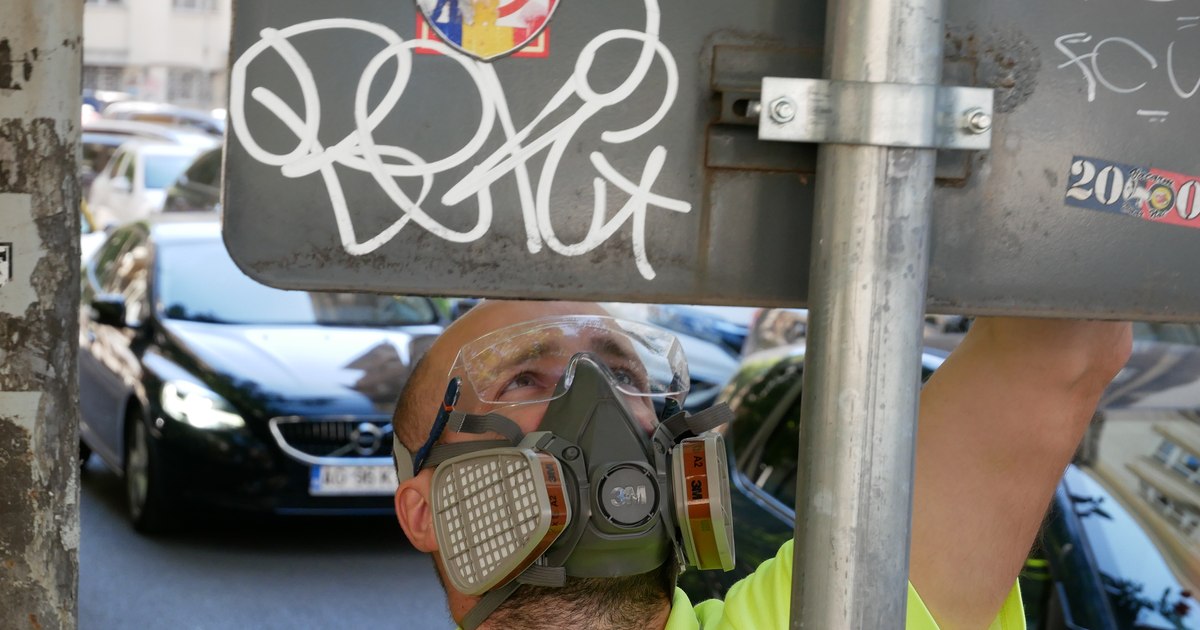
Iulian Carp is 32 years old, he is a sailor and father, but also a volunteer on the streets of Bucharest. In the free days it takes its equipment and cleanses indicators, panels and bus stations covered by stickers and graffiti, transforming the personal routine into a project called “clean city”.
Iulian Carp, while cleaning a road indicator. Photo: Norbert Nemeș
The clock shows it’s 12:30. It is noon in Bucharest, and in the center, on Ion Brezoianu street, the cars hardly advance, a sign that the traffic has entered the rhythm. At a throw of the palace room, the city seems in a hurry, but also blocked in its own agitation. What is on the sidewalk is full of traces: stickers on traffic signs, old graffiti facades, broken posters in the bus stations, stuck over layer, until left than scorching paper.
At the corner of a building there is a man in neon green t -shirt, with a mask, the genre that would be worn by a person working with dangerous substances, goggles and orange gloves. Sits next to an electrical distribution panel, covered from head to toe with TAGS – stylized signatures, quickly drawn with colored spray, one after the other. It has a large equipment bag from which the tip of a bottle comes out, a staircase supported by a fence and two tripods. It is seen to be live. The passers -by take it behind him. Some look, without slowing down. Others may have seen Tiktok most likely, where he is followed by almost 30,000 people. He continues his job. It is called Iulian Carp, he is 32 years old, he is a sailor and, for a few years, he comes alone on the streets of Bucharest to delete the traces that no one else seems to observe. Specifically, it cleanses indicators, panels and bus stations covered by stickers and graffiti.
How did the city start to see
“I said I will never come to Bucharest, because it is far too crowded, too much agitation“This is how Iulian describes the first impression he had about the capital, when he was younger. The city seemed tired even from a distance, a place where everything moves too fast and without breaks.
He is from Galați and graduated from the Naval Academy in Constanța. After finishing his studies he started working as a sailor and, in time, he came to divide his life between long periods and short returns at home. In 2018, he settled in Bucharest, where he caught the pandemia. He says that when he moved, he did not think about how dirty the city is. “I knew this is Bucharest, that’s the capital. I told me I don’t know what can be done or if that is necessarily about me“He took the city as it is, without looking for explanations or solutions.”Being half the time left home, with only four to five people around you, as it is at work, sometimes you feel the need to live in that agitation, to make up for the quiet of those periods“It is one of the observations that explain, in a way, why a city once perceived as intense becomes, later, an accepted choice.
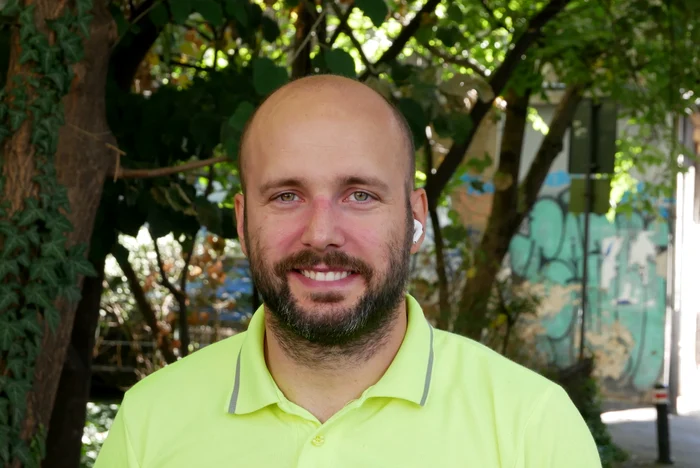
Iulian began to help change the city face in 2021. Photo: Norbert Nemeș
However, with the passage of time, however, the way in which it was related to Bucharest has changed. Not suddenly, but through accumulations. The places they went through daily began to draw their attention in another way. The traffic signs covered with stickers, the walls full of graffiti, the dirty stations. From a point, all this was no longer just part of the landscape. “Over time I thought that, however, I can find a way to do something, but also inspire others-and why not, ashamed, and authorities to do something“.
It all started with a dirty indicator
In 2022, Iulian started what the project would become “clean city”. He remembers exactly the moment: he had come out of the block in the military where he lived and, just a few meters, he saw an indicator covered by stickers. “I left the block, made five meters right and it was a dirty indicator. Another ten meters, another dirty indicator“Nearby was a gang frequented by people with” different vices “, where he often found syringes. The walls were full of TAGS. The idea of cleaning it up quickly. “I said to do something about it. And it was quite simple“.
He spent somewhere at most 300 lei on lime, finding a shade close to that of the wall, he also took a roller of about 50 lei, a bucket, then began to cover the traces. He worked alone, with the materials taken, according to the principle of broken windows theory: if the space is clean, the temptation to vandalize decreases. “After I cleaned up and saw, that gang kept clean for a long time. Until some people gave some tags. Having remaining paint, I covered those and I think at least a year has kept clean there“.

One of the many indicators in the city, covered with stickers. Photo: Norbert Nemeș
In the meantime, he moved, and that place returned to his original state. “Although I plan to inspire the community and those around me, however, it is a rather high degree of convenience on their part“The first exit showed that the work can have an effect. Even if some places are dirty again, he discovered that a punctual intervention can change the way a corner of the city looks – at least for a while.
The kit of an urban volunteer
At first, Iulian went to work with simple things: a jar in which he poured the cleaning solution, a brush, a towel roll, a regular mask and a glass scraper. “The only thing that remained of all initial equipment is the glass scraper“. Meanwhile, it has expanded its kit. Buy the solution” at 12-liter can, at a more industrial level “, uses solvent resistant sprayers and always wears a vapor mask, goggles and gloves. He also took a ladder … “Because it’s hard to get higher. For vandals it is easier to climb the pillar without seeing anyone. To me, to cling to an indicator and I clean it at the same time is not the best solution“. The initial purchase has reached about 500 lei: cleaning solution, sprayer, paper towels, wet towels, protective equipment and bag where everything.”The only consumable, in the true sense of the word, is the solution, and maybe there would be napkin. On a very productive day I use somewhere to one liter of solution for about ten indicators“.
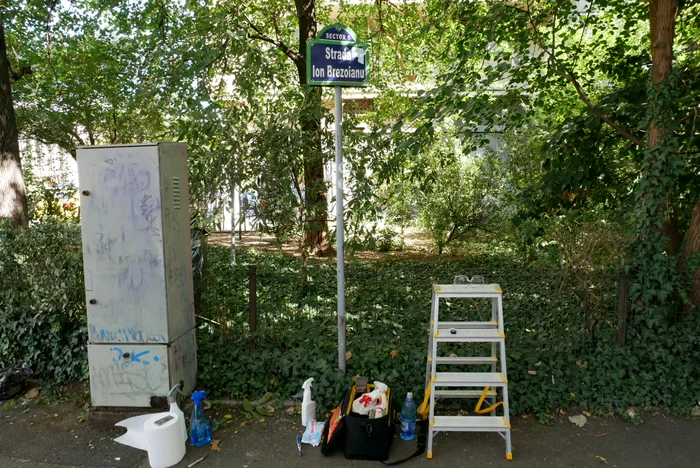
Iulian’s cleaning kit includes solutions, a staircase and protective equipment.
On a “working” day can clean in four to five hours around 10-12 indicators. If it comes across a bus station covered with old paint, the work can stretch at an hour for no square meter. The days of cleanliness choose them according to a simple criterion: when grandparents can stay with his daughter. When he goes to work, he prefers the subway, but sometimes he takes the car and looks for a parking place. “I turned half an hour after a parking place and, while looking, I look after places, given that traffic in Bucharest, in the center, moves at very low speeds“.
People look. Sometimes they ask, rarely intervene
On the street, the reactions of passers -by vary from a simple look at a few short words. “Honestly, I’m not very careful about their reactions, only when someone asks me. It is usually the elderly, who ask me if they are from the town hall or any institution, public authority“Says Julian laughing. Some are surprised that someone uses their free hours to clean the city.”They are amazed that someone is doing this and, on the one hand, they are also discouraging, telling me that they are cleaning, because anyway they get dirty in place“. Others identify him from the Internet.”Generally, it happens to recognize me the world of Tiktok, Facebook, Youtube. Then I come to me and congratulate me on the activity and tell me how much I appreciate what I do. But there are not many cases“.
On Tiktok, Iulian transmits live during the interventions. There is watched by almost 30,000 people, and his videos collected 1.2 million appreciations. Platforms have become a means of showing what it is doing, but also to spread the idea further. “It happened to me to write my world. There are few cases, I will not exaggerate to throw exorbitant numbers, but there are cases of people who wrote to me and asked me what solutions they use, they wrote in private, because they also want to do that“.
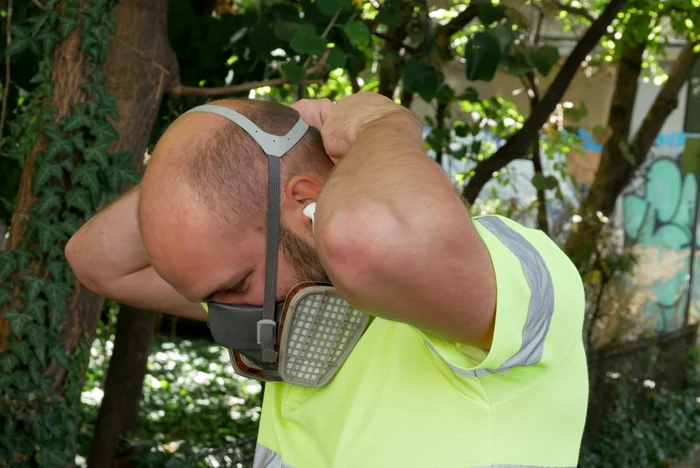
Iulian transmits live on social networks the work he does on the streets of Bucharest.
Messages also appeared from some employees of public institutions, curious what solutions they use. “I think the role is to propagate the message further, to tell people that “OK, it is the job of public authorities, but that does not mean that we have to wait every time to do.” It is ideal to do it within the legal limits and a more positive attitude is needed“.
Online comments are mixed. Some demand punishments for those who vandalize, but Iulian sees another part. “Yes, they need to be caught and punished, but sometimes they think they are exaggerated and they should be understood and that some of them do not have a place to express and maybe something must be done and about it“.
What does a good day mean
For Julian, the true motivation are the small changes they see around, and the applause passes on the secondary level. He noticed that, in the frequented areas, the authorities began to take an attitude. His actions are not a huge transformation, he says, but a beginning that can encourage other people to intervene and make the city more cared for.
When he thinks about the future, he prefers punctual involvements instead of a project with dozens of volunteers. He has organized some events, but they bring costs that, until now, covered alone. In addition, they work with substances that are not of the most friendly, and in large groups people are not always attentive to training.
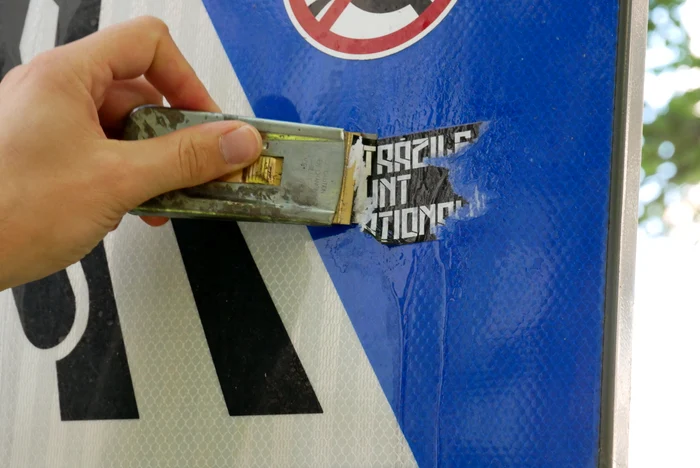
An indicator can be cleaned of stickers in 15 minutes, says Julian. Photo: Norbert Nemeș
Therefore, he prefers to teach individually those who want to try, provided they work and carefully towards passers-by. Among the memories that remained, one is distinguished: in 2022, at the bus stop at the University, a young woman stopped, told her how much she appreciates her work and hugged. For Julian, the gesture mattered mainly by the thought behind him – the proof that someone understands and supports the effort.
He hopes that his example will be an impetus to others. He believes that three or four neighbors can gather, in a weekend, two lime buckets and a few rollers, covering the traces left by vandals and, at the same time, strengthening the community. He wants the authorities to continue to repair what has been affected and at the same time to support cultural spaces for artists – so that urban art interventions become more frequent – such as those in Lujer’s passage, which has been reopened as a cultural space at the Streetwise Festival, where over 120 artists painted around 2,000 meters.
