
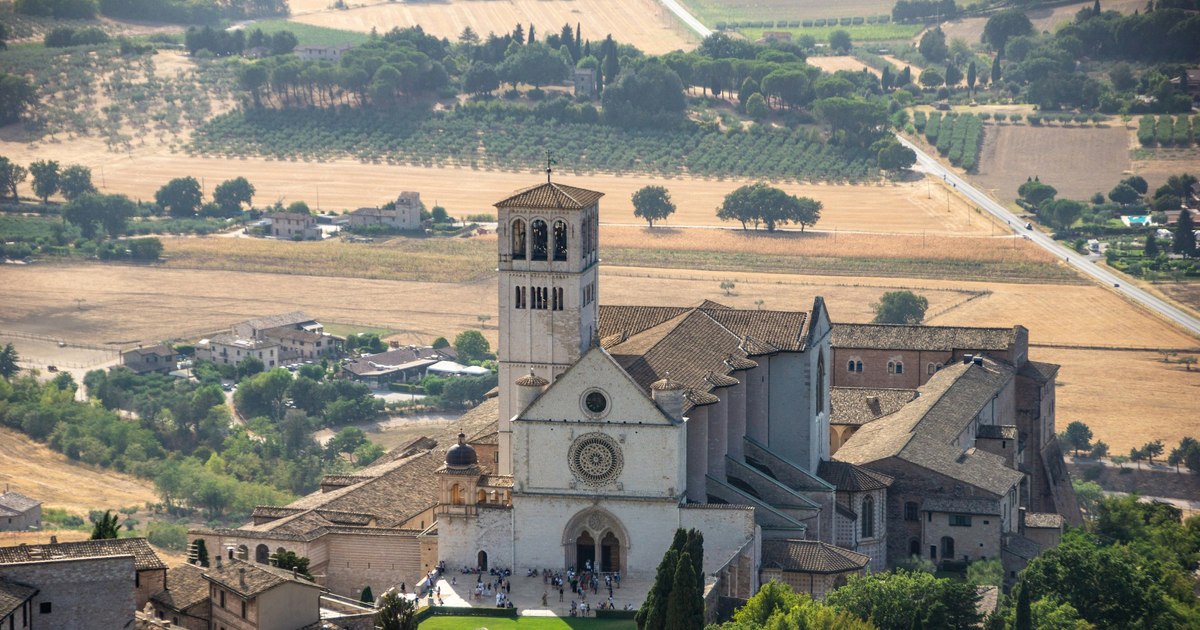
The journey begins with an old refrain by Paolo Conte, listened to in the rental car at Fiumicino airport, on an autumn morning. The lyrics accompany you on the roads leading to Umbria, as a promise of melancholy and warm light. Here, between the hills and villages perched on the rocks, Italy reveals its silent face, far from the rhythm of the big cities. It is an Italy that smells of earth, truffles and wine, an Italy that ages beautifully, like an oil portrait forgotten in the attic.
Umbria, the hidden gem of Italy. PHOTO: Unsplash
When the plane touched down at Fiumicino, the sun was just rising over Rome. The air was soft, translucent, and the first chords of “Via con me” by Paolo Conte matched perfectly with the emotion of the road ahead. I took the rented car – a red Fiat 500 – and headed north, leaving behind the congestion of the Capital. As the highway narrowed, Rome dissolved into a rural setting.
In the heart of Umbria
Umbria welcomes you without haste. It doesn’t have the stridency of Tuscany or the hustle and bustle of the Riviera. It is a quiet land, where the days flow more slowly, and the sky always seems close. First stop: Montecchio, a village perched between the hills, as old as the legends that surround it. The streets are narrow, paved with cubic stone, and the church bell rings solemnly at lunchtime.
The villa we were going to stay in looked like something out of an old Italian movie: stone walls, shutters, an outdoor kitchen and a view that took your breath away. In the evening we grilled meat bought from a small local butcher, the vegetables came from the weekly market in the village, and the wine – a dry Montefalco red – completed the ritual.
During the day, the villages seem deserted. The houses have their shutters drawn, the shops are closed, the streets are empty. You have the impression that life retreats inside the walls, waiting for the coolness of the evening. When the first shadows circle the fences, everything comes back to life: commuters’ cars fill the serpentines like a luminous myriad, the windows come to life, and the air is filled with the smell of a wood fire, a sign of family dinner. Umbria lives according to its own rhythm, simple and ancient, like a deep breath after a long day’s work.
The cities (still) full of history
In Perugia, the capital of the region, you can spend a whole day and still have something unvisited. The city, with its aristocratic air, reminds you that Umbria has always been a bridge between the past and the present. In the old center, the smell of chocolate accompanies you at every step. Piazza IV Novembre is the heart of the city, with the Fontana Maggiore, one of the most beautiful medieval fountains in Italy, and the Palazzo dei Priori, an imposing Gothic palace that houses the National Gallery of Umbria. Here, the works of Pietro Perugino and Pinturicchio seem to preserve the light of past centuries.
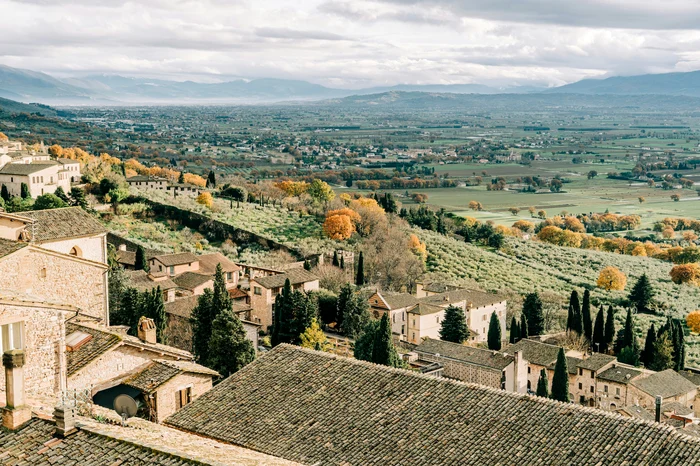
The rolling hills of Italy. PHOTO: Unsplash
We stopped at a small cafe overlooking the valley. The one who served us was a young woman from Bacău, she had a warm smile. He told us that he moved there a few years ago and recommended Spoleto, a lesser-known city, but full of art and medieval walls. It was one of those meetings that stay in your memory, like a discreet note of humanity in a journey.
After Perugia, came Assisi – the place where spirituality and tourism collide. The streets were full of pilgrims, but also of stalls with gaudy souvenirs: magnets with Saint Francis, luminous key rings, colorful statuettes. However, when you move away from the center and enter a quiet courtyard, you feel how the place takes on a different vibe.
The Basilica di San Francesco, built in the 13th century above the tomb of the saint, is a monument of faith and art. In the upper church, the frescoes attributed to Giotto and Cimabue have an emotional simplicity – they seem naive, but precisely through this visual sincerity they manage to speak directly to the soul. The scenes from the life of St. Francis impress not by their pomp, but by their closeness to the human, the fragile. Rocca Maggiore awaits you above, the medieval fortress that watches over the city from above. From there, the panorama of the Tescio valley is overwhelming, and the autumn light enlivens every stone.
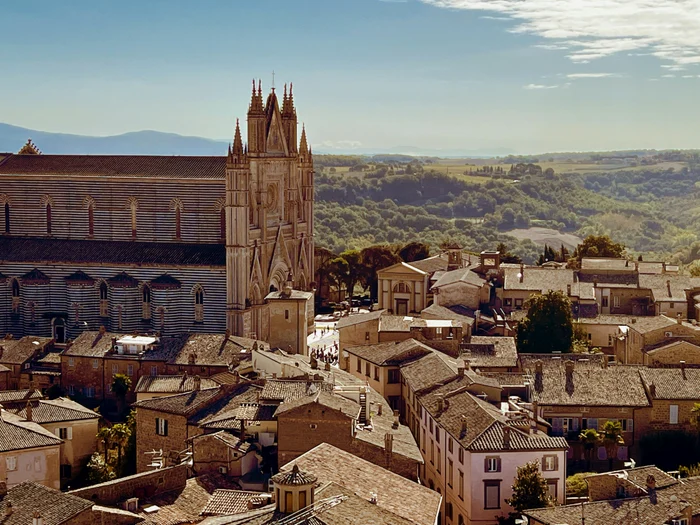
Imposing Orvieto. PHOTO: Unsplash
On another day I visited Orvieto, the city hanging on a cliff, one of the most spectacular in Italy. The Duomo of Orvieto, with its Gothic facade decorated with golden mosaics and Luca Signorelli’s frescoes in the San Brizio Chapel, is a miracle of marble and light. We also went down to the catacombs, a labyrinth of Etruscan tunnels dug into the rock, where history insinuates itself in every corner. We also visited the Pozzo di San Patrizio, the 62 meter deep well, built in the 16th century to provide the city with water in case of siege – a masterpiece of Renaissance engineering. In the streets, many houses were deserted, with fallen shutters, with yellowed sales posters. I had the strange feeling that Italy is getting old, that the traditional village is slowly fading away, giving way to seasonal tourism and definitive peace.
Umbria is an agrarian region with little industry, dependent on agriculture, wine and tourism. In big cities there is still vitality, but in small villages, empty storefronts and closed doors tell a deeper story of change and time.
The waterfall, the lake and the way back
One morning we started south, towards Cascata delle Marmore, near Terni. The waterfall – one of the highest in Europe – is a masterpiece of Roman engineering. The water tumbles in steps over white rocks, and the sound is hypnotic. A little further, the hills and the sky are mirrored in Lake Piediluco.
In the evening, we returned to the villa in Montecchio. The sky was purple, and the air smelled of burnt leaves and must. I opened a bottle of Orvieto Classico, listened to Paolo Conte again and watched the sun sink slowly over the hills.
The next morning, the drive back to Rome was a reverie. Among the vines and olive trees, with the autumn light filtering through the window, I felt that I was leaving behind not just a region, but a state. Paolo Conte sang softly, and Italy, even the aging one, seemed more alive than ever.
The village that silenced
In the heart of the Martani Mountains, at 640 meters above sea level, is Scoppio, a ghost village in Umbria, forgotten by the world and time. Today, only eight people still live in the houses around the old settlement, and its ivy-covered ruins preserve the memory of a community that lived here for centuries. Abandoned in the 1950s, after a series of earthquakes that severely damaged the structure of the houses, Scoppio was left to nature. The rains eroded the foundations, the vegetation conquered the walls, and the road to the church became a path shaded by ferns.
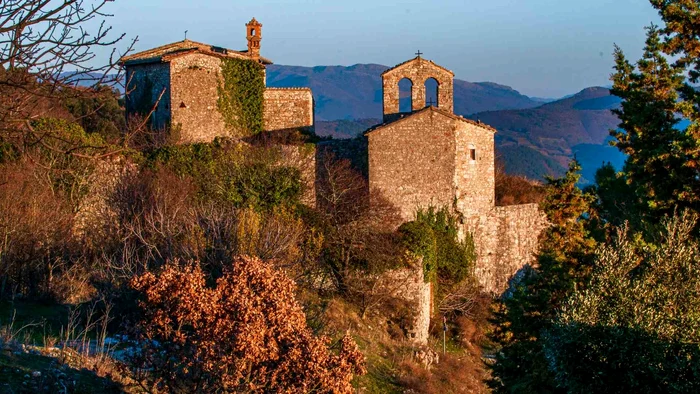
Scoppio, the silent village of Umbria. PHOTO: Wikipedia
It has an ancient history, linked to the noble Arnolfi family, who ruled it since the year 1000. Its name comes from the Latin scopulus, which means “rock” – a direct reference to the rocky promontory on which it is built, an isolated formation that dominates the Matassa Valley. In the Middle Ages, Scoppio was a small fortified castle, with defensive walls, a church dedicated to Saint Peter and several dozen stone houses. On clear days, from here you can see the rooftops of Amelia and the green hills of Umbria.
In 1710, the village counted 25 families. People lived from agriculture, cultivated wheat and vines, raised cattle and went to church on Sundays, where the bell rang across the valley. But after World War II, isolation became a burden. The lack of modern roads, running water and stable electricity pushed young families to the nearby towns – Acquasparta, Terni, Spoleto. The last windows closed in the 1950s, and the bell never rang again.
Abandoned borghs
Today, Scoppio is considered one of the most spectacular abandoned villages in Umbria. The regional authorities included it on the list of “borghi abbandonati” (abandoned villages), and hikers passionate about history and photography seek it out for its melancholic atmosphere. The road to it separates from the provincial road 418, passes over a new viaduct and slips through the oaks. There are no signposts – only the increasingly dense silence and the ruined outline of the church of San Pietro, which seems to watch over the valley. Inside it are preserved some fresco fragments, attributed to the Spoleto painter Piermatteo Piergili.
The nearby CAI Refuge, run by the Italian Alpine Club, once offered overnight accommodation in the area, but is now closed. The ruins are fragile, and nature has conquered almost everything. The central square is a clearing, and the collapsed walls seem to be slowly returning to the ground. Seen from a distance, Scoppio still seems alive: the small tower of the church dominates the rock, and the sunset light plays through the glassless windows. But up close, the silence is complete. Only the crickets and the rustle of the wind can be heard.
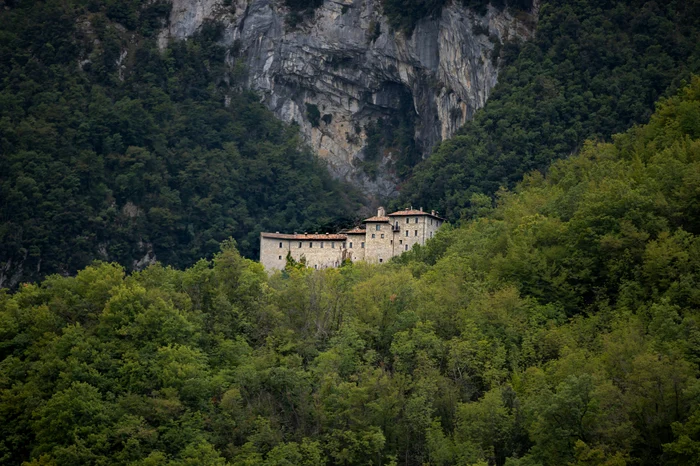
Monastery in the heart of Umbria. PHOTO: Unsplash
In the surrounding villages, the elders still talk about “the village that died in silence”. Some say that a plague epidemic would have emptied the place two centuries ago, others evoke a night of fire and panic, when a fire would have erupted “like an explosion” – uno scoppio -, consuming everything. There is also the legend of the bell that is heard alone on clear nights. No one knows if it’s the wind or the echo of memory, but in front of the ruins, among the collapsed walls and the sound of your own footsteps, it’s easy to believe that the past is not completely lost.
Scoppio no longer appears on the maps, but remains a vivid memory of a rural, simple Italy, which did not die out – it just retreated into a form of long sleep.
Tips & Tricks
ACCOMMODATION: opt for an agriturismo or an isolated villa on the hills – the experience is much more authentic than in an urban hotel.
TRANSPORT: a car is mandatory; villages are hard to reach without it.
FOOD: try Norcia black truffles, Perugina chocolate, local cheeses and umbro pork.
WINES: Sagrantino di Montefalco (red) and Orvieto Classico (white) are emblematic of the region.
THE MOST BEAUTIFUL MOMENT OF THE DAY: sunset.
MUSIC FOR THE ROAD: Paolo Conte, Lucio Dalla, Zucchero.
