
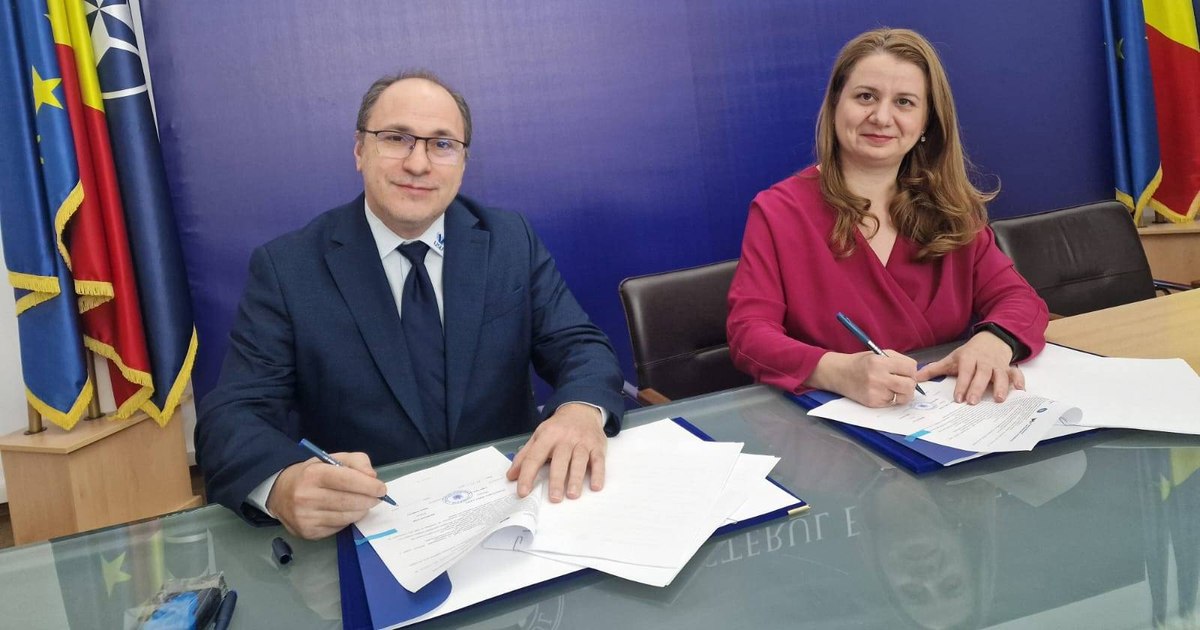
The Ministry of Education and Research has an incumbent, after almost two months of interim. University professor Mihai Dimian, rector of the University of Suceava, will have to answer some major challenges coming from the pre-university system which is facing great turmoil.
The appointment of a new university professor at the head of the Ministry of Education and Research is not exactly what many educational actors in the pre-university system wanted. It is a time when the needs and expectations in pre-university education, faced with great challenges during the past year, are major. What signal is the government giving by appointing the rector of the “Ștefan cel Mare” University from Suceava – politically unaffiliated, but supported by the PNL – as the head of the MEC – and what should be the priorities of the new minister for pre-university education, we tried to find out in a discussion-analysis with the expert in Education, Marian Staș.
“I start from the presumption of openness and good faith, not knowing what the caliber of leadership is in the first place”explains Staș, stating that he does not know what change or transformation projects the new minister has proposed or implemented. “From a political point of view, my opinion is that it was a wise decision rather than a brave one, because between such a profile and the profile, for example, of Andrea Paul (ed. – name also circulated in the public space for the appointment to the post of minister) the difference is like from heaven to earth. And I speak in full knowledge of what Andreea is capable of and does. She is a nuclear, dynamic, strong personality, an exceptional promoter and with a remarkable public presence in terms of “real” school and system transformation and who knows very well the pre-university area and the transformation into the jobs of the future”Marian Staș showed.
Regarding the new minister, Staș says that he is waiting to see what the first moves and the first strategic decisions are regarding the transformation of the pre-university school as a system.
“70% of the ministerial leadership effort still needs to be focused on the pre-university area”
Pre-university education, which is in the process of transformation, should be the main focus of the new minister’s interest, Staș believes.
“I know that the university area is also undergoing transformations, but I continue to believe that at the moment over 60%, if not 70% of the ministerial leadership effort, i.e. change at a strategic level, still has to be focused on the pre-university area”, says the expert.
The national alternative curriculum piloting program is the first measure that expert Marian Staș mentions on the short list of priority measures. This should be increased exponentially and accelerated, because he scores “the exit from communism of pre-university education”. “At the moment the commission is working, there are about 34 high schools”, specifies Staș.
In order to be able to put into practice the alternative curriculum piloting, there is an acute need for change at the level of the National Center for the Development of Professional and Technical Education (CNDIPT) and the National Authority for Qualifications (ANC), because there are technological and economic high schools in the country, from the list of the 34 brave high schools that submitted pilot programs, which have already taken steps before the occupational standards regulatory institutions. “There are approximately nine technological lyceums, economic lyceums, which have written their framework plan with professions for which there are still not all the specifications at the level of the qualifications authority and occupational standards. Why? Because they have not been written yet. (…) It is important to accept and quickly give the green light to all the necessary legislative, methodological changes at the level of the qualifications authority, and especially by CNDIPT, that is, the National Council for the Development of Professional Education and Technical, so that they write the legislation after the technological lyceums and not the lyceums write the framework programs after they do not exist now or are out of date”Staș pointed out.
The technological high schools on the list of the 34 high schools registered for piloting are “two, three, four boat lengths ahead of legislative and methodological specifications”Staș also specified, and for them it is important to specify that they can design their occupational standards so that they can create the future, not be “good” and respect outdated standards.
Expanding undergraduate programs for the teaching profession, a must
Another priority measure mentioned by Prof. Marian Staș is the expansion of bachelor’s programs for the teaching profession, which means that future teachers will be trained through bachelor’s programs, not master’s degrees. It is already happening, Staș said, at the University of Craiova, where there are two programs with double specialization – biology – chemistry and, respectively, philosophy – history – which will train teachers for these disciplines and not chemists, biologists, philosophers and historians.
The third urgent measure, according to the expert, is “paradigm change in the area of inspection and school inspectorates”. It will be necessary to “split the cat in two”, believes Staș, and if the measure cannot be implemented in correlation with the administrative-territorial change, then it must become an objective in itself so as to give up political sinecures, as is the case now.
The three stated measures, Marian Staș also claims, can be implemented this year. The first of them can be checked by March-April, the extension of the license programs for the teaching profession can be done by October, and by the end of the year the institutional transformation of the school inspectorates can be carried out.
Rich academic experience and collaborations with universities outside Romania are the ingredients that can help the new minister to accelerate structural reforms in the Romanian education system, believes Marian Staș, but with one condition: not to respond to political orders.
Separate departments for pre-university and university, union proposal
The pre-university teachers, who did not always have happy experiences when university colleagues were appointed to head the ministry, are now waiting.
“Appointing a university professor to the leadership of the Ministry of Education is, in itself, neither an automatic advantage nor a disadvantage. Leading a system as complex as Romanian education requires, above all, administrative capacity, strategic vision and real availability for social dialogue with all the social actors involved”. states the vice-president of the Federation of Free Trade Unions in Education – Adrian Voica, for “Adevărul”.
Pre-university and university education have different specificities, Voica points out, which is why a constructive solution could be the consolidation of distinct, well-defined departments, with clear responsibilities and operational autonomy, but integrated into a unitary vision. “The pre-university means equity policies, infrastructure, numerous human resources, school management and direct social impact on all communities. The university system operates in a logic of academic autonomy, competition and internationalization. From this perspective, the discussion should not be reduced to the professional profile of the minister, but to the efficiency of the ministerial structure (organization chart)”, added Voica.
An organizational model based on distinct departments would allow the promotion of public policies more adapted to the realities of each sector, faster and coherent decisions, better administrative accountability and the reduction of bureaucratic overlaps.
“At the same time, it must be honestly emphasized that a chronically underfunded system will have structural difficulties regardless of the prestige or professional competence of the minister. No matter how solid the profile of the one in charge, the lack of adequate resources inevitably generates tensions in operation: the decrease in the quality of the educational act, insufficient infrastructure, excessive administrative pressure and, perhaps most seriously, the demotivation of the teaching and auxiliary teaching staff”Voica pointed out.
The reforms that are still being talked about risk remaining simple well-formulated intentions in politicians’ statements, the leader draws attention, in the absence of predictable and adequate financing.
“Education is not reformed through impressive biographies of ministers, but through coherent policies and adequate funding from the State. Having no real financial resources, even the most respected minister will manage the crisis in the system and in no case the performance”concluded Voica.
Who is Mihai Dimian, the new Minister of Education and Research
Mihai Dimian was presented at the PNL BPN meeting, Monday, March 2, 2026, as the formation’s proposal for the Education and Research portfolio, left vacant following the resignation of Prof. Daniel David. On Tuesday, March 3, the decree appointing him to the position of minister was signed by President Nicușor Dan, following the swearing-in on the same day.
Dimian is politically unaffiliated. He has been the rector of the “Ștefan cel Mare” University in Suceava for two years, and previously (2012-2024) he was vice-rector of the university, coordinating the scientific research activity. He is 51 years old, was born in Onești, is married and has a child.
He has a double degree, in Mathematics (1993-1997) and Physics (1997-2001), at the “Al. I. Cuza” University in Iasi and holds a master’s degree in Dynamic Systems and Theoretical Mechanics at the same university. He holds a PhD in Electrical/Electronic Engineering, obtained at the University of Maryland, College Park, USA (2001-2005).
He started his research career in 2001 as an assistant researcher at the University of Versailles St. Quentin, France. They attended the University of Maryland, USA (2002–2005) and the Max Planck Institute for Applied Mathematics, Germany (2005–2006), so that from 2007 he worked at the University of Suceava.
