
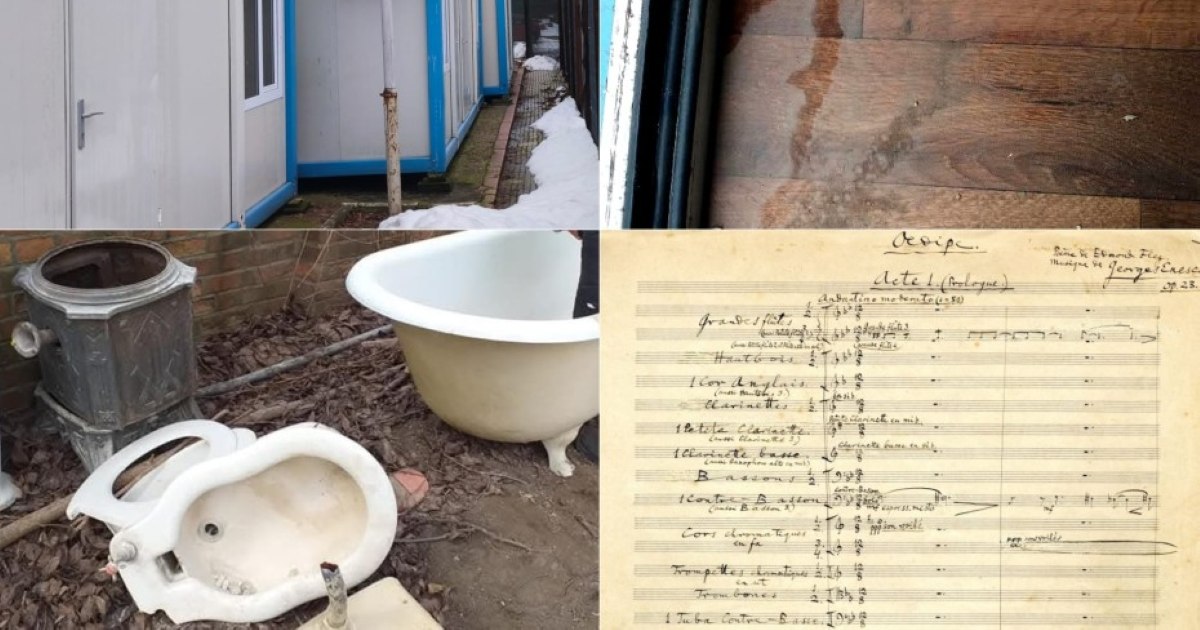
Scandal at the “George Enescu” National Museum after a journalistic investigation revealed that the composer’s manuscripts and heritage assets were stored for over four years in improper conditions. The author of the revelations says that she was threatened.
The scandal broke out after the publication of the investigation carried out by the journalist Alexandra Tănăsescu for the publication “Cultura la dubă”, in which she reported that the manuscripts of the great composer George Enescu, including that of the opera “Oedipe”, together with personal items, pieces of furniture, photographs and other movable assets listed in the Treasury or National Heritage, were kept by the “George Enescu” National Museum, for four and a half years, in modular containers placed outdoors, near the museum restoration site.
According to her, the process of consolidating and restoring the “George Enescu” National Museum (Cantacuzino Palace and Memorial House) began in 2021 and should have ended at the end of 2023. However, after two years, the executing company had completed only 25% of the works, and the Ministry of Culture decided to close the construction site.
As of 2021, the European Heritage-listed museum has remained under scaffolding or wooden proptels, and the movables, except for the violins, have been stored in air-conditioned containers that would have operated around the clock.
However, last winter, one of the devices broke down, and the objects stayed for several nights at temperatures below zero, and when the snow melted, the containers were flooded, according to the images that appeared in the press.
The author of the investigation, threatened by the management of the museum
Alexandra Tănăsescu, the author of the investigation, claims that, after the publication of the article, she was harassed and intimidated by museum officials.
“I was called by the manager of the “George Enescu” National Museum, Cristina Andrei, put on speakerphone during an emergency meeting of the museum’s Board of Directors, intimidated, scolded because I dared to show the conditions in which the heritage is kept and accused that I and my sources will be responsible in the event of a robbery of the heritage stored in containers.
Even worse is that during that conversation a person who presented himself as “the legal representative of the Ministry of Culture, lawyer Lidia Chiran”, pressured me to reveal my sources, he (falsely) stated that whistleblowers are public and also falsely that three sources should mean three specialists. The lawyer informed me that she advises the council to file a criminal complaint against me because I endangered the heritage, which the museum has chosen to store for 4 and a half years in containers that do not respect the law!
When I tried to express my point of view and announced that the discussion was being recorded, the representative of the Ministry of Culture asked me if I was a terrorist and threatened me again that she would file a criminal complaint against me for the recording. the journalist told on Facebook.
The position of the museum and the ministry
Following the “Culture in the van” investigation, Andras Istvan Demeter, the Minister of Culture, announced in a press release that he had ordered an investigation and that he would send a control commission to the Museum, to analyze the conditions in which the heritage objects are kept.
Shortly after, the Ministry of Culture also stated that the lawyer Lidia Chiran did not have a mandate to represent the institution in the meeting of the board of directors, although she has a contract with the museum.
For its part, the “George Enescu” National Museum denied all accusations regarding the way of preserving the manuscripts and other heritage objects that belonged to the great Romanian composer.
“George Enescu’s manuscripts are kept according to the preservation rules in force. The boxes are placed on shelves, in containers. As the museum is under restoration, no other suitable storage spaces were found”, museum representatives told TVR.
The Ministry of Culture seems to have reached the same conclusion, according to the post it made on Facebook.
“Until this moment, during the checks carried out, no situations of destruction of movable cultural assets classified in the Fund or Treasure category have been identified.
The commission found that the sanitary objects referred to in the press material were dismantled from the building body in which they were located and taken over by the representatives of the museum, being stored, together with other objects, in an appropriate space; more precisely: a warehouse.
Also, also following the checks, we were informed that some photos appearing in the media these days were not taken now, but they represent archive material from past years. The respective elements are to be restored and reintegrated into the building as part of the rehabilitation works of the building bodies related to the investment”, transmitted, Thursday, March 5, the Ministry of Culture.
