

Europeans are having fewer and fewer children, and statistics show that the birth rate has reached its lowest level in recent decades. The trend is observed in almost all states of the continent, including Romania.
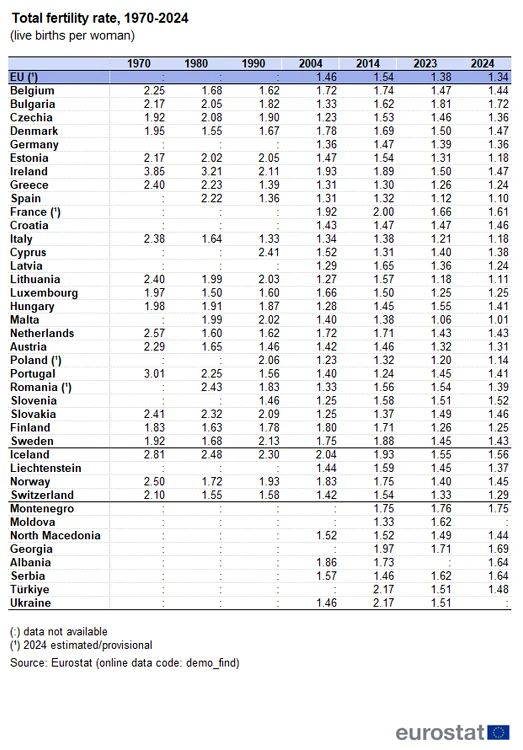
Europe is going through a period of demographic decline unprecedented in the last six decades. Eurostat data for 2024 shows that the total fertility rate in the European Union – the indicator that measures the average number of children a woman gives birth to in a lifetime – has fallen to 1.34, almost half the level of 2.62 recorded in 1964.
This trend is not an isolated phenomenon; the entire European region is facing challenges related to the declining birth rate, and Romania is no exception.
In 2024, 3.55 million children were born in the EU, which corresponds to a crude birth rate of 7.9 per 1,000 inhabitants. Comparatively, in 2000 it was 10.5, in 1985 12.8, and in 1970 16.4.
The highest number of births in the post-war period was recorded in 1964, with 6.8 million children. After that point, the number of births fell steadily until the beginning of the 21st century, when it reached 4.36 million in 2002. In the following years there were temporary increases, but not significant enough to reverse the downward trend, according to ec.europa.
The decrease in the birth rate, a global phenomenon
Specialists emphasize that the decrease in the birth rate is part of a global phenomenon.
More and more countries are experiencing fertility rates below the replacement level of 2.1 children per woman, and estimates suggest that almost all of the world’s states will reach this situation by the end of the century.
The World Health Organization explains this evolution through the theory of the demographic transition: as access to education and contraception increases and socioeconomic factors change, demographic behavior changes over time.
European countries with the highest and lowest fertility rates
In 2024, in Europe, the highest fertility rates are recorded in Montenegro (1.75), Bulgaria (1.72), Georgia (1.69) and Albania and Serbia (both 1.64). Among major economies, France stands out with 1.61 children per woman, followed by the United Kingdom with 1.56 (data available for 2023). Germany has 1.36, slightly above the EU average, while Spain (1.10) and Italy (1.18) have the lowest values. In the Nordic countries, Iceland has 1.56, Denmark 1.47, Norway 1.45, Sweden 1.43, and Finland only 1.25. Other notable figures include Ireland (1.47), Belgium (1.44), Hungary (1.41), Austria (1.31), Greece (1.24) and Poland (1.14).
Romania’s situation
In Romania, the total fertility rate was 1.39 in 2024, but well below the population replacement threshold. The general trend in recent years is downward, signaling the challenges the country has in maintaining a sustainable demographic balance.
The differences between European countries are difficult to explain, even in the case of the Nordic states, which have generous family policies. WHO experts emphasize that, in addition to education and access to contraception, the cost of housing, financial stability, balance between work and family life, and the expenses associated with raising a child matter.
Many governments have introduced measures such as allowances, tax breaks, subsidized childcare and parental leave, but the impact of these policies on the total fertility rate remains difficult to quantify. In Northern and Western Europe, falling below the replacement level and postponing the first child began as early as the 1960s, leading to higher average ages at birth.
In Eastern Europe, the phenomenon started later, and the average age at first child remains lower.
In the last decade, between 2014 and 2024, the fertility rate in the EU fell from 1.54 to 1.34. Some countries saw larger declines, others had slight increases. Experts warn that the analysis of short periods can be influenced by temporary factors, such as the pandemic or economic crises, which affect the timing of the birth of children without significantly changing the total number of children per lifetime.
