
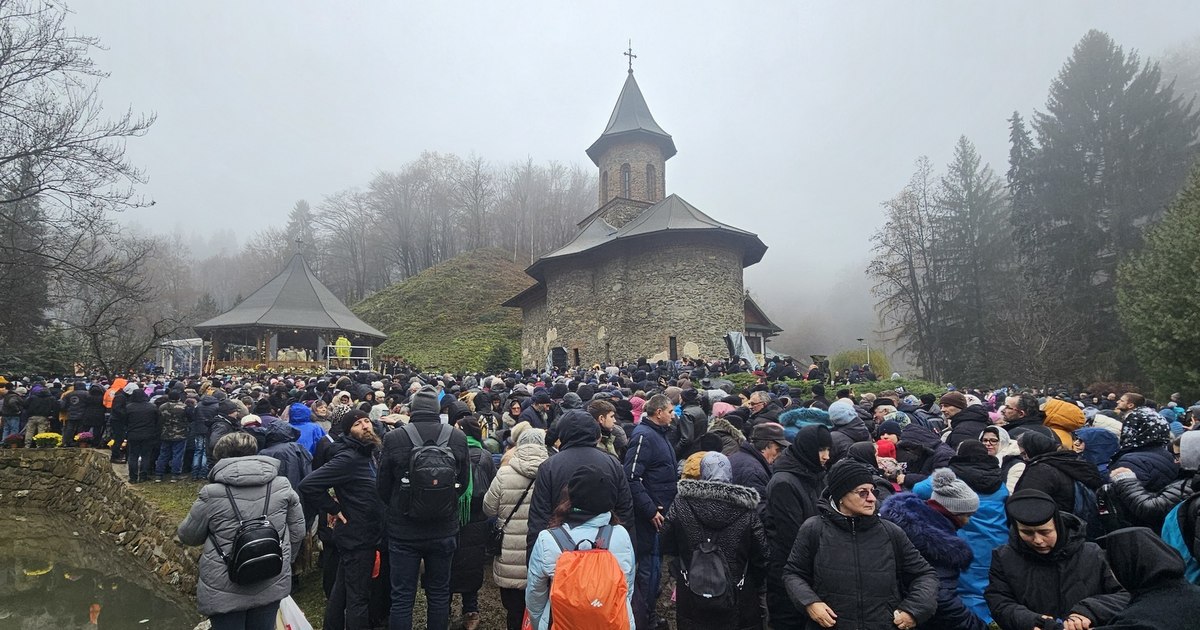
Romania has over 27,000 churches, and most Romanians declare themselves religious. However, many young people say they rarely go to church and that their experiences in places of worship are less profound than they might have expected.
The 2021 census and the latest surveys and research indicate that religion continues to play an important role in Romanian society.
The majority of Romanians consider themselves religious, even if they do not regularly attend services, and the growing number of places of worship and the majority belonging to Orthodoxy confirm that religion remains an important component of Romanians’ cultural identity.
In recent years, new places of worship have been erected in almost every neighborhood, and some have begun to attract young people. Those who attend them see them as a means of relaxation, seeking peace and regaining energy, or thus affirming their interest in spirituality.
Young people seek peace in the church
Other young people claim that they are not interested in religious services, either because they consider them boring and useless, or they cite other personal reasons. Invited to talk about their “relationship” with the church and how religious they consider themselves, many young people from “Generation Z”, those born after the year 2000, spoke about their experiences.
A young man says that he attends the local church at least once a month, but only for a few minutes and mostly outside of services.
“When it’s very crowded, it’s like the atmosphere overwhelms me. Once, after about 20 minutes of being at the service, I started to feel a bit sick and had to go outside to get some air. Then I recovered, went inside a little more, walked around the courtyard, lit candles and also went into the small church, where it was quiet and I read some prayers.” write this on the reddit platform.
Another says he goes to church weekly and compares it to a hospital.
“As in the case of doctors, here you can come across good, passionate priests who have a vocation, and this is felt in the way they serve, in the quietness and order in the church, in the way they sing and how the service proceeds, they feel at confession when they have the patience to listen to you and are involved in the discussion. Or you can meet superficial people, who feel less the warmth and beauty of the church”he adds.
Some young people from Generation Z say that they feel great, motivated and full of energy after a stop at church. Others complain about the atmosphere inside, because of the smell of incense and the behavior of some of the worshippers.
“The strong smell of incense makes my already allergy-weakened respiratory system react—nausea, dry throat, itchy nose. I can’t stand the whispers and hugs and theatrics that some people put on to show that they are more faithful than their neighbor.” says a netizen.
Another netizen complains that the windows in the church he sometimes attends are always closed, and the place of worship is small and crowded, so the air becomes difficult to breathe.
“Besides the pressure that the job gives me, there’s also standing for two hours, which often makes me feel physically sick. It helps to sit down, but you still have to get up from time to time. I still like to pray alone in church, when no one is around, and light a candle.”reports a young woman.
Another says that he stopped going to church every Sunday because he started to get bored more and more quickly.
“I stay for 10-15 minutes, while I light some candles and give a pomelic. Then I leave”he adds.
Another young man says that during services he felt as if he had nothing to do in the church.
Religious experiences that left traces
For another Romanian from “Generation Z”, the religious experience started in the family became a source of anxiety.
“I grew up in an ultra-orthodox family. I used to tremble all night with fear, I fell asleep only after the rooster crowed the third time, because who knows what that means. I had heard that between midnight and the rooster crows three times, spirits can walk the earth, including the devils. I was also faint with fear, I thought they were coming for me. It’s terrible for a child.” he remembers this.
The young woman adds that she was affected by family discussions about undead, hell and religious superstitions. He says that he had heard from his relatives that if he does his nails with nail polish and goes to hell, the devils will give his nails hot pitch, or that smoking is incense offered to the devils.
“At church I heard the same discussions. We had even gone on vacation to monasteries, to stay with nuns there, and it seemed sinister to me. I also had the misfortune of going to church when there were people who thought they were possessed. I was very afraid of becoming possessed myself.”it states.
Another young man says he encourages others to pray, fast and go to confession, although he rarely gets to do these things and says he is too busy to attend the neighborhood church.
Romanian customs from the 19th century: “Abstinence is so harsh that you cannot buy a cup of milk with gold”
Religious traditions mixed with ancient customs
Romanians have long been considered a religious people, faithful to rituals and traditions, but some foreign travelers noticed that, beyond the observance of customs, faith was often more formal than deep.
In the 18th century, the scholar Ignaz von Born (1742–1791) traveled to Transylvania and Banat and left to posterity a novel description of the beliefs of the Romanians of that time.
“They have no more religion than their cattle; except their repeated fasts, which extend nearly half a year, and which are so strict that they dare not eat any meat, eggs, or milk at all, they have scarcely any idea of other religious duties. But this fast they observe with such sanctity, that nothing can make them lighten or break it, even if they disregard all other laws divine or human. A robber will not allow himself to resist this abstinence, nor will he scold his wife or another for fear that God will not bless his exploits. The rites or ceremonies of this people have more to do with heathenism than with the religion they profess; for example, a woman among them would never dare to kill an animal of any kind.” stated the geologist in the work “Travels through the Banat of Temeswar; Transylvania and Hungary in the year 1770”.
The fasts of the past, a symbol of religiosity
In the 19th century, James Oscar Noyes (1829–1872), an American physician in the sultan’s army, lived for several years in Wallachia and published accounts of Romanian beliefs. He claimed that in the villages almost anyone could become a priest and that they were almost indistinguishable from the other locals except for the hat, boots and long beard. The parishioners treated the faith in a superficial way, it showed.
“To make the sign of the cross from right to left when praying or when thundering, to repeat the sign of the cross when meeting the priest, when passing a church, or when trying to drive out the devil, to prostrate like the Turks, being careful to avoid the kneeling position of the Catholic heretics, to venerate the popes and to curse the Pope and the Muslims, to keep a hundred and fifty feasts on year and to fast one hundred and ten days — this is the teaching that the Greek Orthodox Church gives to its millions of followers”claimed the American author.
The rich obtained the forgiveness of sins more easily from the priests, through acts of charity, he added, and in the churches, places where the peasants and the nobles formed a motley assembly, few parishioners seemed concerned with the sermons. However, the posts were kept with sanctity by the Romanians.
“The abstinence during fasting days is so severe that you cannot buy, with gold, even a cup of milk. Vasile, the famous Romanian robber, after he had killed an entire family and robbed their house on a Friday, was shocked to see one of his gang licking a plate that had contained butter. “Pagan!” he shouted, giving a terrible blow to the one who had broken the fast, “don’t do you have no fear of God?” wrote James Noyes.
Romanians of the famous geologist Ignaz von Born, from the 18th century: “It seemed to me that I was in the kingdom of the dead”
Romania has over 27,000 churches
Romanians are considered one of the most religious nations, and the latest opinion polls published in Romania have confirmed this fact. One such barometer, conducted in 2025 by INSCOP Research, with the participation of 1,150 people, showed that 85 percent of respondents consider themselves religious. The research showed that young people generally consider themselves to be less religious.
“The religiosity of Romanians is one of culture and identity, a fact emphasized by the very large majority of 85 percent who consider themselves religious. Practicing religiosity is less, but significant, given that 30.6 percent of the population declares that they go to church at least once a week,” explained Remus-Ioan Ștefureac, the general director of INSCOP Research.
The same survey showed that 7.6 percent of respondents say they go to church several times a week, 23 percent say they go once a week, and 17.1 percent at least once a month. 25.4 percent of those surveyed say they go to church only on major holidays, while 19.4 percent go very rarely and 6.8 percent never go.
According to the 2021 Census, over 14 million Romanians declared their membership of the Orthodox religion, compared to over 16.3 million in the previous census, from 2011. Another over 740,000 Romanians declared themselves Roman Catholic, 495,000 Reformed, over 400,000 Pentecostal, 115,000 Greek Catholic, 103,000 Baptists and 65,000 Seventh-day Adventists. Almost 130,000 Romanians declared themselves atheists or no religion.
After 1990, the number of churches built in Romania grew at a noticeable rate, especially in urban areas, where almost every neighborhood of the cities has its own church. The most recent centralization published by the State Secretariat for Religions, from December 31, 2015, shows that at that time there were 27,384 places of worship belonging to the 18 religious cults in Romania. Of these, over 16,400 are Orthodox, almost 3,000 Pentecostal, over 1,600 Roman Catholic, over 1,500 Baptist, about 1,300 Adventist or Reformed.
